

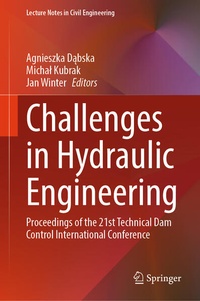
Challenges in Hydraulic Engineering
Description
This book includes the select, peer-reviewed proceedings from the 21st Technical Dam Control International Conference, providing a comprehensive exploration of developments and critical discussions in hydraulic engineering. This collection of research and expert findings included here focus on the issues and technologies in hydraulic structures' design, safety, and sustainability. The book includes key thematic areas such as safety, geotechnics, maintenance, operation technologies, wet landfills, renewable energy, climate change, environmental impact, and urban hydraulic engineering. The book covers methodologies for ensuring the safety and reliability of dam structures. It also highlights the latest advancements in construction technologies and their impact on the efficiency and resilience of water-related projects. Significant emphasis is put on the environmental implications of hydraulic structures, particularly concerning climate change and sustainable development practices. The book offers valuable insights into urbanized areas' water retention strategies and hydraulic engineering challenges.
With contributions from scholars and practitioners, this book provides a resource for professionals, researchers, and policymakers involved in hydraulic engineering and environmental management. It not only captures the field's current state but also provides a forward-looking perspective on innovation and sustainability.
More details
Persons
Agnieszka Dabska is an Assistant Professor at the Faculty of Environmental Engineering, Warsaw University of Technology, with research focused on soil and water seepage. Her research interests combine the physical and mechanical properties of natural and man-made soils, particularly compactibility and permeability, their correlations and practical applications in structures. Agnieszka Dabska's main scientific research area covers problems of sand deformation due to seepage and soil resistance to failure due to seepage. She also contributes to applied research projects concerning modern numerical methods for high-fidelity simulation of geohazards. In her work, she applies scientific knowledge in practice by conducting soil laboratory and field tests for practical applications, assessing and providing expertise on the technical condition of building structures, and providing scientific-technical supervision of hydraulic structures. Additionally, her scientific activity is also closely related to implementing the EN 1997 Eurocode 7 standard in Poland.
Jan Adam Winter is a Professor at the Faculty of Environmental Engineering, Warsaw University of Technology. His academic and professional work focuses on hydraulic structures and inland waterways, with particular emphasis on the design, operation, monitoring, and safety of dams and water-retaining structures. His research interests include the technical condition assessment of hydrotechnical facilities, seepage processes, sedimentation in reservoirs, abrasion processes in reservoir shores, and the role of hydraulic structures in flood protection systems. He has extensive experience in applied research and expert activities related to hydraulic engineering, including technical diagnostics, monitoring systems, and safety assessments of dams and water management infrastructure. He has contributed to numerous scientific monographs and edited volumes in the field of hydraulic engineering and dam safety, and has been actively involved in interdisciplinary projects linking research, engineering practice, and water management institutions. In addition to his academic activities, he has long-standing experience in cooperation with public institutions responsible for water resources management and hydraulic infrastructure.
Michal Kubrak is an Assistant Professor at the Faculty of Environmental Engineering, Warsaw University of Technology. His academic work addresses unsteady flow phenomena in pressurized pipeline systems, with particular emphasis on water hammer modeling. His research combines numerical simulations and laboratory experiments and includes studies on hydraulic transients in multi-material pipeline systems with varying geometric characteristics. He has contributed to the development and validation of numerical models, as well as to investigations of practical methods for mitigating pressure surges. In addition to his research activities, he has experience in applied research projects related to water management systems and teaches courses in fluid mechanics and hydraulics.
Content
Introduction.- Safety of Hydraulic Structures.- Geotechnics in Hydraulic Engineering.- Operation of Hydraulic Structures.- Design and Construction Technologies.- Wet Landfills.- Renewable Energy.- Climate Change and Sustainable Development.- Impact of Hydraulic Structures on the Environment.- Hydraulic Engineering in Urban Areas.- Conclusions and Future Directions.