

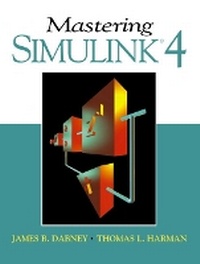
Mastering Simulink 4
2nd Edition
Published on 26. April 2001
Book
Paperback/Softback
432 pages
978-0-13-017085-9 (ISBN)
Description
For courses in Control Theory and Operational Amplifiers.
Simulink is a programming language specifically designed for simulating dynamical systems using standard block diagram notation. Therefore students should have the appropriate mathematical preparation including a good understanding of the fundamental concepts from introductory courses such as calculus and differential equations. The text presents detailed coverage of programming using Simulink. Beginning with a block diagram tutorial, the book presents an overview of Simulink and describes in detail the procedures for building, editing, and running a Simulink model. The book also provides explanations for debugging techniques, including the interactive debugger. The text concludes with an introduction to Stateflow (TM), a Simulink extension that adds the capability to model finite state machines subsystems using a variant of the popular Statecharts formalism.
Simulink is a programming language specifically designed for simulating dynamical systems using standard block diagram notation. Therefore students should have the appropriate mathematical preparation including a good understanding of the fundamental concepts from introductory courses such as calculus and differential equations. The text presents detailed coverage of programming using Simulink. Beginning with a block diagram tutorial, the book presents an overview of Simulink and describes in detail the procedures for building, editing, and running a Simulink model. The book also provides explanations for debugging techniques, including the interactive debugger. The text concludes with an introduction to Stateflow (TM), a Simulink extension that adds the capability to model finite state machines subsystems using a variant of the popular Statecharts formalism.
Reviews / Votes
"...there are numerous engaging illustrations of situations involving motivation ... It is likely to appeal to a concrete, down-to-earth type of person looking for very practical advice." - Dr. Jeffrey G. Reed, Marian College"Each section uses a variety of tools to engage and challenge the reader ... These tools lead the reader to greater self-discovery." - Dr. Kenneth Davis, Villanova University
More details
Edition
2nd edition
Language
English
Place of publication
United States
Publishing group
Pearson Education (US)
Target group
College/higher education
Dimensions
Height: 235 mm
Width: 178 mm
Thickness: 16 mm
Weight
601 gr
ISBN-13
978-0-13-017085-9 (9780130170859)
Copyright in bibliographic data and cover images is held by Nielsen Book Services Limited or by the publishers or by their respective licensors: all rights reserved.
Schweitzer Classification
Other editions
New editions
James Dabney | James B. Dabney | Thomas L. Harman
Mastering Simulink
Book
01/2004
1st Edition
Pearson
€183.49
Shipment within 15-20 days
Previous edition

James B. Dabney | Thomas L. Harman
Mastering SIMULINK 2
Book
02/1998
Pearson
€39.60
Article exhausted; check for reprint
Persons
Sharon Lund O'Neil, author of Motivation: An ATM Card for Success, is a widely published author. Her human relations cases, based on the corporate work environment, are popular with both trainers and educators. With a common-sense approach to problem solving, she has led national professional and educational organizations and has been the recipient of many teaching awards. She holds a doctorate from the University of Illinois and is currently a professor at the University of Houston.
Content
1. Introduction.
2. Block Diagrams.
3. Quick Start.
4. Model Building.
5. Continuous Systems.
6. Discrete-Time Systems.
7. Subsystems and Masking.
8. Simulink Analysis Tools.
9. Callbacks.
10. S-Functions.
11. Graphical Animations.
12. Debugging.
13. Numerical Issues.
14. Introduction to Stateflow.
2. Block Diagrams.
3. Quick Start.
4. Model Building.
5. Continuous Systems.
6. Discrete-Time Systems.
7. Subsystems and Masking.
8. Simulink Analysis Tools.
9. Callbacks.
10. S-Functions.
11. Graphical Animations.
12. Debugging.
13. Numerical Issues.
14. Introduction to Stateflow.