

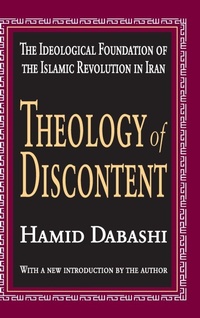
Theology of Discontent
The Ideological Foundation of the Islamic Revolution in Iran
1st Edition
Published on 25. September 2017
Book
Hardback
706 pages
978-1-138-53955-6 (ISBN)
Description
Scores of books and articles have been published, addressing one or another aspect of the Islamic Revolution in Iran. Missing from this body of scholarship, however, has been a comprehensive analysis of the intellectual and ideological cornerstones of one of the most dramatic revolutions in our time. In this remarkable volume, Hamid Dabashi brings together, in a sustained and engagingly written narrative, the leading revolutionaries who have shaped the ideological disposition of this cataclysmic event. Dabashi has spent over ten years studying the writings, in their original Persian and Arabic, of the most influential Iranian clerics and thinkers.Examining the revolutionary sentiments and ideas of such figures as Jalal Al-e Ahmad, Ali Sharicati, Morteza Motahhari, Sayyad Abolhasan Bani-Sadr, and finally the Ayatollah Khomeini, the work also analyzes the larger historical and theoretical implications of any construction of "the Islamic Ideology." Carefully located in the social and intellectual context of the four decades preceding the 1979 revolution, Theology of Discontent is the definitive treatment of the ideological foundations of the Islamic Revolution, with particular attention to the larger, more enduring ramifications of this revolution for radical Islamic revivalism in the entire Muslim world.This volume will be of interest to Islamicists, Middle East historians and specialists, as well as scholars and students of "liberation theologies," comparative religious revolutions, and mass collective behavior. Bruce Lawrence of Duke University calls this volume "a superb and unprecedented study.... In brilliant figural strokes, he arrays EuroAmerican sociological theory as the crucial backdrop of a deeper understanding of contemporary Iranian history."
More details
Language
English
Place of publication
London
United Kingdom
Publishing group
Taylor & Francis Ltd
Target group
College/higher education
Dimensions
Height: 235 mm
Width: 157 mm
Thickness: 42 mm
Weight
1159 gr
ISBN-13
978-1-138-53955-6 (9781138539556)
Copyright in bibliographic data and cover images is held by Nielsen Book Services Limited or by the publishers or by their respective licensors: all rights reserved.
Schweitzer Classification
Other editions
Additional editions
E-Book
07/2017
Routledge
€72.49
Available for download
E-Book
07/2017
Routledge
€72.49
Available for download

Book
01/2005
1st Edition
Routledge
€81.70
Shipment within 10-15 days
Person
Hamid Dabashi is the Hagop Kevorkian Professor of Iranian Studies and Comparative Literature at Columbia University in New York. He is a founding member of the Institute for Comparative Literature and Society, as well as a founding member of the Center for Palestine Studies at Columbia University. Most recently he is the author of Europe and Its Shadows (Pluto, 2019), Brown Skin, White Masks (Pluto, 2011) and Can Non-Europeans Think? (Zed, 2015).
Content
Introduction: Formative Forces of "the Islamic Ideology"; 1: Jalal Al-e Ahmad: The Dawn of "the Islamic Ideology"; 2: Ali Shari'ati: The Islamic Ideologue Par Excellence; 3: Morteza Motahhari: The Chief Ideologue of the Islamic Revolution; 4: Sayyid Mahmud Taleqani: The Father of the Revolution; 5: Allamah Sayyid Muhammad Hossein Tabataba'i: The Philosophical Dimensions of "the Islamic Ideology"; 6: Mehdi Bazargan: The Devout Engineer; 7: Abolhasan Bani-Sadr: The Monotheist Economist; 8: Ayatollah Khomeini: The Theologian of Discontent; Conclusion: Dimensions of "The Islamic Ideology"