

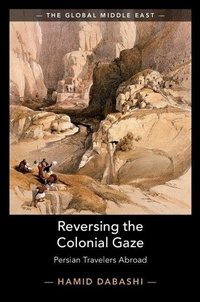
Reversing the Colonial Gaze
Persian Travelers Abroad
Published on 16. January 2020
Book
Hardback
408 pages
978-1-108-48812-9 (ISBN)
Description
Exploring the furthest reaches of the globe, Persian travelers from Iran and India travelled across Russian and Ottoman territories, to Asia, Africa, North and South America, Europe and beyond. Remapping the world through their travelogues, Reversing the Colonial Gaze offers a comprehensive and transformative analysis of the journeys of over a dozen of these nineteenth-century Persian travelers. By moving beyond the dominant Eurocentric perspectives on travel narratives, Hamid Dabashi works to reverse the colonial gaze which has thus far been cast upon these rich body of travelogues. His lyrical and engaging re-evaluation of these journeys, complimented by close-readings of seminal travelogues, challenges the systematic neglect of these narratives in scholarly literature. Opening up the entirety of these overlooked or abused travelogues, Dabashi reveals not a mere repetition of cliche accounts of Iranian or Muslim encounters with the West, but a path-breaking introduction to a constellation of revelatory travel narratives that re-imagine and reclaim the world beyond colonial borders.
Reviews / Votes
'In a series of fascinating vignettes, Dabashi gives us an enormously rich account of travellers from Iran and India who ethnographically recorded other cultures in Asia, Africa and Europe in the nineteenth century. In the process, he forcefully reminds us that the intellectual discovery of the world was not a uniquely Western virtue.' Partha Chatterjee, Columbia University 'Offering us fascinating readings of Iranian and Indian travelogues, Dabashi charts out new spatial relationships, demonstrating how these writers created a global Persianate universe, which was typified by a mixture of literary and cultural traditions. The book celebrates and analyzes these creative worlds, reconstructing a rich tradition, which can serve as a much-needed antidote to narratives of origin and supremacy.' Lior Sternfeld, Pennsylvania State University 'Via this rich exploration of hitherto little-studied examples of travel literature in Persian, Dabashi not only provides a framework for understanding a crucial transition period in the history of Iran in a global context, but also offers refreshing insights into ongoing debates on modernity and the role of orientalism.' Gabrielle van den Berg, Universiteit LeidenMore details
Series
Language
English
Place of publication
Cambridge
United Kingdom
Target group
Professional and scholarly
Illustrations
Worked examples or Exercises; 15 Halftones, black and white
Dimensions
Height: 235 mm
Width: 157 mm
Thickness: 27 mm
Weight
745 gr
ISBN-13
978-1-108-48812-9 (9781108488129)
Copyright in bibliographic data and cover images is held by Nielsen Book Services Limited or by the publishers or by their respective licensors: all rights reserved.
Schweitzer Classification
Other editions
Additional editions
Book
03/2022
Cambridge University Press
€47.10
Shipment within 15-20 days
E-Book
01/2020
Cambridge University Press
€29.49
Available for download
E-Book
01/2020
Cambridge University Press
€28.99
Available for download
Person
Hamid Dabashi is the Hagop Kevorkian Professor of Iranian Studies and Comparative Literature at Columbia University in New York. He is a founding member of the Institute for Comparative Literature and Society, as well as a founding member of the Center for Palestine Studies at Columbia University. Most recently he is the author of Europe and Its Shadows (Pluto, 2019), Brown Skin, White Masks (Pluto, 2011) and Can Non-Europeans Think? (Zed, 2015).
Content
1. Mr Shushtari travels to India; 2. Mirza Abu Taleb travels from India; 3. An Ilchi wonders about the world; 4. A colonial officer is turned upside down; 5. A Shirazi shares his travelogues; 6. A wandering monarch; 7. Hajj Sayyah leads a peripatetic life; 8. In the company of a refined prince; 9. A wandering mystic; 10. In and out of a homeland; 11. The fact and fiction of a homeland; 12. Professor Sayyah comes home to teach.