

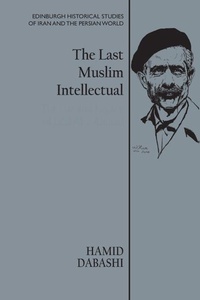
The Last Muslim Intellectual
The Life and Legacy of Jalal Al-e Ahmad
Published on 31. March 2021
Book
Hardback
304 pages
978-1-4744-7928-8 (ISBN)
Description
This book explores the life and legacy of Jalal Al-e Ahmad (1923-69) - arguably the most prominent Iranian public intellectual of his time - and contends that he was the last Muslim intellectual to have articulated a vision of Muslim worldly cosmopolitanism, before the militant Islamism of the last half a century degenerated into sectarian politics and intellectual alienation from the world at large.
Hamid Dabashi places Al-e Ahmad beside other towering critical thinkers of his time, showing how he personified a state of Muslim anticolonial modernity that has now disappeared behind the smokescreen of sectarian politics. This unprecedented engagement with Al-e Ahmad's life and legacy is a prelude to what Dabashi calls a 'post-Islamist Liberation Theology'.
The Last Muslim Intellectual is about expanding the wide spectrum of anticolonial thinking beyond its established canonicity and adding a critical Muslim thinker to it - an urgent task, if the future of Muslim critical thinking is to be considered in liberated terms beyond the dead-end of its current sectarian predicament.
Hamid Dabashi places Al-e Ahmad beside other towering critical thinkers of his time, showing how he personified a state of Muslim anticolonial modernity that has now disappeared behind the smokescreen of sectarian politics. This unprecedented engagement with Al-e Ahmad's life and legacy is a prelude to what Dabashi calls a 'post-Islamist Liberation Theology'.
The Last Muslim Intellectual is about expanding the wide spectrum of anticolonial thinking beyond its established canonicity and adding a critical Muslim thinker to it - an urgent task, if the future of Muslim critical thinking is to be considered in liberated terms beyond the dead-end of its current sectarian predicament.
Reviews / Votes
Hamid Dabashi's remarkable work on Iranian 'cosmopolitan humanism' has already expanded the parameters of discussions on non-western thought to highlight the quest for an anticolonial modernity as integral to its global reach. In this well-balanced and elegantly written volume, Dabashi treats Al-e Ahmad, a preeminent intellectual of his time, as a pioneering -anticolonial theorist who Islamist thinkers, such as Ali Shari'ati, would only later develop an elective affinity for, in the process recasting him an anti-western nativist. Dabashi situates Al-e Ahmad alongside other anticolonial thinkers to remind us that "Al-e Ahmad could not have anticipated Shari'ati would have taken him all the way to the borderlines of a committed Islamist ideologue." Along the way, this provocative work raises important questions about the evolution of an anticolonial canon and the crystallization of sectarian divisions. * Ali Mirsepassi, Albert Gallatin Research Excellence Professor, New York University * In prose crackling with an urgency and tenor reminiscent of Jalal Al-e Ahmad's own style in Persian, Hamid Dabashi delivers an impassioned argument for reading Al-e Ahmad as the last cosmopolitan Muslim intellectual on a par with the likes of Cesaire and Fanon. * Nasrin Rahimieh, Howard Baskervile Professor of Humanities, UC Irvine *More details
Series
Language
English
Place of publication
Edinburgh
United Kingdom
Product notice
Unsewn / adhesive bound
Illustrations
14 B/W illustrations
Dimensions
Height: 236 mm
Width: 157 mm
Thickness: 30 mm
Weight
680 gr
ISBN-13
978-1-4744-7928-8 (9781474479288)
Copyright in bibliographic data and cover images is held by Nielsen Book Services Limited or by the publishers or by their respective licensors: all rights reserved.
Schweitzer Classification
Other editions
Additional editions
E-Book
03/2021
Edinburgh University Press
€26.49
Available for download
E-Book
03/2021
Edinburgh University Press
€26.49
Available for download
Person
Hamid Dabashi is Hagop Kevorkian Professor of Iranian Studies and Comparative Literature at Columbia University in New York. He is the author of many books and articles on the social and intellectual history of Islam, both medieval and modern, many of them translated into other languages. He is a globally recognized critical thinker on contemporary affairs and a regular columnist for Aljazeera.
Content
Acknowledgements; Introduction: The Last Muslim Intellectual; 1. Remembrance of Things Past; 2. Something of an Autobiography; 3. Her Husband Jalal; 4. The Master Essayist; 5. Gharbzadegi: The Condition of Coloniality; 6. Literary Interludes; 7. Traveling in and out of a Homeland; 8. Translating the World; 9. From a Short Life to a Lasting Legacy: Towards a Post-Islamist Liberation Theology.