

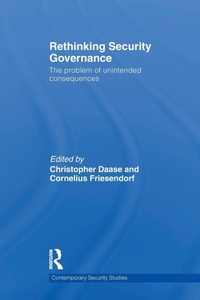
Rethinking Security Governance
The Problem of Unintended Consequences
1st Edition
Published on 21. February 2012
Book
Paperback/Softback
240 pages
978-0-415-53262-4 (ISBN)
Description
This book explores the unintended consequences of security governance actions and explores how their effects can be limited.
Security governance describes new modes of security policy that differ from traditional approaches to national and international security. While traditional security policy used to be the exclusive domain of states and aimed at military defense, security governance is performed by multiple actors and is intended to create a global environment of security for states, social groups, and individuals. By pooling the strength and expertise of states, international organizations, and private actors, security governance is seen to provide more effective and efficient means to cope with today's security risks.
Generally, security governance is assumed to be a good thing, and the most appropriate way of coping with contemporary security problems. This assumption has led scholars to neglect an important phenomenon: unintended consequences. While unintended consequences do not need to be negative, often they are. The CIA term "blowback," for example, refers to the phenomenon that a long nurtured group may turn against its sponsor. The rise of al Qaeda, which had benefited from US Cold War policies, is only one example.
Raising awareness about unwanted and even paradoxical policy outcomes and suggesting ways of avoiding damage or limiting their scale, this book will be of much interest to students of security governance, risk management, international security and IR.
Christopher Daase is Professor at the Goethe University Frankfurt and head of the research department International Organizations and International Law at the Peace Research Institute Frankfurt (PRIF/HSFK).
Cornelius Friesendorf is lecturer at the Goethe University Frankfurt and research fellow at the Peace Research Institute Frankfurt (PRIF/HSFK).
Security governance describes new modes of security policy that differ from traditional approaches to national and international security. While traditional security policy used to be the exclusive domain of states and aimed at military defense, security governance is performed by multiple actors and is intended to create a global environment of security for states, social groups, and individuals. By pooling the strength and expertise of states, international organizations, and private actors, security governance is seen to provide more effective and efficient means to cope with today's security risks.
Generally, security governance is assumed to be a good thing, and the most appropriate way of coping with contemporary security problems. This assumption has led scholars to neglect an important phenomenon: unintended consequences. While unintended consequences do not need to be negative, often they are. The CIA term "blowback," for example, refers to the phenomenon that a long nurtured group may turn against its sponsor. The rise of al Qaeda, which had benefited from US Cold War policies, is only one example.
Raising awareness about unwanted and even paradoxical policy outcomes and suggesting ways of avoiding damage or limiting their scale, this book will be of much interest to students of security governance, risk management, international security and IR.
Christopher Daase is Professor at the Goethe University Frankfurt and head of the research department International Organizations and International Law at the Peace Research Institute Frankfurt (PRIF/HSFK).
Cornelius Friesendorf is lecturer at the Goethe University Frankfurt and research fellow at the Peace Research Institute Frankfurt (PRIF/HSFK).
More details
Series
Language
English
Place of publication
London
United Kingdom
Publishing group
Taylor & Francis Ltd
Target group
College/higher education
Professional and scholarly
Illustrations
4 s/w Abbildungen, 4 s/w Tabellen
4 Tables, black and white; 4 Illustrations, black and white
Dimensions
Height: 234 mm
Width: 156 mm
Thickness: 13 mm
Weight
374 gr
ISBN-13
978-0-415-53262-4 (9780415532624)
Copyright in bibliographic data and cover images is held by Nielsen Book Services Limited or by the publishers or by their respective licensors: all rights reserved.
Schweitzer Classification
Other editions
Additional editions
Christopher Daase | Cornelius Friesendorf
Rethinking Security Governance
The Problem of Unintended Consequences
E-Book
05/2010
Routledge
€72.49
Available for download
Christopher Daase | Cornelius Friesendorf
Rethinking Security Governance
The Problem of Unintended Consequences
E-Book
05/2010
Routledge
€72.49
Available for download
Christopher Daase | Cornelius Friesendorf
Rethinking Security Governance
The Problem of Unintended Consequences
Book
04/2010
1st Edition
Routledge
€231.70
Shipment within 15-20 days
Persons
Christopher Daase is Professor at the Goethe University Frankfurt and head of the research department International Organizations and International Law at the Peace Research Institute Frankfurt (PRIF/HSFK).
Cornelius Friesendorf is lecturer at the Goethe University Frankfurt and research fellow at the Peace Research Institute Frankfurt (PRIF/HSFK).
Cornelius Friesendorf is lecturer at the Goethe University Frankfurt and research fellow at the Peace Research Institute Frankfurt (PRIF/HSFK).
Content
Introduction: Security Governance and the Problem of Unintended Consequences Christopher Daase and Cornelius Friesendorf 1. Strengthening Autocracy: The World Bank and Social Reform in Egypt Florian Kohstall 2. Security Governance, Complex Peace Support Operations and the Blurring of Civil-Military Tasks Susan E. Penksa 3. Unintended Consequences of International Statebuilding Ulrich Schneckener 4. Unintended Consequences of International Security Assistance: Doing More Harm than Good? Ursula C. Schroeder 5. Unintended Criminalizing Consequences of Sanctions: Lessons from the Balkans Peter Andreas 6. Unintended Consequences of Measures to Counter the Financing of Terrorism Thomas J. Biersteker 7. Neither Seen Nor Heard: The Unintended Consequences of Counter-Trafficking and Counter-Smuggling Benjamin S. Buckland 8. Unintended Consequences of Targeted Sanctions Mikael Eriksson 9. The Privatization of Force and its Consequences: Unintended but not Unpredictable Joerg Friedrichs Conclusion: Analyzing and Avoiding Unintended Consequences of Security Governance Cornelius Friesendorf and Christopher Daase