

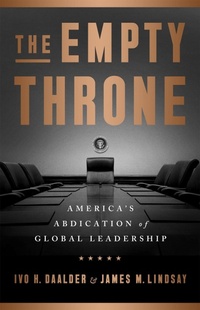
The Empty Throne
America's Abdication of Global Leadership
Published on 17. January 2019
Book
Hardback
256 pages
978-1-5417-7385-1 (ISBN)
Description
American foreign policy is adrift. For seventy years, the world order that the United States fashioned out of the ruins of World War II produced unprecedented global stability, prosperity, and democratic consensus. Critics argue that Donald Trump's America First policy threatens this world order. What Trump's staunchest critics fail to realize, though, is this order has been fraying for years. Ivo Daalder, former ambassador to NATO and the president of the Chicago Council on Global Affairs, and James Lindsay, a senior vice president at the Council of Foreign Relations, give us a chilling account of why things are worse than they seem. At its core the U.S.-led world order has been a victim of its own success, well before Trump even campaigned for office. The unprecedented period of peace at the end of the 20th century produced record economic growth. Once poor countries like China, India, and Brazil prospered, and as they grew richer, they increasingly contested both the rules and America's privileged position within the order. At the same time, as the costs grew, many Americans soured on the benefits of global leadership, especially as their own prospects for a better life dimmed. Now that Trump sits in the Oval Office, optimists hope that his advisers will curb Trump's taste for foreign policy disruption. But even if this does occur, neither Trump nor his advisers have a strategy for addressing the fundamental challenge for American foreign policy: how to revitalize the world order on which America's security and prosperity rests. Daalder and Lindsay are sure Trump will damage that order; he may well finish it off for good.
More details
Language
English
Place of publication
United States
Target group
College/higher education
Professional and scholarly
Product notice
Trade binding
Dimensions
Height: 244 mm
Width: 158 mm
Thickness: 27 mm
Weight
458 gr
ISBN-13
978-1-5417-7385-1 (9781541773851)
Copyright in bibliographic data and cover images is held by Nielsen Book Services Limited or by the publishers or by their respective licensors: all rights reserved.
Schweitzer Classification
Other editions
Additional editions
E-Book
10/2018
PublicAffairs
€12.99
Available for download
Persons
American foreign policy is adrift. For seventy years, the world order that the United States fashioned out of the ruins of World War II produced unprecedented global stability, prosperity, and democratic consensus. Critics argue that Donald Trump's America First policy threatens this world order. What Trump's staunchest critics fail to realize, though, is this order has been fraying for years. Ivo Daalder, former ambassador to NATO and the president of the Chicago Council on Global Affairs, and James Lindsay, a senior vice president at the Council of Foreign Relations, give us a chilling account of why things are worse than they seem.
At its core the U.S.-led world order has been a victim of its own success, well before Trump even campaigned for office. The unprecedented period of peace at the end of the 20th century produced record economic growth. Once poor countries like China, India, and Brazil prospered, and as they grew richer, they increasingly contested both the rules and America's privileged position within the order. At the same time, as the costs grew, many Americans soured on the benefits of global leadership, especially as their own prospects for a better life dimmed.
Now that Trump sits in the Oval Office, optimists hope that his advisers will curb Trump's taste for foreign policy disruption. But even if this does occur, neither Trump nor his advisers have a strategy for addressing the fundamental challenge for American foreign policy: how to revitalize the world order on which America's security and prosperity rests. Daalder and Lindsay are sure Trump will damage that
At its core the U.S.-led world order has been a victim of its own success, well before Trump even campaigned for office. The unprecedented period of peace at the end of the 20th century produced record economic growth. Once poor countries like China, India, and Brazil prospered, and as they grew richer, they increasingly contested both the rules and America's privileged position within the order. At the same time, as the costs grew, many Americans soured on the benefits of global leadership, especially as their own prospects for a better life dimmed.
Now that Trump sits in the Oval Office, optimists hope that his advisers will curb Trump's taste for foreign policy disruption. But even if this does occur, neither Trump nor his advisers have a strategy for addressing the fundamental challenge for American foreign policy: how to revitalize the world order on which America's security and prosperity rests. Daalder and Lindsay are sure Trump will damage that