

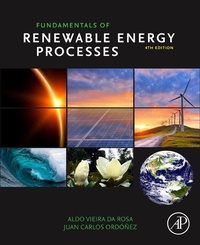
Fundamentals of Renewable Energy Processes
4th Edition
Published on 30. June 2021
Book
Paperback/Softback
944 pages
978-0-12-816036-7 (ISBN)
Description
Fundamentals of Renewable Energy Processes, Fourth Edition, winner of a 2022 Textbook Excellence Award (Texty) from the Textbook and Academic Authors Association, provides accessible coverage of clean, safe alternative energy sources such as solar and wind power. Aldo da Rosa's classic and comprehensive resource has provided thousands of engineers, scientists, students and professionals alike with a thorough grounding in the scientific principles underlying the complex world of renewable energy technologies. The fourth edition has been fully updated and revised by new author Juan Ordonez, Director of the Energy and Sustainability Center at Florida State University, and includes new worked examples, more exercises, and more illustrations to help facilitate student learning.
More details
Edition
4th edition
Language
English
Place of publication
San Diego
United States
Publishing group
Elsevier Science Publishing Co Inc
Target group
College/higher education
Undergraduate and first-year graduate engineering and physics students taking courses on renewable energy topics. Researchers, engineers, scientists, investors, and technicians working in energy-related disciplines.
Product notice
Paperback (trade)
Unsewn / adhesive bound
Dimensions
Height: 234 mm
Width: 192 mm
Thickness: 34 mm
Weight
1429 gr
ISBN-13
978-0-12-816036-7 (9780128160367)
Copyright in bibliographic data and cover images is held by Nielsen Book Services Limited or by the publishers or by their respective licensors: all rights reserved.
Schweitzer Classification
Other editions
Additional editions
Aldo Vieira Da Rosa | Juan Carlos Ordonez
Fundamentals of Renewable Energy Processes
E-Book
02/2021
4th Edition
Academic Press
€73.99
Available for download
Previous edition
Aldo Vieira Da Rosa
Fundamentals of Renewable Energy Processes
Book
10/2018
3rd Edition
Academic Press
€90.36
The article will not be published
Persons
Dr. da Rosa taught the perennially popular Renewable Energy course at Stanford University for over 30 years. Former Chairman of the Brazilian National Research Council, Director of the Aeronautical Technical Center, and founder of Brazilian NASA, he also served as the CEO of a tech start-up, Chairman of the Board for a microprocessor manufacturer, and as a member of Siemens Corporation's scientific advisory board. Juan C. Ordonez is a Professor of Mechanical Engineering at Florida State University, where he serves as Director of the Energy and Sustainability Center and as Principal Investigator on thermal management for the Center for Advanced Power Systems. His research lies within the fields of heat transfer and applied thermodynamics and their application to the design, modeling and optimization of energy systems. He obtained his Ph.D. in Mechanical Engineering from Duke University working in the field of thermodynamic optimization and his M.S. degree in Energy Systems and a B.S. in Mechanical Engineering from UPB - Colombia.
Content
1. Introduction
PART I: HEAT ENGINES
2. A Minimum of Thermodynamics and of the Kinetic Theory of Gases
3. Mechanical Heat Engines
4. Ocean Thermal Energy Converters
5. Thermoelectricity
6. Thermionics
7. AMTEC
8. Radio-Noise Generators
PART II: THE WORLD OF HYDROGEN
9. Fuel Cells
10. Hydrogen Production
11. Hydrogen Storage
PART III: ENERGY FROM THE SUN
12. Solar Radiation
13. Biomass
14. Photovoltaic Converters
PART IV: WIND AND WATER
15. Wind Energy
16. Ocean Engines
PART V: LAND AND BEYOND
17. Nuclear Energy
18. Storage of Energy
PART I: HEAT ENGINES
2. A Minimum of Thermodynamics and of the Kinetic Theory of Gases
3. Mechanical Heat Engines
4. Ocean Thermal Energy Converters
5. Thermoelectricity
6. Thermionics
7. AMTEC
8. Radio-Noise Generators
PART II: THE WORLD OF HYDROGEN
9. Fuel Cells
10. Hydrogen Production
11. Hydrogen Storage
PART III: ENERGY FROM THE SUN
12. Solar Radiation
13. Biomass
14. Photovoltaic Converters
PART IV: WIND AND WATER
15. Wind Energy
16. Ocean Engines
PART V: LAND AND BEYOND
17. Nuclear Energy
18. Storage of Energy