

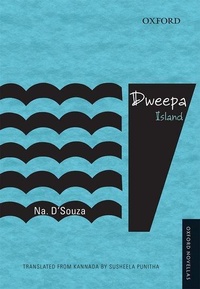
Dweepa
Island
Published in December 2013
Book
Paperback/Softback
128 pages
978-0-19-809744-0 (ISBN)
Description
To one side of the village, Hosamanehalli, flowed the Sharavathi. On the other was Sita Parvatha. This was no mountain despite its name; it was a hillock. Its back was lush with forestlands but its head was bald. During the times of the Ramayana, Rama, Sita and Lakshmana had crossed the Sharavathi and rested in a cave on top of this hill. Now, sprawled at its foot were five families, three areca plantations and three rice fields. Of the five families, three were those of the landlords, the other two of bonded labourers, bonded since birth. Of the three landlords, Heramba Hegde and Parameshwarappa were wealthy; they owned the bonded labourers, Byra and Hala, who worked their land. Ganapayya was neither rich nor poor. He did not own labourers; he hired some and paid them wages. But that did not make a difference to his status. The respect the landlords commanded came from their place and role in the community, not from their wealth. This had been the system in the villages for generations.
Everything changed with the Sharavathi Hydro-electric Project. Countless villages were submerged and with them went the lifestyle and values that had sustained communities in the Malnad area. The government arranged to compensate the displaced landlords with land. The labourers had no land anyway, so they were not covered by the compensation. A Submersion Office was set up to see to the process but only those landlords who could grease the palms of the officials were given land elsewhere.
Ganapayya was not wealthy enough to bribe. So his application was 'lost'. He decided to stay back with his wife and father and face the consequences of the change in the landscape, thanks to modernisation. When the river did rise and submerge the land around the Linganmakki Dam, it spared Ganapayya's house. Sharavathi did not drown him but people did. He was judged by an alien urban yardstick and found wanting. As money became the new criterion for respect, he felt degraded by his community and his wife. In losing his self-worth as a person, Ganapayya lost everything else.
Everything changed with the Sharavathi Hydro-electric Project. Countless villages were submerged and with them went the lifestyle and values that had sustained communities in the Malnad area. The government arranged to compensate the displaced landlords with land. The labourers had no land anyway, so they were not covered by the compensation. A Submersion Office was set up to see to the process but only those landlords who could grease the palms of the officials were given land elsewhere.
Ganapayya was not wealthy enough to bribe. So his application was 'lost'. He decided to stay back with his wife and father and face the consequences of the change in the landscape, thanks to modernisation. When the river did rise and submerge the land around the Linganmakki Dam, it spared Ganapayya's house. Sharavathi did not drown him but people did. He was judged by an alien urban yardstick and found wanting. As money became the new criterion for respect, he felt degraded by his community and his wife. In losing his self-worth as a person, Ganapayya lost everything else.
More details
Series
Language
English
Place of publication
New Delhi
India
Product notice
Paperback (trade)
Unsewn / adhesive bound
Dimensions
Height: 180 mm
Width: 124 mm
Thickness: 8 mm
Weight
113 gr
ISBN-13
978-0-19-809744-0 (9780198097440)
Copyright in bibliographic data and cover images is held by Nielsen Book Services Limited or by the publishers or by their respective licensors: all rights reserved.
Schweitzer Classification
Persons
Na. D'Souza has written forty-five novels including Manjina Kanu and Baman and twenty-five children's novels as well. Many of his short stories and novels have been translated into Telugu, Malayalam, English, Tamil, Sanskrit, Hindi, and Konkani.
Susheela Punitha (translator) is former Professor of English, Mount Carmel College, and Centre for Postgraduate Studies, Seshadripuram College, Bangalore.
Susheela Punitha (translator) is former Professor of English, Mount Carmel College, and Centre for Postgraduate Studies, Seshadripuram College, Bangalore.
Content
AUTHOR'S NOTE ; TRANSLATOR'S NOTE ; INTRODUCTION ; KINSHIP TERMS ; DWEEPA ; GLOSSARY ; ABOUT THE AUTHOR AND THE TRANSLATOR