

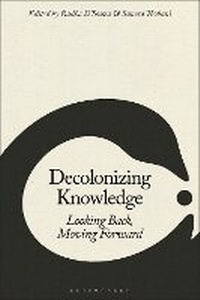
Decolonizing Knowledge
Looking Back, Moving Forward
Published on 24. April 2025
Book
Hardback
296 pages
979-8-7651-2546-5 (ISBN)
Description
Interdisciplinary scholars rethink strategies for moving contemporary decolonization politics forward by revisiting the writings of the mid-20th century anti-colonial movements' leading intellectuals.
Decolonizing Knowledge draws on intellectual histories of anti-colonial thinkers who developed their ideas of decolonization through practical engagement with struggles for freedom from colonialism. Reading works by J.P.S. Uberoi, Frantz Fanon, Aime Cesaire, C.L.R. James and Andaiye, among others, interdisciplinary activist scholars reflect on the meaning of decolonization that emerged from anti-colonial struggles of the past and its relevance today.
Each chapter in the volume reflects on one or more texts from anti-colonial thinkers of the past to draw out the meaning of decolonization as conceptualized by earlier generations, providing key insights from their thinking and examining their relevance for contemporary struggles for racial, gender and class justice. With authors writing from multiple disciplines, these essays straddle a range of themes from theory and practice, art and literature, gender and violence, and political economy, to address a subject that is preoccupying academia and activists in the 21st century.
Decolonizing Knowledge is an intervention into contemporary debates on decolonizing curricula and universities, arguing that these calls need to be firmly engaged in wider social practices for justice, and that they can learn much from those who wrote on the topic amid the 20th century's many struggles for freedom.
Decolonizing Knowledge draws on intellectual histories of anti-colonial thinkers who developed their ideas of decolonization through practical engagement with struggles for freedom from colonialism. Reading works by J.P.S. Uberoi, Frantz Fanon, Aime Cesaire, C.L.R. James and Andaiye, among others, interdisciplinary activist scholars reflect on the meaning of decolonization that emerged from anti-colonial struggles of the past and its relevance today.
Each chapter in the volume reflects on one or more texts from anti-colonial thinkers of the past to draw out the meaning of decolonization as conceptualized by earlier generations, providing key insights from their thinking and examining their relevance for contemporary struggles for racial, gender and class justice. With authors writing from multiple disciplines, these essays straddle a range of themes from theory and practice, art and literature, gender and violence, and political economy, to address a subject that is preoccupying academia and activists in the 21st century.
Decolonizing Knowledge is an intervention into contemporary debates on decolonizing curricula and universities, arguing that these calls need to be firmly engaged in wider social practices for justice, and that they can learn much from those who wrote on the topic amid the 20th century's many struggles for freedom.
Reviews / Votes
This exciting and thought-provoking collection looks at how colonial knowledge is produced and resisted in locales and by people not always given due consideration in mainstream theory and politics. * Nivi Manchanda, Reader in International Politics, Queen Mary University of London, UK * In a time when the practice of decoloniality is getting increasingly distracted by superficial propositions, neocolonial appropriations and banal jargon, this edited volume brings in fresh air of hope that there is still a possibility to revive the practical intentions with which decolonial movements were born. * Sayan Dey, Assistant Professor of English, Bayan College, Oman, and author of Garbocracy: Towards a Great Human Collapse (2024) * An essential and timely work, this volume illuminates foundational perspectives on decolonization, offering a "back to the classics" approach that revisits the deeper traditions of Third World anti-colonial and anti-racist thought. Rooting current manifestations of decolonization in the works of Fanon, Cesaire, Mariategui, Du Bois, Uberoi, Dutt, Rodney and others, the chapters powerfully challenge the institutional cooptation of the decolonial in academia and reframe it in connection to a broader societal and global project. * Gabriela Veronelli, Professor of Latin American Philosophy and Decolonial Theory, Universidad Nacional de San Martin, Argentina *More details
Language
English
Place of publication
New York
United States
Publishing group
Bloomsbury Publishing Plc
Target group
Professional and scholarly
College/higher education
Dimensions
Height: 236 mm
Width: 156 mm
Thickness: 30 mm
Weight
580 gr
ISBN-13
979-8-7651-2546-5 (9798765125465)
Copyright in bibliographic data and cover images is held by Nielsen Book Services Limited or by the publishers or by their respective licensors: all rights reserved.
Schweitzer Classification
Other editions
Additional editions
E-Book
04/2025
Bloomsbury Academic USA
€24.49
Available for download
Persons
Radha D'Souza is Professor of Law, Development and Conflict Studies at the University of Westminster, UK. She is a lawyer, social justice activist, writer and commentator. Together with Dutch artist Jonas Staal she is co-founder of the art project Court for Intergenerational Climate Crimes.
Sunera Thobani is Distinguished Professor in the Department of Asian Studies at the University of British Columbia, Canada. Her publications include Exalted Subjects (2007); Contesting Islam, Constructing Race and Sexuality (Bloomsbury Academic, 2020); and Coloniality and Racial (In)Justice in the University (2022). She is founding member of Researchers and Academics of Colour for Equity (RACE, 2001).
Sunera Thobani is Distinguished Professor in the Department of Asian Studies at the University of British Columbia, Canada. Her publications include Exalted Subjects (2007); Contesting Islam, Constructing Race and Sexuality (Bloomsbury Academic, 2020); and Coloniality and Racial (In)Justice in the University (2022). She is founding member of Researchers and Academics of Colour for Equity (RACE, 2001).
Content
Notes on Contributors
Preface
1. Introduction (Radha D'Souza, University of Westminster, UK, and Sunera Thobani, University of British Columbia, Canada)
2. Decolonizing knowledge: Science, scientists and science education (Radha D'Souza, University of Westminster, UK)
3. Decolonization, feminist politics and 'the Muslim woman's question': Reading Fanon in the context of the Afghan and Gaza wars (Sunera Thobani, University of British Columbia, Canada)
4. On ethnographic refusal: Indigeneity, 'voice' and colonial citizenship (Audra Simpson, Columbia University, USA)
5. Fire: The decolonial pedagogy of subversion in Cesaire and Djonga (Angelica de Freitas e Silva, Agencia de Iniciativas Cidadas/AIC, Brazil)
6. Class and struggle: Cabral, Rodney and the complexities of culture in Africa (David Austin, John Abbott College and the McGill Institute for the Study of Canada, Canada)
7. The politics and place of Rajani Palme Dutt (Tanroop Sandhu, Queen Mary University of London, UK)
8. Labour super-exploitation, Black liberation and communist thought (Andrew Higginbottom, Kingston University, UK)
9. Before intersectionality: Difference, exploitation and emancipation in Ruy Mauro Marini, Walter Rodney and Andaiye (Amanda Latimer, Kingston University, UK)
10. From statehood to democratic confederalism: Decolonization and Abdullah OEcalan's solution to the Kurdish question (Behnam Amini, York University, Canada)
11. Reflecting on coloniality of power, colonial violence and decolonization through the University of Rojava (Jan Yasin Sunca, Universite Libre de Bruxelles, Belgium)
Index
Preface
1. Introduction (Radha D'Souza, University of Westminster, UK, and Sunera Thobani, University of British Columbia, Canada)
2. Decolonizing knowledge: Science, scientists and science education (Radha D'Souza, University of Westminster, UK)
3. Decolonization, feminist politics and 'the Muslim woman's question': Reading Fanon in the context of the Afghan and Gaza wars (Sunera Thobani, University of British Columbia, Canada)
4. On ethnographic refusal: Indigeneity, 'voice' and colonial citizenship (Audra Simpson, Columbia University, USA)
5. Fire: The decolonial pedagogy of subversion in Cesaire and Djonga (Angelica de Freitas e Silva, Agencia de Iniciativas Cidadas/AIC, Brazil)
6. Class and struggle: Cabral, Rodney and the complexities of culture in Africa (David Austin, John Abbott College and the McGill Institute for the Study of Canada, Canada)
7. The politics and place of Rajani Palme Dutt (Tanroop Sandhu, Queen Mary University of London, UK)
8. Labour super-exploitation, Black liberation and communist thought (Andrew Higginbottom, Kingston University, UK)
9. Before intersectionality: Difference, exploitation and emancipation in Ruy Mauro Marini, Walter Rodney and Andaiye (Amanda Latimer, Kingston University, UK)
10. From statehood to democratic confederalism: Decolonization and Abdullah OEcalan's solution to the Kurdish question (Behnam Amini, York University, Canada)
11. Reflecting on coloniality of power, colonial violence and decolonization through the University of Rojava (Jan Yasin Sunca, Universite Libre de Bruxelles, Belgium)
Index