

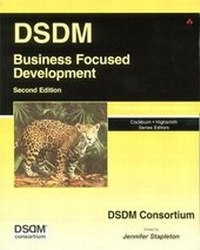
DSDM
Business Focused Development
2nd Edition
Published on 15. November 2002
Book
Paperback/Softback
272 pages
978-0-321-11224-8 (ISBN)
Description
The Dynamic Systems Development Method is a process that is used to deliver new software systems.
Practitioner's guide addressing issues such as how to get people from different disciplines to work together as a team, how to gain commitment and how to manage projects within normal business constraints.
New edition covers how to use DSDM with other methodologies such as Extreme Programming and UML.
Updated case studies showing how DSDM is used in companies such as BT and British Airways.
Based on best practices and lessons learned by DSDM Consortium members and is vendor independent.
Members of the DSDM Consortium include Hewlett Packard, BT, British Airways, Ministry of Defence, PWC, Vodafone and KPMG.
User Level:
Professional
Audience:
Software developers.
Author Biography:
The DSDM Consortium aimes to produce and evolve the de facto approach to building systems both quickly and efficiently. In the UK, DSDM is the most commonly used method for RAD since it has repeatedly demonstrated success in organizations of all sizes. It is now gaining acceptace on a worlwide basis
Practitioner's guide addressing issues such as how to get people from different disciplines to work together as a team, how to gain commitment and how to manage projects within normal business constraints.
New edition covers how to use DSDM with other methodologies such as Extreme Programming and UML.
Updated case studies showing how DSDM is used in companies such as BT and British Airways.
Based on best practices and lessons learned by DSDM Consortium members and is vendor independent.
Members of the DSDM Consortium include Hewlett Packard, BT, British Airways, Ministry of Defence, PWC, Vodafone and KPMG.
User Level:
Professional
Audience:
Software developers.
Author Biography:
The DSDM Consortium aimes to produce and evolve the de facto approach to building systems both quickly and efficiently. In the UK, DSDM is the most commonly used method for RAD since it has repeatedly demonstrated success in organizations of all sizes. It is now gaining acceptace on a worlwide basis
More details
Series
Edition
2nd edition
Language
English
Place of publication
New Jersey
United States
Publishing group
Pearson Education (US)
Target group
Professional and scholarly
Illustrations
bibliography, index
Dimensions
Height: 187 mm
Width: 235 mm
Thickness: 14 mm
Weight
495 gr
ISBN-13
978-0-321-11224-8 (9780321112248)
Copyright in bibliographic data and cover images is held by Nielsen Book Services Limited or by the publishers or by their respective licensors: all rights reserved.
Schweitzer Classification
Other editions
Previous edition
Book
06/1997
Addison Wesley
€45.54
Article exhausted; check for reprint
Persons
The DSDM Consortium aimes to produce and evolve the de facto approach to building systems both quickly and efficiently. In the UK, DSDM is the most commonly used method for RAD since it has repeatedly demonstrated success in organizations of all sizes. It is now gaining acceptance on a worldwide basis
Content
Contents at a Glance
Part I The Framework
Chapter 1 DSDM Process Overview
Chapter 2 The Underlying Principles
Chapter 3 The Process in Action
Chapter 4 Time Versus Functionality
Chapter 5 People Working Together
Chapter 6 The Agile Project Manager in Action
Chapter 7 Impact on the Organisation
Chapter 8 Never Mind the Quality?
Chapter 9 Prototyping is Not a Waste of Time
Chapter 10 The Agile Professional
Chapter 11 Extreme Programming (XP) in a DSDM Environment
Chapter 12 Technology Support
Chapter 13 Keeping the System Going
Part II Case Studies
Chapter 14 Implementing DSDM in e-BA
Chapter 15 DSDM and Eliminating the Contractual Divide
Chapter 16 DSDM in a non-IT Project
Chapter 17 An Object-oriented DSDM Project
Chapter 18 How DSDM can de-risk Offshore Working
Chapter 19 What Happens When it all Goes Horribly Wrong
Chapter 20 A Measured DSDM Project - BT
Chapter 21 From DSDM Adhocracy to DSDM Factory
Chapter 22 DSDM in Process Improvement
Chapter 23 DSDM and Business Rules
Part III Information
Chapter 24 Where Do I Go From Here
Part IV Appendices
Appendix A e-DSDM, a Specialisation
Appendix B The Agile Manifesto
References
Part I The Framework
Chapter 1 DSDM Process Overview
Chapter 2 The Underlying Principles
Chapter 3 The Process in Action
Chapter 4 Time Versus Functionality
Chapter 5 People Working Together
Chapter 6 The Agile Project Manager in Action
Chapter 7 Impact on the Organisation
Chapter 8 Never Mind the Quality?
Chapter 9 Prototyping is Not a Waste of Time
Chapter 10 The Agile Professional
Chapter 11 Extreme Programming (XP) in a DSDM Environment
Chapter 12 Technology Support
Chapter 13 Keeping the System Going
Part II Case Studies
Chapter 14 Implementing DSDM in e-BA
Chapter 15 DSDM and Eliminating the Contractual Divide
Chapter 16 DSDM in a non-IT Project
Chapter 17 An Object-oriented DSDM Project
Chapter 18 How DSDM can de-risk Offshore Working
Chapter 19 What Happens When it all Goes Horribly Wrong
Chapter 20 A Measured DSDM Project - BT
Chapter 21 From DSDM Adhocracy to DSDM Factory
Chapter 22 DSDM in Process Improvement
Chapter 23 DSDM and Business Rules
Part III Information
Chapter 24 Where Do I Go From Here
Part IV Appendices
Appendix A e-DSDM, a Specialisation
Appendix B The Agile Manifesto
References