

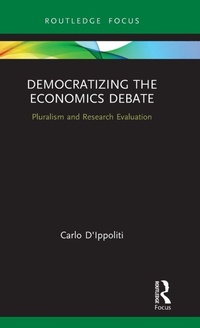
Democratizing the Economics Debate
Pluralism and Research Evaluation
1st Edition
Published on 24. March 2020
Book
Hardback
106 pages
978-0-367-34201-2 (ISBN)
Description
More than a decade since the global financial crisis, economics does not exhibit signs of significant change. Mainstream economists act on an idealized image of science, which includes the convergence of all perspectives into a single supposed scientific truth. Democratizing the Economics Debate shows that this idealized image both provides an inadequate description of what science should be and misrepresents the recent past and current state of economics.
Economics has always been characterized by a plurality of competing perspectives and research paradigms, however, there is evidence of a worrying global involution in the last 40 years. Even as the production of economics publications has exploded, the economics debate is becoming less plural and increasingly hierarchical. Among several causes, the tendency to conformism has been exacerbated in recent years with the use of formal schemes of research quality evaluation. This book documents how such schemes now cover more than half of all economists worldwide and reviews the impact of biased methods of research evaluation on the stunting of levels of pluralism in economics.
The book will be of interest to anyone who worries for the state of the democratic debate. As experts who intervene in the public debate, economists must assure society that they are working in the best possible way, which includes fostering a wide and fair scientific debate. It is this test of social legitimacy that economics currently fails.
Economics has always been characterized by a plurality of competing perspectives and research paradigms, however, there is evidence of a worrying global involution in the last 40 years. Even as the production of economics publications has exploded, the economics debate is becoming less plural and increasingly hierarchical. Among several causes, the tendency to conformism has been exacerbated in recent years with the use of formal schemes of research quality evaluation. This book documents how such schemes now cover more than half of all economists worldwide and reviews the impact of biased methods of research evaluation on the stunting of levels of pluralism in economics.
The book will be of interest to anyone who worries for the state of the democratic debate. As experts who intervene in the public debate, economists must assure society that they are working in the best possible way, which includes fostering a wide and fair scientific debate. It is this test of social legitimacy that economics currently fails.
More details
Series
Language
English
Place of publication
London
United Kingdom
Publishing group
Taylor & Francis Ltd
Target group
College/higher education
Illustrations
12 s/w Abbildungen, 1 s/w Tabelle
1 Tables, black and white; 12 Illustrations, black and white
Dimensions
Height: 222 mm
Width: 145 mm
Thickness: 10 mm
Weight
285 gr
ISBN-13
978-0-367-34201-2 (9780367342012)
Copyright in bibliographic data and cover images is held by Nielsen Book Services Limited or by the publishers or by their respective licensors: all rights reserved.
Schweitzer Classification
Other editions
Additional editions
Book
09/2021
1st Edition
Routledge
€35.80
Shipment within 15-20 days
E-Book
03/2020
1st Edition
Routledge
€31.49
Available for download
E-Book
03/2020
1st Edition
Routledge
€31.49
Available for download
Person
Carlo D'Ippoliti is Associate Professor of Political Economy at Sapienza University of Rome, Italy, and editor of PSL Quarterly Review. He is the author of Economics and Diversity (Routledge, 2011) and co-editor of The Routledge Handbook of Heterodox Economics (Routledge, 2017).
Content
Introduction. 1. How economics should be (a) Experts wish to project unanimity (b) Is scientists' authority legitimate? (c) Science from the crooked wood of humankind (d) Economists as human beings (e) How to regain trust 2. What economics is (a) Economics has both grown and narrowed (b) Are there a mainstream and a heterodox economics? (c) Why mainstream pluralism is not enough (d) Is mainstream economics "neoliberal"? (e) Economics is too hierarchical 3. What economics could become (a) A global phenomenon (b) Bias and discrimination in research evaluation (c) The trouble with citation metrics (d) Consequences of research evaluation in economics (e) Conclusions: economics at a crossroads