

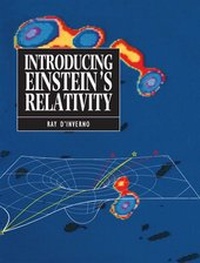
Introducing Einstein's Relativity
Published on 20. August 1992
Book
Hardback
394 pages
978-0-19-859653-0 (ISBN)
Description
There is little doubt that Einstein's theory of relativity captures the imagination. Not only has it radically altered the way we view the universe, but the theory also has a considerable number of surprises in store. This is especially so in the three main topics of current interest that this book reaches, namely: black holes, gravitational waves, and cosmology.
The main aim of this textbook is to provide students with a sound mathematical introduction coupled to an understanding of the physical insights needed to explore the subject. Indeed, the book follows Einstein in that it introduces the theory very much from a physical point of view. After introducing the special theory of relativity, the basic field equations of gravitation are derived and discussed carefully as a prelude to first solving them in simple cases and then exploring the three main
areas of application.
Einstein's theory of relativity is undoubtedly one of the greatest achievements of the human mind. Yet, in this book, the author makes it possible for students with a wide range of abilities to deal confidently with the subject. Based on the author's fifteen years experience of teaching this subject, this is achieved by breaking down the main arguments into simple logical steps. The book includes numerous illustrative diagrams and exercises (of varying degrees of difficulty), and as a result
this book makes an excellent course for any student coming to the subject for the first time.
The main aim of this textbook is to provide students with a sound mathematical introduction coupled to an understanding of the physical insights needed to explore the subject. Indeed, the book follows Einstein in that it introduces the theory very much from a physical point of view. After introducing the special theory of relativity, the basic field equations of gravitation are derived and discussed carefully as a prelude to first solving them in simple cases and then exploring the three main
areas of application.
Einstein's theory of relativity is undoubtedly one of the greatest achievements of the human mind. Yet, in this book, the author makes it possible for students with a wide range of abilities to deal confidently with the subject. Based on the author's fifteen years experience of teaching this subject, this is achieved by breaking down the main arguments into simple logical steps. The book includes numerous illustrative diagrams and exercises (of varying degrees of difficulty), and as a result
this book makes an excellent course for any student coming to the subject for the first time.
Reviews / Votes
Ray d'Inverno's Introducing Einstein's Relativity seems to have done a wonderful job of taming what many undergraduates consider a ferocious course. The book has a large, reader-friendly format, with a lot of illustrations. Important equations are highlighted in boxes and the reader does not have to wade through an undifferentiated mass of tensor calculus. * New Scientist * The visually stunning dust jacket cloaks exceptionally well-presented text and figures, making reading irresistible. This is a fine book which I have added to the recommended bibliography for my courses; colleagues at other universities are advised not to overlook it. * Times Higher Education Supplement * This book is designed to explain the theory in terms which many students will find easier to digest. * Aslib Book Guide, Vol. 58, No. 1, January 1993 * a highly accessible undergraduate text book packaged in a reader-friendly style ... a comprehensive and accessible book * Felicity Mellor, The Observatory, Vol. 113, No. 1114 * a very readable and well illustrated treatment of general relativity, gravitational waves, black holes and cosmology * Australian & New Zealand Physicist, Volume 30, Number 3, March 1993 * The great experience of teaching Relativity is reflected by an excellent presentation of the material in the book ... It is a highly recommended introduction to the mathematical foundations as well as pjhysical ideas underlying Einstein's Relativity. The text is concise and clear but nevertheless of a high level. The author has succeeded in writing a beautiful self-contained text ... very useful for students and graduates who want to become familiar withEinstein's theory of Relativity ... it can be unreservedly recommended as a good tool for preparing examinations in relativity. In all respects it is a pleasure to read this distinguished textbook. * D. Kramer, Class. Quantum Grav. 11 (1994) * an intuitive and motivating presentation with mathematical precision where the latter is needed ... Extremely helpful are more than 200 figures, illustrating subjects which in many cases are difficult to imagine ... this book is one of the best pedagogical approaches to introduce general relativity and to present a connection to more advanced topics in this field. Hence it is highly recommendable for every student or teacher interested in this subject. * Bernd Wegner, Mathematics Abstracts, 774/93 *
More details
Language
English
Place of publication
Oxford
United Kingdom
Publishing group
Oxford University Press
Target group
College/higher education
Illustrations
frontispiece, numerous line figures
Dimensions
Height: 259 mm
Width: 205 mm
Thickness: 30 mm
Weight
1087 gr
ISBN-13
978-0-19-859653-0 (9780198596530)
Copyright in bibliographic data and cover images is held by Nielsen Book Services Limited or by the publishers or by their respective licensors: all rights reserved.
Schweitzer Classification
Other editions
Additional editions
Ray D'Inverno
Introducing Einstein's Relativity
Book
08/1992
Clarendon Press
€68.09
Article exhausted; check different version
Person
Content
PART A: SPECIAL RELATIVITY; PART B: THE FORMALISM OF TENSORS; PART C: GENERAL RELATIVITY; PART D: BLACK HOLES; PART E: GRAVITATIONAL WAVES; PART F: COSMOLOGY