

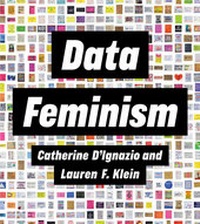
Data Feminism
Published on 17. March 2020
Book
Hardback
328 pages
978-0-262-04400-4 (ISBN)
Description
A new way of thinking about data science and data ethics that is informed by the ideas of intersectional feminism.
Today, data science is a form of power. It has been used to expose injustice, improve health outcomes, and topple governments. But it has also been used to discriminate, police, and surveil. This potential for good, on the one hand, and harm, on the other, makes it essential to ask: Data science by whom? Data science for whom? Data science with whose interests in mind? The narratives around big data and data science are overwhelmingly white, male, and techno-heroic. In Data Feminism, Catherine D'Ignazio and Lauren Klein present a new way of thinking about data science and data ethics-one that is informed by intersectional feminist thought.
Illustrating data feminism in action, D'Ignazio and Klein show how challenges to the male/female binary can help challenge other hierarchical (and empirically wrong) classification systems. They explain how, for example, an understanding of emotion can expand our ideas about effective data visualization, and how the concept of invisible labor can expose the significant human efforts required by our automated systems. And they show why the data never, ever "speak for themselves."
Data Feminism offers strategies for data scientists seeking to learn how feminism can help them work toward justice, and for feminists who want to focus their efforts on the growing field of data science. But Data Feminism is about much more than gender. It is about power, about who has it and who doesn't, and about how those differentials of power can be challenged and changed.
Today, data science is a form of power. It has been used to expose injustice, improve health outcomes, and topple governments. But it has also been used to discriminate, police, and surveil. This potential for good, on the one hand, and harm, on the other, makes it essential to ask: Data science by whom? Data science for whom? Data science with whose interests in mind? The narratives around big data and data science are overwhelmingly white, male, and techno-heroic. In Data Feminism, Catherine D'Ignazio and Lauren Klein present a new way of thinking about data science and data ethics-one that is informed by intersectional feminist thought.
Illustrating data feminism in action, D'Ignazio and Klein show how challenges to the male/female binary can help challenge other hierarchical (and empirically wrong) classification systems. They explain how, for example, an understanding of emotion can expand our ideas about effective data visualization, and how the concept of invisible labor can expose the significant human efforts required by our automated systems. And they show why the data never, ever "speak for themselves."
Data Feminism offers strategies for data scientists seeking to learn how feminism can help them work toward justice, and for feminists who want to focus their efforts on the growing field of data science. But Data Feminism is about much more than gender. It is about power, about who has it and who doesn't, and about how those differentials of power can be challenged and changed.
Reviews / Votes
Without ever finger-wagging, Data Feminism reveals inequities and offers a way out of a broken system in which the numbers are allowed to lie.-WIRED ...the authors' demystification of data science and advocacy for data feminism are extremely timely. The book also serves as an important introduction to intersectional feminist practice by providing inspiring examples of marginalised women and communities taking power back by collecting and wielding "counter-data" to challenge the status quo.
-Times Higher Education
More details
Series
Language
English
Place of publication
Cambridge
United States
Publishing group
MIT Press Ltd
Target group
US School Grade: College Graduate Student and over
Product notice
Cloth over boards
Illustrations
83 color illus., 7 b&w illus.; 90 Illustrations
Dimensions
Height: 229 mm
Width: 203 mm
Thickness: 22 mm
ISBN-13
978-0-262-04400-4 (9780262044004)
Copyright in bibliographic data and cover images is held by Nielsen Book Services Limited or by the publishers or by their respective licensors: all rights reserved.
Schweitzer Classification
Other editions
Additional editions
Catherine D'Ignazio | Lauren F. Klein
Data Feminism
E-Book
03/2020
MIT Press
€32.49
Available for download
Persons
Catherine D'Ignazio is Assistant Professor of Urban Science and Planning in the Department of Urban Studies and Planning at MIT. Lauren F. Klein is Associate Professor of English and Quantitative Theory and Methods at Emory University.