

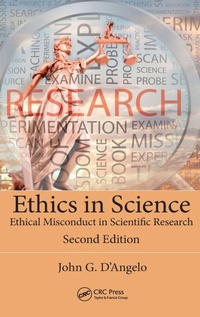
Ethics in Science
Ethical Misconduct in Scientific Research, Second Edition
2nd Edition
Published on 11. December 2018
Book
Hardback
144 pages
978-1-138-39244-1 (ISBN)
Description
Providing the tools necessary for a robust debate, this fully revised and updated second edition of Ethics in Science: Ethical Misconduct in Scientific Research explains various forms of scientific misconduct. The first part describes a variety of ethical violations, why they occur, how they are handled, and what can be done to prevent them along with a discussion of the peer-review process. The second presents real-life case studies that review the known facts, allowing readers to decide for themselves whether an ethical violation has occurred and if so, what should be done. With 4 new chapters and an updated selection of case studies, this text provides resources for guided discussion of topical controversies and how to prevent scientific misconduct.
Key Features:
Fully revised and updated text which explains the various forms of scientific misconduct.
New chapters include hot topics such as Ethics of the Pharmaceutical Industry, The Responsibility of Science to the Environment and Summary of Ethics Guidelines of STEM Professional Societies.
Provides the necessary tools to lead students in the discussion of topical controversies.
Includes descriptions of real ethical case studies, a number of which are new for the Second Edition.
This book is applicable to any science and any level of education.
Key Features:
Fully revised and updated text which explains the various forms of scientific misconduct.
New chapters include hot topics such as Ethics of the Pharmaceutical Industry, The Responsibility of Science to the Environment and Summary of Ethics Guidelines of STEM Professional Societies.
Provides the necessary tools to lead students in the discussion of topical controversies.
Includes descriptions of real ethical case studies, a number of which are new for the Second Edition.
This book is applicable to any science and any level of education.
Reviews / Votes
This book is intended for those who want to teach integrity and responsible conduct of research, with reflections on the ethics of science. The cases are an excellent basis for interactive training, as all these examples are controversial and raise challenging questions that need to be explored further. D'Angelo brings home in a forceful way the important role that scientific publications and scientific publishing can play in highlighting misconduct and bad practices, while also showing how these can be the source of bad practices as well when quality peer review or editorial evaluations are compromised. As we all know, these negative behaviors by authors and editors are often the consequence of the race to publish (. . . or perish) which too often leads to evaluation criteria for the promotion of researchers and allocation of resources that are based on quantity of publication, rather than quality. This book helps to provide a way forward by using concrete examples to signal where and how misconduct is likely to occur, and what can be done to avoid these pitfalls.- Herve Maisonneuve, Redaction Medicale et Scientifique, Translated from the original French.
More details
Edition
2nd edition
Language
English
Place of publication
London
United Kingdom
Publishing group
Taylor & Francis Ltd
Target group
Professional and scholarly
Academic and Professional Practice & Development
Illustrations
3 s/w Tabellen
3 Tables, black and white
Dimensions
Height: 240 mm
Width: 161 mm
Thickness: 14 mm
Weight
414 gr
ISBN-13
978-1-138-39244-1 (9781138392441)
Copyright in bibliographic data and cover images is held by Nielsen Book Services Limited or by the publishers or by their respective licensors: all rights reserved.
Schweitzer Classification
Other editions
Additional editions
Book
12/2018
2nd Edition
CRC Press
€73.30
Shipment within 10-20 days
E-Book
12/2018
2nd Edition
CRC Press
€67.49
Available for download
E-Book
12/2018
2nd Edition
CRC Press
€67.49
Available for download
Previous edition
Book
07/2017
1st Edition
CRC Press
€222.84
Article exhausted; check for reprint
Person
Stony Brook University, Bachelor of Science (BS), Chemistry, 1996 - 2000
The University of Connecticut, Doctor of Philosophy (Ph.D.), Chemistry, 2000 - 2005
Postdoctoral Research Associate, Johns Hopkins University,2005 - 2007
Alfred University, NY, August 2007 - Present
John D'Angelo teaches the following courses: Organic Chemistry I & II and associated labs; General Chemistry I & II labs and occasionally lectures; Basic (non majors) Organic Chemistry; How Science Changed the World (As a First Year Experience Course). He is also the current President of the Faculty Senate.
The University of Connecticut, Doctor of Philosophy (Ph.D.), Chemistry, 2000 - 2005
Postdoctoral Research Associate, Johns Hopkins University,2005 - 2007
Alfred University, NY, August 2007 - Present
John D'Angelo teaches the following courses: Organic Chemistry I & II and associated labs; General Chemistry I & II labs and occasionally lectures; Basic (non majors) Organic Chemistry; How Science Changed the World (As a First Year Experience Course). He is also the current President of the Faculty Senate.
Content
Scientific misconduct in research: What is it, why does it happen, and how do we identify when it happens?
What constitutes scientific misconduct?
Authorship and intellectual property.
Bad ethics vs. bad science.
New results that prove old results wrong.
The whistle-blower's dilemma.
What are the penalties for scientific misconduct?
Human and animal subjects.
What is peer review's role in scientific misconduct?
Revisiting Vlad and Frankie.
Can peer reviewers be unethical?
What effect on the public does scientific misconduct have?
MMR and autism.
Climategate.
HIV vaccine.
Animal rights groups.
Cold fusion.
Bernard Kettlewell.
Electromagnetic field and high-tension power lines.
Fracking and pollution.
What constitutes responsible conduct from the point+A76 of view of human and animal subjects in research?
The ethics of the pharmaceutical industry.
Science and the public.
The role of government in scientific misconduct?
The responsibility of science to the environment.
Is there some research that shouldn't be done because of threats the results may pose to society?
Summary of ethics guidelines of STEM professional societies.
Can Scientific misconduct be prevented?
Intentional negligence in acknowledgment of previous work.
Deliberate fabrication of data.
Deliberate omission of known data that doesn't agree with hypotheses.
Passing another researcher's data as one's own.
Publication of results without consent of all the researchers.
Failure to acknowledge all the researchers who performed the work.
Conflict-of-interest issues.
Repeated publication of too-similar results.
Breach of confidentiality.
Misrepresenting others' work.
Wrapping up.
Case Studies.
Darwin and Wallace.
Rangaswamy Srinivasan-VISX patent dispute.
Schwartz and Mirkin.
Corey and Woodward.
Cordova, Scripps Research Institute, and Stockholm University.
La Clair and hexacyclinol.
Woodward and quinine.
DNA.
David Baltimore and Teresa Imanishi-Kari.
John Fenn-Yale patent dispute.
VIOXX (R).
Index.
What constitutes scientific misconduct?
Authorship and intellectual property.
Bad ethics vs. bad science.
New results that prove old results wrong.
The whistle-blower's dilemma.
What are the penalties for scientific misconduct?
Human and animal subjects.
What is peer review's role in scientific misconduct?
Revisiting Vlad and Frankie.
Can peer reviewers be unethical?
What effect on the public does scientific misconduct have?
MMR and autism.
Climategate.
HIV vaccine.
Animal rights groups.
Cold fusion.
Bernard Kettlewell.
Electromagnetic field and high-tension power lines.
Fracking and pollution.
What constitutes responsible conduct from the point+A76 of view of human and animal subjects in research?
The ethics of the pharmaceutical industry.
Science and the public.
The role of government in scientific misconduct?
The responsibility of science to the environment.
Is there some research that shouldn't be done because of threats the results may pose to society?
Summary of ethics guidelines of STEM professional societies.
Can Scientific misconduct be prevented?
Intentional negligence in acknowledgment of previous work.
Deliberate fabrication of data.
Deliberate omission of known data that doesn't agree with hypotheses.
Passing another researcher's data as one's own.
Publication of results without consent of all the researchers.
Failure to acknowledge all the researchers who performed the work.
Conflict-of-interest issues.
Repeated publication of too-similar results.
Breach of confidentiality.
Misrepresenting others' work.
Wrapping up.
Case Studies.
Darwin and Wallace.
Rangaswamy Srinivasan-VISX patent dispute.
Schwartz and Mirkin.
Corey and Woodward.
Cordova, Scripps Research Institute, and Stockholm University.
La Clair and hexacyclinol.
Woodward and quinine.
DNA.
David Baltimore and Teresa Imanishi-Kari.
John Fenn-Yale patent dispute.
VIOXX (R).
Index.