

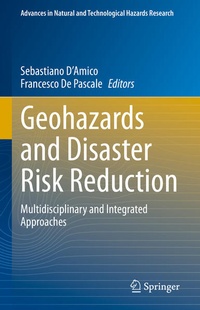
Geohazards and Disaster Risk Reduction
Multidisciplinary and Integrated Approaches
Published on 5. May 2023
Book
Hardback
XI, 507 pages
978-3-031-24540-4 (ISBN)
Description
This book provides a comprehensive and multidisciplinary approach to addressing geohazards, with topics such as social vulnerability reduction, risk prevention, institutional preparedness, and community resilience. It also introduces new technologies to study geohazards, which is important since geohazards have caused many casualties, economic losses, and damage to cultural heritage throughout human history. Despite this, the culture of risk prevention is not yet widespread, so Disaster Risk Reduction activities must focus on increasing capacities, strategies, and action plans for prevention and preparedness in local communities.
More details
Series
Edition
2023 ed.
Language
English
Place of publication
Cham
Switzerland
Publishing group
Springer International Publishing
Target group
Professional and scholarly
Illustrations
28 s/w Abbildungen, 110 farbige Abbildungen
XI, 507 p. 138 illus., 110 illus. in color.
Dimensions
Height: 241 mm
Width: 160 mm
Thickness: 34 mm
Weight
939 gr
ISBN-13
978-3-031-24540-4 (9783031245404)
DOI
10.1007/978-3-031-24541-1
Schweitzer Classification
Other editions
Additional editions
Sebastiano D'Amico | Francesco De Pascale
Geohazards and Disaster Risk Reduction
Multidisciplinary and Integrated Approaches
Book
05/2024
Springer
€160.49
Shipment within 15-20 days
Sebastiano D'Amico | Francesco De Pascale
Geohazards and Disaster Risk Reduction
Multidisciplinary and Integrated Approaches
E-Book
05/2023
1st Edition
Springer
€160.49
Available for download
Content
-
Part I Geohazards and Disaster Prevention: Approaches
and Case Studies.
- 1. Social Vulnerability and Geohazards: Review and Implications. - 2. Representations of Catastrophe Victims in Journalistic Narration: L'Aquila Earthquake of 2009. - 3. Perception of the Self-Exposure to Geohazards in the Italian Coastal Population of the Adriatic Basin. - 4. Urban Transformation, Collective Memory, and Disaster Preparedness: A Case from Turkey. - 5. Perceptions and Practices of Disaster Governance in Countries with Long History of Centralized Administration: A Case Study of Balikesir Municipalities, Turkey. - 6. Reducing the Risk from Asbestos in the Built Environment During Natural Hazard Events. -
Part II Climate Change Perspectives.
- 7. Communicating Weather Risk in the Twenty-First Century: Approaches Using Video Games and Virtual Reality. - 8. Assessing Coastal Flood Impact on Buildings: A Climate Change Perspective from the Developing Nation. - 9. Coping with Disasters: What Place Names Can Tell Us About Anthropocene and Climate Change. - 10. Climate Change and the Rising Disaster Risk in Africa. - 11. Water and Geohazards in Lower Casamance: Risk Perception and Prevention Strategies of the Populations in the Baïla Marigot Basin (Casamance, Senegal). - 12. The Risk of Marine Erosion in Tunisian Beaches: A Retrospective Reading for a Prospective Vision. - 13. African Indigenous Understanding of Climate Change and Disaster Risk Nexus. -
Part III Resilience and Disaster Preparedness.
- 14. Building Resilience in Times of New Global Challenges: A Focus on Six Main Attributes. - 15. Community Resilience Through Recovery: Capacity Building and Sustainability. - 16. Community Resilience Through Local Action: AKAH's Winter Preparedness and Avalanche Readiness Programme. - 17. Civic Resilience: Botanical Gardens in North America, Birth, Development, and Environmental Awareness. - 18. Measuring Willingness to Pay for Community-Based Resilience Training in the Southeast USA. - 19. Where There Is Smoke: Normalizing Community Preparedness and Geohazard Resilience: A Wildfire Perspective. - 20. Istanbul Resilience Approach Against Earthquake. -
Part IV Pandemic, Vulnerabilities and Ethics.
- 21. The Covid-19 Protection Index (CPI) as a Way to Identify Vulnerabilities and Disparities Across Brazilian Territories. - 22. The Social Vulnerability Index: A Literature Review. - 23. Geoethics, Environmental Law and the Necessary Dialogue Between Knowledges.