

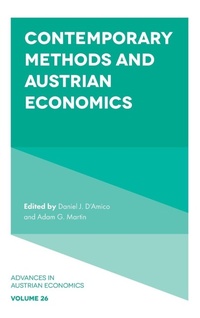
Contemporary Methods and Austrian Economics
Published on 27. January 2022
Book
Hardback
184 pages
978-1-80262-288-1 (ISBN)
Description
Austrian economics is known for extensive-and many economists would say excessive-ruminations on methodology. Attempting to steer a middle course between radical forms of historicism (there are no economic laws) and scientism (economic laws are as precise as physical laws), this approach often appears to diminish the importance of empirical testing and quantitative methods more generally. Since the Austrian revival of the 1970's, social scientists have developed a number of new theoretical and empirical approaches to studying the social world. Experimental and behavioral economics have exploded in popularity. Econometrics has arguably taken a more central role in the discipline than even formal economic theory. And, most prominently, econometricians have developed quasi-experimental techniques for examining real-world data as part of the "credibility revolution."
This volume, Contemporary Methods and Austrian Economics, examines the relationship between Austrian economics and these new social scientific methods. Do Austrian critiques of the excessive ambitions of formal theory and empirical measurement still hold water (if they ever did)? Do the findings of these new approaches bolster or undermine distinctively Austrian theories? How should we update our views on the relationship between abstract economic theory and empirical investigations?
This volume, Contemporary Methods and Austrian Economics, examines the relationship between Austrian economics and these new social scientific methods. Do Austrian critiques of the excessive ambitions of formal theory and empirical measurement still hold water (if they ever did)? Do the findings of these new approaches bolster or undermine distinctively Austrian theories? How should we update our views on the relationship between abstract economic theory and empirical investigations?
More details
Series
Language
English
Place of publication
Bingley
United Kingdom
Target group
Professional and scholarly
Dimensions
Height: 235 mm
Width: 157 mm
Thickness: 15 mm
Weight
426 gr
ISBN-13
978-1-80262-288-1 (9781802622881)
Copyright in bibliographic data and cover images is held by Nielsen Book Services Limited or by the publishers or by their respective licensors: all rights reserved.
Schweitzer Classification
Other editions
Additional editions
Daniel J. D'Amico | Adam G. Martin
Contemporary Methods and Austrian Economics
E-Book
01/2022
1st Edition
Emerald Publishing Limited
€92.49
Available for download
Persons
Daniel J. D'Amico is the Associate Director of the Political Theory Project at Brown University, where he is also a Lecturer in Economics. His current research focuses upon the political economy of crime and punishment throughout history and around the world.
Adam G. Martin is an Associate Professor in Agricultural and Applied Economics and Political Economy Research Fellow at the Free Market Institute at Texas Tech University. His research interests focus on the intersection of philosophy, politics, and economics. He is the Vice President of the Society for the Development of Austrian Economics.
Adam G. Martin is an Associate Professor in Agricultural and Applied Economics and Political Economy Research Fellow at the Free Market Institute at Texas Tech University. His research interests focus on the intersection of philosophy, politics, and economics. He is the Vice President of the Society for the Development of Austrian Economics.
Content
Chapter 1. Austrian Economics and the New Paternalism; Daniel M. Hausman
Chapter 2. Austrian Critiques of Behavioral Economics: Common Misconceptions and Low Hanging Fruit; Jason A. Aimone
Chapter 3. Rules, Perception and the Intelligibility of Laboratory Experiments on Social Interaction in Economics; Erik O. Kimbrough
Chapter 4. Laboratory Experiments and Austrian Economics; Shaun P. Hargreaves Heap
Chapter 5. The Binding Force of Economics; Colin Harris, Andrew Myers, Christienne Briol, and Sam Carlen
Chapter 6. Causal Inference and Austrian Economics; Kevin Grier
Chapter 7. Information and Markets: Toward a critical sociological appreciation of F.A. Hayek; Bruce G. Carruthers
Chapter 8. The Elusive Empirics of Austrian Capital Theory; Nicolas Cachanosky
Chapter 9. How Cognitive Institutions and Interpretative Rationality enable Markets with Infinite Variety; Erwin Dekker
Chapter 2. Austrian Critiques of Behavioral Economics: Common Misconceptions and Low Hanging Fruit; Jason A. Aimone
Chapter 3. Rules, Perception and the Intelligibility of Laboratory Experiments on Social Interaction in Economics; Erik O. Kimbrough
Chapter 4. Laboratory Experiments and Austrian Economics; Shaun P. Hargreaves Heap
Chapter 5. The Binding Force of Economics; Colin Harris, Andrew Myers, Christienne Briol, and Sam Carlen
Chapter 6. Causal Inference and Austrian Economics; Kevin Grier
Chapter 7. Information and Markets: Toward a critical sociological appreciation of F.A. Hayek; Bruce G. Carruthers
Chapter 8. The Elusive Empirics of Austrian Capital Theory; Nicolas Cachanosky
Chapter 9. How Cognitive Institutions and Interpretative Rationality enable Markets with Infinite Variety; Erwin Dekker