

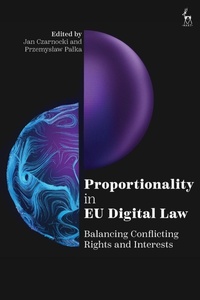
Proportionality in EU Digital Law
Balancing Conflicting Rights and Interests
Will be published approx. on 26. February 2026
Book
Paperback/Softback
312 pages
978-1-5099-7455-9 (ISBN)
Description
This book addresses the interplay between the proportionality principle and EU digital law.
Does EU digital law provide a fair balance of rights and interests? How does proportionality limit legislation in the digital economy? How can it be used to balance competing rights and interests? Diving into the dialectics of law and technology, the book analyses the relevance of the proportionality principle in regulating the digital world and as a vital tool for balancing competing rights and interests.
The chapters analyse how conflicting rights and interests are resolved in EU digital law through the proportionality principle and critically reflect on its application. They scrutinise recent EU regulatory initiatives such as the GDPR, AI Act, Copyright Directive, DSA, and more. They reflect on the unique context of AI systems regulation, digital marketing, and data protection, illuminating the application and impact of proportionality in these arenas.
Providing an in-depth examination of legal actors and real-life conflicts resolved by applying EU digital law, the book explains the pivotal role of the principle of proportionality in achieving an optimal balance of rights in our digital era.
Does EU digital law provide a fair balance of rights and interests? How does proportionality limit legislation in the digital economy? How can it be used to balance competing rights and interests? Diving into the dialectics of law and technology, the book analyses the relevance of the proportionality principle in regulating the digital world and as a vital tool for balancing competing rights and interests.
The chapters analyse how conflicting rights and interests are resolved in EU digital law through the proportionality principle and critically reflect on its application. They scrutinise recent EU regulatory initiatives such as the GDPR, AI Act, Copyright Directive, DSA, and more. They reflect on the unique context of AI systems regulation, digital marketing, and data protection, illuminating the application and impact of proportionality in these arenas.
Providing an in-depth examination of legal actors and real-life conflicts resolved by applying EU digital law, the book explains the pivotal role of the principle of proportionality in achieving an optimal balance of rights in our digital era.
More details
Language
English
Place of publication
Oxford
United Kingdom
Publishing group
Bloomsbury Publishing PLC
Target group
Professional and scholarly
College/higher education
Dimensions
Height: 234 mm
Width: 156 mm
Thickness: 17 mm
Weight
477 gr
ISBN-13
978-1-5099-7455-9 (9781509974559)
Copyright in bibliographic data and cover images is held by Nielsen Book Services Limited or by the publishers or by their respective licensors: all rights reserved.
Schweitzer Classification
Other editions
Additional editions

Jan Czarnocki | Przemyslaw Palka
Proportionality in EU Digital Law
Balancing Conflicting Rights and Interests
E-Book
10/2024
1st Edition
Hart Publishing
€49.99
Available for download

Jan Czarnocki | Przemyslaw Palka
Proportionality in EU Digital Law
Balancing Conflicting Rights and Interests
E-Book
10/2024
1st Edition
Hart Publishing
€49.99
Available for download
Persons
Jan Czarnocki is Marie Sklodowska-Curie Fellow and Doctoral Researcher at the KU Leuven Centre for IT & IP Law, Belgium.
Przemyslaw Palka is Assistant Professor at the Jagiellonian University Faculty of Law, Poland.
Przemyslaw Palka is Assistant Professor at the Jagiellonian University Faculty of Law, Poland.
Content
Foreword, Wojciech Wiewiorowski (European Data Protection Supervisor, Poland)
1. Introduction, Jan Czarnocki (KU Leuven, Belgium), Przemyslaw Palka (Jagiellonian University, Poland)
2. The Origins of Proportionality and Balancing in the Jurisprudence of the European Court of Human Rights, Bart van der Sloot (Tilburg University, the Netherlands)
3. Proportionality in Modern Regulatory States Confused about Priorities. Judges Like, but do not Comply with Academic Doctrines, Paul De Hert (Tilburg University, the Netherlands)
4. Proportionality of Goals or Means? The Politics of Data Governance in the Shade of Constitutional Norms, Przemyslaw Palka (Jagiellonian University, Poland)
5. Between Rights, Interests and Risk - The Role of the Proportionality Balancing in EU Digital Law, Jan Czarnocki (KU Leuven, Belgium)
6. Proportionality in the Proposed Artificial Intelligence Liability Directive and the Revised Product Liability Directive, Li Shu (Erasmus University Rotterdam, the Netherlands)
7. The Principle of Proportionality in Relations between Users and Providers of Digital Services, Aleksandra Gliszczynska-Grabias (Polish Academy of Sciences), Michal Jablonski (University of Warsaw, Poland) and Krzysztof Kozminski (University of Warsaw, Poland)
8. Regulating AdTech: Chasing Chimeras or the Art of the Possible? Vasileios Michail Karkatzounis (University of Aegean, Greece), Apostolos Vorras (University of Aegean, Greece) and Lilian Mitrou (University of Aegean, Greece)
9. The Data Act and the Balance of Interests between Device Purchases and Manufacturers, Bohdan Widla (Jagiellonian University, Poland)
10. A Balancing Exercise: Applying the Principle of Proportionality to Determine the Effect of Withdrawal of Consent for Processing Personal Data in Biomedical Research, Marcu Florea (University of Groningen, the Netherlands) and Jeanne Mifsud Bonnici (University of Groningen, the Netherlands)
11. Proportionality and Civil Law Policy in Copyright: Criticism of Necessity Standard as Applied in CJEU Case Poland v Parliament and Council (C-401/19), Konrad Gliscinski (Jagiellonian University, Poland)
12. EU Digital COVID Certificate Regulation: A Retrospective Analysis on Proportionality and Data Protection, Fatma Suemerya Dogan (Jagiellonian University, Poland) and Paul De Hert (Tilburg University, the Netherlands)
13. Is Prohibiting Targeted Ads for Minors under Digital Services Act Proportionate? The Need for a Child-rights-based Approach to Protecting Children's Personal Data Online, Mateusz Kupiec (Polish Academy of Sciences)
1. Introduction, Jan Czarnocki (KU Leuven, Belgium), Przemyslaw Palka (Jagiellonian University, Poland)
2. The Origins of Proportionality and Balancing in the Jurisprudence of the European Court of Human Rights, Bart van der Sloot (Tilburg University, the Netherlands)
3. Proportionality in Modern Regulatory States Confused about Priorities. Judges Like, but do not Comply with Academic Doctrines, Paul De Hert (Tilburg University, the Netherlands)
4. Proportionality of Goals or Means? The Politics of Data Governance in the Shade of Constitutional Norms, Przemyslaw Palka (Jagiellonian University, Poland)
5. Between Rights, Interests and Risk - The Role of the Proportionality Balancing in EU Digital Law, Jan Czarnocki (KU Leuven, Belgium)
6. Proportionality in the Proposed Artificial Intelligence Liability Directive and the Revised Product Liability Directive, Li Shu (Erasmus University Rotterdam, the Netherlands)
7. The Principle of Proportionality in Relations between Users and Providers of Digital Services, Aleksandra Gliszczynska-Grabias (Polish Academy of Sciences), Michal Jablonski (University of Warsaw, Poland) and Krzysztof Kozminski (University of Warsaw, Poland)
8. Regulating AdTech: Chasing Chimeras or the Art of the Possible? Vasileios Michail Karkatzounis (University of Aegean, Greece), Apostolos Vorras (University of Aegean, Greece) and Lilian Mitrou (University of Aegean, Greece)
9. The Data Act and the Balance of Interests between Device Purchases and Manufacturers, Bohdan Widla (Jagiellonian University, Poland)
10. A Balancing Exercise: Applying the Principle of Proportionality to Determine the Effect of Withdrawal of Consent for Processing Personal Data in Biomedical Research, Marcu Florea (University of Groningen, the Netherlands) and Jeanne Mifsud Bonnici (University of Groningen, the Netherlands)
11. Proportionality and Civil Law Policy in Copyright: Criticism of Necessity Standard as Applied in CJEU Case Poland v Parliament and Council (C-401/19), Konrad Gliscinski (Jagiellonian University, Poland)
12. EU Digital COVID Certificate Regulation: A Retrospective Analysis on Proportionality and Data Protection, Fatma Suemerya Dogan (Jagiellonian University, Poland) and Paul De Hert (Tilburg University, the Netherlands)
13. Is Prohibiting Targeted Ads for Minors under Digital Services Act Proportionate? The Need for a Child-rights-based Approach to Protecting Children's Personal Data Online, Mateusz Kupiec (Polish Academy of Sciences)