

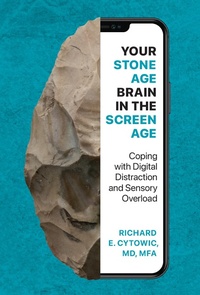
Your Stone Age Brain in the Screen Age
Coping with Digital Distraction and Sensory Overload
Published on 1. October 2024
Book
Hardback
344 pages
978-0-262-04900-9 (ISBN)
Description
An award-winning neurologist on the Stone-Age roots of our screen addictions, and what to do about them.
The human brain hasn’t changed much since the Stone Age, let alone in the mere thirty years of the Screen Age. That’s why, according to neurologist Richard Cytowic—who, Oliver Sacks observed, “changed the way we think of the human brain”—our brains are so poorly equipped to resist the incursions of Big Tech: They are programmed for the wildly different needs of a prehistoric world. In Your Stone Age Brain in the Screen Age, Cytowic explains exactly how this programming works—from the brain’s point of view. What he reveals in this book shows why we are easily addicted to screen devices; why young, developing brains are particularly vulnerable; why we need silence; and what we can do to push back.
In the engaging storytelling style of his popular TED Talk, Cytowic draws an easily comprehensible picture of the Stone Age brain’s workings—the function of neurotransmitters like dopamine in basic instincts for survival such as desire and reward; the role of comparison in emotion, and emotion in competition; and, most significantly, the orienting reflex, one of the unconscious circuits that automatically focus, shift, and sustain attention. Given this picture, the nature of our susceptibility to digital devices becomes clear, along with the possibility of how to break their spell.
Full of practical actions that we can start taking right away, Your Stone Age Brain in the Screen Age offers compelling evidence that we can change the way we use technology, resist its addictive power over us, and take back the control we have lost.
The human brain hasn’t changed much since the Stone Age, let alone in the mere thirty years of the Screen Age. That’s why, according to neurologist Richard Cytowic—who, Oliver Sacks observed, “changed the way we think of the human brain”—our brains are so poorly equipped to resist the incursions of Big Tech: They are programmed for the wildly different needs of a prehistoric world. In Your Stone Age Brain in the Screen Age, Cytowic explains exactly how this programming works—from the brain’s point of view. What he reveals in this book shows why we are easily addicted to screen devices; why young, developing brains are particularly vulnerable; why we need silence; and what we can do to push back.
In the engaging storytelling style of his popular TED Talk, Cytowic draws an easily comprehensible picture of the Stone Age brain’s workings—the function of neurotransmitters like dopamine in basic instincts for survival such as desire and reward; the role of comparison in emotion, and emotion in competition; and, most significantly, the orienting reflex, one of the unconscious circuits that automatically focus, shift, and sustain attention. Given this picture, the nature of our susceptibility to digital devices becomes clear, along with the possibility of how to break their spell.
Full of practical actions that we can start taking right away, Your Stone Age Brain in the Screen Age offers compelling evidence that we can change the way we use technology, resist its addictive power over us, and take back the control we have lost.
More details
Language
English
Place of publication
Cambridge (Massachusetts)
United States
Publishing group
MIT Press Ltd
Illustrations
10 COLOR ILLUS., 11 BLACK AND WHITE ILLUS.
Dimensions
Height: 243 mm
Width: 160 mm
Thickness: 37 mm
Weight
583 gr
ISBN-13
978-0-262-04900-9 (9780262049009)
Copyright in bibliographic data and cover images is held by Nielsen Book Services Limited or by the publishers or by their respective licensors: all rights reserved.
Schweitzer Classification
Other editions
Additional editions
Richard E. Cytowic
Your Stone Age Brain in the Screen Age
Coping with Digital Distraction and Sensory Overload
E-Book
10/2024
MIT Press
€33.99
Available for download
Person
Richard E. Cytowic
Content
Contents
Your Stone-Age Brain—3 Million BCE vs. Today
1 Engineered Addiction: Brain Drain and “Virtual” Autism
2 Selfies Kill More People Than Sharks
3 The Brain-Energy Cost of Screen Distractions
4 The Brain-Energy Cost of Multitasking
5 The Digital Difference: We Treat It Socially
6 Silence Is an Essential Nutrient
7 Your Brain Is a Hackable Change Detector
8 What Gets Caught in the Corner of Your Eye
9 Missing Critical Windows Degrades Empathy
10 How Blue Screen Light Wrecks Normal Sleep
11 Hooked in the Pursuit of Happiness
12 Pandora’s Box: How Ambivalence Keeps Us Hooked
13 iPads in the Nursery or Not?
14 Human Contact Traded for a Googlized Mind
15 The Consequences of Forced Viewing
16 Does Heavy Viewing Induce Autistic-Like Symptoms?
17 Social Learning: Kindergarten, Handwriting, and Dexterity
18 War Games: Is the Only Winning Move Not to Play?
19 Coda: Lessons from the Lockdown Years
Appendix: Keeping a Dream Diary
Acknowledgements
Notes
Index
Your Stone-Age Brain—3 Million BCE vs. Today
1 Engineered Addiction: Brain Drain and “Virtual” Autism
2 Selfies Kill More People Than Sharks
3 The Brain-Energy Cost of Screen Distractions
4 The Brain-Energy Cost of Multitasking
5 The Digital Difference: We Treat It Socially
6 Silence Is an Essential Nutrient
7 Your Brain Is a Hackable Change Detector
8 What Gets Caught in the Corner of Your Eye
9 Missing Critical Windows Degrades Empathy
10 How Blue Screen Light Wrecks Normal Sleep
11 Hooked in the Pursuit of Happiness
12 Pandora’s Box: How Ambivalence Keeps Us Hooked
13 iPads in the Nursery or Not?
14 Human Contact Traded for a Googlized Mind
15 The Consequences of Forced Viewing
16 Does Heavy Viewing Induce Autistic-Like Symptoms?
17 Social Learning: Kindergarten, Handwriting, and Dexterity
18 War Games: Is the Only Winning Move Not to Play?
19 Coda: Lessons from the Lockdown Years
Appendix: Keeping a Dream Diary
Acknowledgements
Notes
Index