

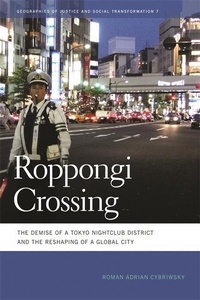
Roppongi Crossing
The Demise of a Tokyo Nightclub District and the Reshaping of a Global City
Published on 15. March 2011
Book
Paperback/Softback
328 pages
978-0-8203-3832-3 (ISBN)
Description
For most of the latter half of the twentieth century, Roppongi was an enormously popular nightclub district that stood out from the other pleasure quarters of Tokyo for its mix of international entertainment and people. It was where Japanese and foreigners went to meet and play. With the crash of Japan's bubble economy in the 1990s, however, the neighborhood declined, and it now has a reputation as perhaps Tokyo's most dangerous district-a hotbed of illegal narcotics, prostitution, and other crimes. Its concentration of "bad foreigners," many from China, Russia and Eastern Europe, West Africa, and Southeast Asia is thought to be the source of the trouble.
Roman Adrian Cybriwsky examines how Roppongi's nighttime economy is now under siege by both heavy-handed police action and the conservative Japanese "construction state," an alliance of large private builders and political interests with broad discretion to redevelop Tokyo. The construction state sees an opportunity to turn prime real estate into high-end residential and retail projects that will "clean up" the area and make Tokyo more competitive with Shanghai and other rising business centers in Asia.
Roppongi Crossing is a revealing ethnography of what is arguably the most dynamic district in one of the world's most dynamic cities. Based on extensive fieldwork, it looks at the interplay between the neighborhood's nighttime rhythms; its emerging daytime economy of office towers and shopping malls; Japan's ongoing internationalization and changing ethnic mix; and Roppongi Hills and Tokyo Midtown, the massive new construction projects now looming over the old playground.
Roman Adrian Cybriwsky examines how Roppongi's nighttime economy is now under siege by both heavy-handed police action and the conservative Japanese "construction state," an alliance of large private builders and political interests with broad discretion to redevelop Tokyo. The construction state sees an opportunity to turn prime real estate into high-end residential and retail projects that will "clean up" the area and make Tokyo more competitive with Shanghai and other rising business centers in Asia.
Roppongi Crossing is a revealing ethnography of what is arguably the most dynamic district in one of the world's most dynamic cities. Based on extensive fieldwork, it looks at the interplay between the neighborhood's nighttime rhythms; its emerging daytime economy of office towers and shopping malls; Japan's ongoing internationalization and changing ethnic mix; and Roppongi Hills and Tokyo Midtown, the massive new construction projects now looming over the old playground.
Reviews / Votes
Entirely original. Cybriwsky provides a very personal take on the changes now occurring in Tokyo's fascinating Roppongi district; the result is a wonderful book that should find a wide audience in urban studies. -- David W. Edgington * author of <i>Japan at the Millennium: Joining Past and Future</i> * Roman Cybriwsky is well known for his pioneering geographic research on Tokyo. In his new book, he describes Roppongi, a famous cultural district that has undergone a substantial transformation over the last half century. Roppongi Crossing is a major contribution to the literature on Japan and on cities in general. It is also highly enjoyable reading. -- P. P. Karan * author of <i>Japan in the Twenty-First Century: Environment, Economy, and Society</i> * A fascinating and very personal tour through Tokyo's notorious neighborhood of Roppongi. It graphs the gritty history and geography of the district's social life as it transforms from sin city to high end heaven courtesy of Japan's construction state. Roppongi Crossing is a readable, unusually gripping and sensitive ethnographic saunter through urban change. -- Neil Smith * author <i>Uneven Development</i> * Drawing upon his years of experience living in and studying Tokyo, Cybriwsky's ethnography of its Roppongi District offers the kind of keen insight into the area that most foreign observers are unable to provide. In the process, he vividly details the morality play that is in Roppongi and Tokyo, a daily balancing act pitting individualism versus groupism, defiance versus conformity, and internationalization versus Japaneseness. -- A. J. Jacobs * <i>Journal of Urban Affairs</i> * Cybriwsky offers important insights into the transition of a zone of liminality in the midst of a mega urban society. -- Anni Greve * <i>Journal of Historical Geography</i> *More details
Series
Language
English
Place of publication
Georgia
United States
Target group
College/higher education
Professional and scholarly
Product notice
Paperback (trade)
Illustrations
5 Maps; 5 Maps; 5 Maps; 5 Maps; 5 Maps; 5 Maps; 5 Maps
Dimensions
Height: 229 mm
Width: 152 mm
Thickness: 19 mm
Weight
476 gr
ISBN-13
978-0-8203-3832-3 (9780820338323)
Copyright in bibliographic data and cover images is held by Nielsen Book Services Limited or by the publishers or by their respective licensors: all rights reserved.
Schweitzer Classification
Person
ROMAN ADRIAN CYBRIWSKI is a professor of geography and urban studies and director of Asian studies at Temple University. He is the author of several books, including Tokyo: The Shogun's City at the Twenty-first Century.