

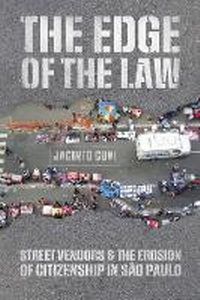
The Edge of the Law
Street Vendors and the Erosion of Citizenship in Sao Paulo
Published on 16. June 2025
Book
Hardback
208 pages
978-0-226-84087-1 (ISBN)
Description
How street vendors tangle with the law in Sao Paulo, Brazil.
With a little initiative and very little startup money, an outgoing individual might sell you a number of delights and conveniences familiar to city dwellers-from cold water bottles while you're sitting in traffic to a popsicle from a cart on a summer afternoon in the park. Such vendors form a significant share of the workforce in Sao Paulo, Brazil, but their ubiquity belies perpetual struggle. Some have the right to practice their trade; others do not. All of them strive to make it-or stay afloat.
In The Edge of the Law, sociologist Jacinto Cuvi introduces us to the world of street vendors and teases out the relationship between the construction of legality and the experience of citizenship. As Sao Paulo's city government undertakes a large-scale plan to cancel street vending licenses and evict street vendors, Cuvi reveals how the rights of informal workers can be revoked or withheld and how the lines can be redrawn between work that is "legal" and work that takes place under constant fear of law enforcement. Alongside the mechanics of disenfranchisement, Cuvi captures the lived experience of criminalization, dissecting the distribution of (shallow) rights among vendors who continually reinvent strategies to eke out a living while dealing with the constraints and pressures of informal citizenship at the edge of the law.
With a little initiative and very little startup money, an outgoing individual might sell you a number of delights and conveniences familiar to city dwellers-from cold water bottles while you're sitting in traffic to a popsicle from a cart on a summer afternoon in the park. Such vendors form a significant share of the workforce in Sao Paulo, Brazil, but their ubiquity belies perpetual struggle. Some have the right to practice their trade; others do not. All of them strive to make it-or stay afloat.
In The Edge of the Law, sociologist Jacinto Cuvi introduces us to the world of street vendors and teases out the relationship between the construction of legality and the experience of citizenship. As Sao Paulo's city government undertakes a large-scale plan to cancel street vending licenses and evict street vendors, Cuvi reveals how the rights of informal workers can be revoked or withheld and how the lines can be redrawn between work that is "legal" and work that takes place under constant fear of law enforcement. Alongside the mechanics of disenfranchisement, Cuvi captures the lived experience of criminalization, dissecting the distribution of (shallow) rights among vendors who continually reinvent strategies to eke out a living while dealing with the constraints and pressures of informal citizenship at the edge of the law.
Reviews / Votes
"The Edge of the Law explores the politics of securing rights in the community of street traders in downtown Sao Paulo. It provides a deep ethnographic and detailed history of how street vendors have struggled to secure their rights. In doing so, the book unpacks the nature of informality, examining the full range of actors and the institutional, legal, and political dynamics that constitute this field. Both rich in detail and sophisticated in its theoretical probing, this book does a superb job of bringing readers into the contested world of urban informality." -- Patrick Heller, Brown University "The greatest strength of The Edge of the Law is the amount of human detail, vividly depicting the day-to-day actions of street vendors and those charged with implementing Sao Paulo's street vending policies, and the beliefs that guide those actions. The book is packed with human agency, ingenuity, and suffering, conveyed through dramatic, comic, and tragic stories." -- Chris Tilly, University of California, Los Angeles "The Edge of the Law offers a fresh and analytically rich perspective on how legality structures inequality in contemporary cities. It provides an account that resonates across urban sociology, political sociology, and socio-legal studies. And as such, it will be a welcome resource to enrich discussions on courses on urban inequality, citizenship, law and society, and Latin American politics. By complementing lawmaking with the politics of enforcement, Cuvi delivers a meaningful theoretical contribution and an empirically grounded portrait of how the making of the postindustrial city is intertwined with the incremental unmaking of its citizens." * Social Forces * The International Studies Association (ISA)'s International Political Sociology Book Award * The International Studies Association (ISA)'s International Political Sociology Book Award *More details
Language
English
Place of publication
Chicago
United States
Publishing group
The University of Chicago Press
Target group
Professional and scholarly
Illustrations
4 halftones
Dimensions
Height: 229 mm
Width: 152 mm
Thickness: 20 mm
Weight
399 gr
ISBN-13
978-0-226-84087-1 (9780226840871)
Copyright in bibliographic data and cover images is held by Nielsen Book Services Limited or by the publishers or by their respective licensors: all rights reserved.
Schweitzer Classification
Person
Jacinto Cuvi is associate professor of sociology and development studies at the Universite libre de Bruxelles, Belgium.
Content
Abbreviations
1. Introduction
2. Unmaking Citizens
3. The Daily Struggle
4. The Rights of Time
5. The Right Narrative
6. The Politics of Hope
7. The Empty Promise
8. The Making of Lawlessness
Conclusion: The End of Citizenship?
Acknowledgments
Appendix: Fieldwork
Notes
References
Index
1. Introduction
2. Unmaking Citizens
3. The Daily Struggle
4. The Rights of Time
5. The Right Narrative
6. The Politics of Hope
7. The Empty Promise
8. The Making of Lawlessness
Conclusion: The End of Citizenship?
Acknowledgments
Appendix: Fieldwork
Notes
References
Index