

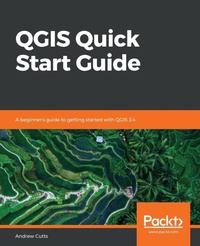
QGIS Quick Start Guide
A beginner's guide to getting started with QGIS 3.4
Published on 31. January 2019
Book
Paperback/Softback
164 pages
978-1-78934-115-7 (ISBN)
Description
Step through loading GIS data, creating GIS data, styling GIS and making maps with QGIS following a simple narrative that will allow you to build confidence as you progress.
Key Features
Work with GIS data, a step by step guide from creation to making a map
Perform geoprocessing tasks and automate them using model builder
Explore a range of features in QGIS 3.4, discover the power behind open source desktop GIS
Book DescriptionQGIS is a user friendly, open source geographic information system (GIS). The popularity of open source GIS and QGIS, in particular, has been growing rapidly over the last few years. This book is designed to help beginners learn about all the tools required to use QGIS 3.4.
This book will provide you with clear, step-by-step instructions to help you apply your GIS knowledge to QGIS. You begin with an overview of QGIS 3.4 and its installation. You will learn how to load existing spatial data and create vector data from scratch. You will then be creating styles and labels for maps. The final two chapters demonstrate the Processing toolbox and include a brief investigation on how to extend QGIS.
Throughout this book, we will be using the GeoPackage format, and we will also discuss how QGIS can support many different types of data.
Finally, you will learn where to get help and how to become engaged with the GIS community.What you will learn
Use existing data to interact with the canvas via zoom/pan/selection
Create vector data and a GeoPackage and build a simple project around it
Style data, both vector and raster data, using the Layer Styling Panel
Design, label, save, and export maps using the data you have created
Analyze spatial queries using the Processing toolbox
Expand QGIS with the help of plugins, model builder, and the command line
Who this book is forIf you know the basic functions and processes of GIS, and want to learn to use QGIS to analyze geospatial data and create rich mapping applications, then this is the book for you.
Key Features
Work with GIS data, a step by step guide from creation to making a map
Perform geoprocessing tasks and automate them using model builder
Explore a range of features in QGIS 3.4, discover the power behind open source desktop GIS
Book DescriptionQGIS is a user friendly, open source geographic information system (GIS). The popularity of open source GIS and QGIS, in particular, has been growing rapidly over the last few years. This book is designed to help beginners learn about all the tools required to use QGIS 3.4.
This book will provide you with clear, step-by-step instructions to help you apply your GIS knowledge to QGIS. You begin with an overview of QGIS 3.4 and its installation. You will learn how to load existing spatial data and create vector data from scratch. You will then be creating styles and labels for maps. The final two chapters demonstrate the Processing toolbox and include a brief investigation on how to extend QGIS.
Throughout this book, we will be using the GeoPackage format, and we will also discuss how QGIS can support many different types of data.
Finally, you will learn where to get help and how to become engaged with the GIS community.What you will learn
Use existing data to interact with the canvas via zoom/pan/selection
Create vector data and a GeoPackage and build a simple project around it
Style data, both vector and raster data, using the Layer Styling Panel
Design, label, save, and export maps using the data you have created
Analyze spatial queries using the Processing toolbox
Expand QGIS with the help of plugins, model builder, and the command line
Who this book is forIf you know the basic functions and processes of GIS, and want to learn to use QGIS to analyze geospatial data and create rich mapping applications, then this is the book for you.
More details
Language
English
Place of publication
Birmingham
United Kingdom
Target group
Professional and scholarly
US School Grade: College Graduate Student
Dimensions
Height: 235 mm
Width: 191 mm
Thickness: 10 mm
Weight
295 gr
ISBN-13
978-1-78934-115-7 (9781789341157)
Copyright in bibliographic data and cover images is held by Nielsen Book Services Limited or by the publishers or by their respective licensors: all rights reserved.
Schweitzer Classification
Other editions
Additional editions
E-Book
09/2024
Packt Publishing
from
€33.89
Available for download
Person
Andrew Cutts holds a geography degree and a masters degree in GIS and has almost 20 years of experience in working with geospatial technology. He currently works as a freelance geospatial consultant. He has worked in local government, large multinational companies, and small and medium-sized enterprises. He has run a geospatial blog for almost 3 years and is a co-host of the #scenefromabove podcast. Andrew has spoken at events worldwide on GIS and Earth observation. He is a keen user of Python, especially for rapid prototyping for geospatial challenges. Currently, he is working with clients to maximize their investment with geospatial technology through direct consulting, training, and technical writing.
Content
Table of Contents
Getting Started with QGIS 3
Loading Data
Creating Data
Styling Data
Creating Maps
Spatial Processing
Expanding QGIS 3
Getting Started with QGIS 3
Loading Data
Creating Data
Styling Data
Creating Maps
Spatial Processing
Expanding QGIS 3