

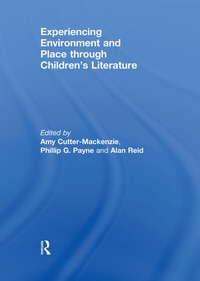
Experiencing Environment and Place through Children's Literature
1st Edition
Published on 9. June 2011
Book
Hardback
232 pages
978-0-415-67286-3 (ISBN)
Description
Recent scholarship on children's literature displays a wide variety of interests in classic and contemporary children's books. While environmental and ecological concerns have led to an interest in 'ecocriticism', as yet there is little on the significance of the ecological imagination and experience to both the authors and readers - young and old - of these texts. This edited collection brings together a set of original international research-based chapters to explore the role of children's literature in learning about environments and places, with a focus on how children's literature may inform and enrich our imagination, experiences and responses to environmental challenges and injustice. Contributions from Australia, Canada, USA and UK explore the diverse ways in which children's literature can provide what are arguably some of the first and possibly most formative engagements that some children might have with 'nature'. Chapters examine classic and new storybooks, mythic tales, and image-based and/or written texts read at home, in school and in the field. Contributors focus on exploring how children's literature mediates and informs our imagination and understandings of diverse environments and places, and how it might open our eyes and lives to other presences, understandings and priorities through stories, their telling and re-telling, and their analysis.
This book was originally published as a special issue of Environmental Education Research.
This book was originally published as a special issue of Environmental Education Research.
More details
Language
English
Place of publication
London
United Kingdom
Publishing group
Taylor & Francis Ltd
Target group
College/higher education
Illustrations
2 s/w Tabellen
2 Tables, black and white
Dimensions
Height: 246 mm
Width: 174 mm
Weight
562 gr
ISBN-13
978-0-415-67286-3 (9780415672863)
Copyright in bibliographic data and cover images is held by Nielsen Book Services Limited or by the publishers or by their respective licensors: all rights reserved.
Schweitzer Classification
Other editions
Additional editions
Amy Cutter-Mackenzie | Phillip Payne | Alan Reid
Experiencing Environment and Place through Children's Literature
Book
08/2014
1st Edition
Routledge
€94.00
Shipment within 15-20 days
Amy Cutter-Mackenzie | Phillip Payne | Alan Reid
Experiencing Environment and Place through Children's Literature
E-Book
06/2014
1st Edition
Routledge
€69.99
Available for download
Amy Cutter-Mackenzie | Phillip Payne | Alan Reid
Experiencing Environment and Place through Children's Literature
E-Book
06/2014
1st Edition
Routledge
€69.99
Available for download
Persons
Amy Cutter-Mackenzie is a Senior Lecturer in the Faculty of Education, Monash University, Australia. Her research interests focus on children's and teachers' thinking and experiences in environmental education in a range of contexts and spaces (including schools, garden spaces, teacher education, higher education, outdoor education, children's literature, research and early years settings). She is the editor of the Australian Journal of Environmental Education.
Phillip Payne joined Monash University, Australia, in early 2006 as the Course Director of Sport and Outdoor Recreation and Research Leader of the Movement, Environment and Community (MEC) group. He is an international editorial board member for Environmental Education Research, Journal of Environmental Education, and Australian Journal of Environmental Education. He has published and presented approximately 100 academic papers.
Alan Reid is a Senior Lecturer in Education and member of the Centre for Research in Education and the Environment, University of Bath, UK. He coordinates doctoral programmes in research methods in education, and teaches on undergraduate and graduate programmes in environmental education, technologies and learning, and research methods. His research interests focus on teachers' thinking and practice in environmental education, and policy-related, methodological and philosophical issues in environmental education theory, research and practice. Recent co-edited publications include Participation and Learning: Perspectives on Education and the environment, health and sustainability (2008) and Researching education and the environment: retrospect and prospect (2008).
Phillip Payne joined Monash University, Australia, in early 2006 as the Course Director of Sport and Outdoor Recreation and Research Leader of the Movement, Environment and Community (MEC) group. He is an international editorial board member for Environmental Education Research, Journal of Environmental Education, and Australian Journal of Environmental Education. He has published and presented approximately 100 academic papers.
Alan Reid is a Senior Lecturer in Education and member of the Centre for Research in Education and the Environment, University of Bath, UK. He coordinates doctoral programmes in research methods in education, and teaches on undergraduate and graduate programmes in environmental education, technologies and learning, and research methods. His research interests focus on teachers' thinking and practice in environmental education, and policy-related, methodological and philosophical issues in environmental education theory, research and practice. Recent co-edited publications include Participation and Learning: Perspectives on Education and the environment, health and sustainability (2008) and Researching education and the environment: retrospect and prospect (2008).
Content
Introduction: Experiencing Environment and Place through Children's Literature Amy Cutter-Mackenzie, Philip Payne, and Alan Reid 1. Through Green Eyes: Complex Visual Culture and Post-Literacy Sidney Dobrin 2. Re-searching and re-storying the complex and complicated relationship of biophilia and bibliophilia Heesoon Bai, Daniela Elza, Peter Kovacs and Serenna Romanycia 3. Remarkable-tracking, experiential education of the ecological imagination Philip Payne 4. Children's literature as a springboard to place-based embodied learning Linda Wason-Ellam 5. The Stories are the people and the land: Three educators respond to environmental teachings in Indigenous children's literature Lisa Korteweg, Ismel Gonzales, and JoJo Guillet 6. What's there, what if, what then and what can we do? An Immersive and Embodied Experience of Environment and Place through Children's Literature Geraldine Burke and Amy Cutter-Mackenzie 7. Exploring instructional strategies to develop prospective elementary teacher children's literature book evaluation skills for science, ecology and environmental education Bill Hug 8. Developing environmental agency and engagement through young people's fiction Jean Webb and Stephen Bigger 9. The Lord of the Rings - a mythos applicable in unsustainable times? Alun Morgan 10. Reading The Lorax, orienting in potentiality Amy Sloane 11. Openings for researching environment and place in children's literature: ecologies, potentials, realities, and challenges Alan Reid, Philip Payne and Amy Cutter-Mackenzie