

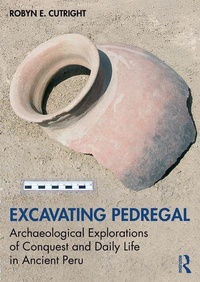
Excavating Pedregal
Archaeological Explorations of Conquest and Daily Life in Ancient Peru
1st Edition
Published on 18. August 2025
Book
Paperback/Softback
192 pages
978-1-032-55457-0 (ISBN)
Description
Excavating Pedregal offers a new synthesis of household-level experiences of imperial conquest on the north coast of Peru, using excavations at the Late Intermediate Period farming community of Pedregal as an engaging case study of archaeological research in action. Alongside this central case study, short essays by other archaeological stakeholders highlight diverse experiences and perspectives within archaeology.
This book draws on the author's 15 years of experience teaching undergraduates and over 20 years as an archaeologist in Peru to offer an accessible account of how archaeological research happens. Chapters introduce key concepts from anthropological archaeology and link research questions to methods, data analysis, and findings. The book balances a discussion of the scientific processes and anthropological theories that ground archaeological research with a tangible account of the lived experiences and practical considerations of doing archaeology. Excavating Pedregal's multivocal approach complements the central case study with vignettes by North American and Latin American archaeologists, students, and community members. These short essays enrich the main themes of the book and introduce readers to different perspectives and voices within the field, highlighting the way collaboration and conversation with multiple stakeholders enhance the study of the past.
Excavating Pedregal is an approachable introduction to how archaeology works for undergraduate students and general readers. It supplements a traditional introductory text by contextualizing research questions, methods, and data in a concrete, contemporary case study while also offering a sense of the diversity of questions, experiences, and methods that exist in archaeology today and satisfying the curiosity of those who wonder what it's like to dig up the past.
This book draws on the author's 15 years of experience teaching undergraduates and over 20 years as an archaeologist in Peru to offer an accessible account of how archaeological research happens. Chapters introduce key concepts from anthropological archaeology and link research questions to methods, data analysis, and findings. The book balances a discussion of the scientific processes and anthropological theories that ground archaeological research with a tangible account of the lived experiences and practical considerations of doing archaeology. Excavating Pedregal's multivocal approach complements the central case study with vignettes by North American and Latin American archaeologists, students, and community members. These short essays enrich the main themes of the book and introduce readers to different perspectives and voices within the field, highlighting the way collaboration and conversation with multiple stakeholders enhance the study of the past.
Excavating Pedregal is an approachable introduction to how archaeology works for undergraduate students and general readers. It supplements a traditional introductory text by contextualizing research questions, methods, and data in a concrete, contemporary case study while also offering a sense of the diversity of questions, experiences, and methods that exist in archaeology today and satisfying the curiosity of those who wonder what it's like to dig up the past.
More details
Language
English
Place of publication
London
United Kingdom
Publishing group
Taylor & Francis Ltd
Target group
General
Illustrations
8 s/w Tabellen, 67 s/w Abbildungen, 67 s/w Photographien bzw. Rasterbilder
8 Tables, black and white; 67 Halftones, black and white; 67 Illustrations, black and white
Dimensions
Height: 173 mm
Width: 246 mm
Thickness: 15 mm
Weight
420 gr
ISBN-13
978-1-032-55457-0 (9781032554570)
Copyright in bibliographic data and cover images is held by Nielsen Book Services Limited or by the publishers or by their respective licensors: all rights reserved.
Schweitzer Classification
Other editions
Additional editions
Robyn E. Cutright
Excavating Pedregal
Archaeological Explorations of Conquest and Daily Life in Ancient Peru
E-Book
08/2025
Routledge
€55.49
Available for download
Robyn E. Cutright
Excavating Pedregal
Archaeological Explorations of Conquest and Daily Life in Ancient Peru
Book
08/2025
1st Edition
Routledge
€215.77
Shipment within 10-20 days
Robyn E. Cutright
Excavating Pedregal
Archaeological Explorations of Conquest and Daily Life in Ancient Peru
E-Book
08/2025
Routledge
€55.49
Available for download
Person
Robyn E. Cutright is W. George Matton Professor of Anthropology and Latin American Studies at Centre College, Danville, Kentucky. Her research focuses on the local experiences of Chimu conquest on the north coast of Peru, using daily culinary practice as a window onto broader regional processes of change. This research has been supported by the Wenner-Gren Foundation for Anthropological Research, the Social Science Research Council, a Fulbright Fellowship, the Curtiss T. and Mary G. Brennan Foundation, and the Rust Family Foundation. She is co-editor of Ancient Households on the North Coast of Peru, and author of The Story of Food in the Human Past: How What We Ate Made Us Who We Are. She is also editor of Nawpa Pacha: The Journal of the Institute of Andean Studies. Cutright received her Ph.D. in Anthropology from the University of Pittsburgh and her B.A. in Anthropology and Spanish from Lawrence University.
Content
Introduction: What Is an Archaeologist and How Did I Become One? 1 What Do Archaeologists Want to Know about the Past? 2 Reasoning like an Archaeologist: Connecting Questions to Evidence 3 Who Cares about Archaeology and Why? Archaeology's Stakeholders 4 How Do You Know Where to Dig? Surveying Regions, Landscapes, and Sites 5 Brushing Dirt Off of Other Dirt: Excavating Archaeological Sites 6 Making Sense of Time, Space, and Artifacts 7 Corn, Fish, and Conquest: Analyzing Plant and Animal Remains 8 Tools of the Trade: Ceramic Pots and Stone Implements as Culinary Technologies9 Reading the Bones: Bioarchaeology of Cuisine, Identity, and Experience under Chimu Rule 10 Conclusions, Conversations, and New Directions