

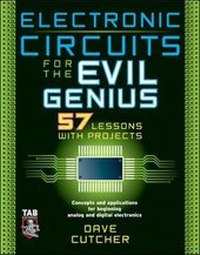
Electronic Circuits for the Evil Genius
Published on 16. January 2005
Book
Paperback/Softback
225 pages
978-0-07-144881-9 (ISBN)
Description
The newest addition to the bestselling "Evil Genius" series, this book gives electronic hobbyists everything they need to master basic circuits and circuit design through 57 easy-to-follow lessons and 5 fun, complete projectsWork from ideas to real and useful prototypes, and have something to show for your learning.Read and build, test and modify - learning depends on observations.Analysis is done by using a digital multi-meter and using your computer as an oscilloscope.
More details
Series
Language
English
Place of publication
New York
United States
Publishing group
McGraw-Hill Education - Europe
Target group
Professional and scholarly
Illustrations
200 Illustrations
Dimensions
Height: 274 mm
Width: 216 mm
Thickness: 10 mm
Weight
482 gr
ISBN-13
978-0-07-144881-9 (9780071448819)
Copyright in bibliographic data and cover images is held by Nielsen Book Services Limited or by the publishers or by their respective licensors: all rights reserved.
Schweitzer Classification
Other editions
New editions
Dave Cutcher
Electronic Circuits for the Evil Genius 2/E
Book
11/2010
2nd Edition
TAB Books Inc
€28.30
Article not available at the moment
Person
McGraw-Hill authors represent the leading experts in their fields and are dedicated to improving the lives, careers, and interests of readers worldwide
Content
FOREWORDPREFACEACKNOWLEDGMENTSPart I: ComponentsSection One: ComponentsSection Two: Resist If You MustSection Three: More Components and SemiconductorsPart II: Introducing Digital ElectronicsSection Four: Digital LogicSection Five: The First NAND Gate CircuitSection Six: Analog Switches for Digital CircuitsSection Seven: The NAND Gate OscillatorSection Eight: Digital Logic DesignSection Nine: Digital Logic ApplicationPart III: Counting Systems in ElectronicsSection Ten: Introducing an Analog-to-Digital ConverterSection Eleven: The 4017 Walking Ring CounterSection Twelve: Running a Seven-Segment DisplaySection Thirteen: Define, Design, and Make Your Own ProjectPart IV: Amplifier Introduced and AppliedSection Fourteen: What Is an Amplifier?Section Fifteen: Exploring the Op AmpSection Sixteen: Applying the Op Amp; Building the IntercomSection Seventeen: Putting It All TogetherINDEX