

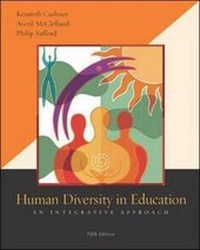
Human Diversity in Education: AND PowerWeb
An Integrative Approach
5th Edition
Published on 29. April 2005
Book
Paperback/Softback
480 pages
978-0-07-312651-7 (ISBN)
Description
This research-based, comprehensive introduction to multicultural education and diversity prepares future teachers for the wide diversity of students they will meet in their classrooms, schools, and communities. Moving beyond the purely cultural approach of many comparable texts, "Human Diversity in Education" addresses the full range of human diversity found in today's schools - including nationality, ethnicity, race, religion, gender, class, language, sexual orientation, and ability levels. Based on the assumption that change begins with the individual teacher, the text argues that prospective teachers must learn to incorporate issues of diversity in all of their work - including in their interactions with children, parents, colleagues, and the community.
More details
Edition
5th Revised edition
Language
English
Place of publication
London
United States
Publishing group
McGraw-Hill Education - Europe
Target group
College/higher education
Edition type
Revised edition
Dimensions
Height: 228 mm
Width: 177 mm
Thickness: 17 mm
Weight
650 gr
ISBN-13
978-0-07-312651-7 (9780073126517)
Copyright in bibliographic data and cover images is held by Nielsen Book Services Limited or by the publishers or by their respective licensors: all rights reserved.
Schweitzer Classification
Other editions
New editions

Kenneth Cushner | Averil McClelland | Philip Safford
Human Diversity in Education: An Integrative Approach
Book
06/2008
6th Edition
McGraw-Hill Humanities/Social Sciences/Languages
€130.93
Article exhausted; check for reprint
Persons
Kenneth Cushner is Associate Dean for Student Life and Intercultural Affairs, and Professor of Education and in the College and Graduate School of Education at Kent State University. He received his doctorate at the University of Hawaii while on scholarship with the Institute of Culture and Communication of the East-West Center. Dr. Cushner is a frequent contributor to the professional development of educators and other professionals through workshops, writing, consulting, and travel programs. Among his publications, he is co-author of Intercultural Interactions: A Practical Guide, 2/e (Sage Publications, 1996); co-editor of Improving Intercultural Interactions, Vol. 2 (Sage Pub, 1997); editor of International Perspectives on Intercultural Education (Lawrence Erlbaum Associates, 1998), and author of Human Diversity in Action (McGraw-Hill, 1999). He has taught in schools or developed educational programs for teachers and youths on all seven continents, and is current Director of COST--The Consortium for Overseas Student Teaching. Averil McClelland is Associate Professor of Cultural Foundations of Education and Director of the Project on the Study of Gender and Education in the College of Education at Kent State University. She received her undergraduate degree in sociology with honors from Hiram College and her M.Ed. and Ph.D. in cultural foundations from Kent State University. The author of several articles on gender and multicultural issues in education, she is author of a sourcebook, The Education of Women in the United States, and a Member Center Director with the National Council for Research on Women. Philip Safford is Professor of Psychology, Case Western Reserve University, and Professor Emeritus, Special Education, Kent State University. His Ph.D. was earned through the combined program in education and psychology of the University of Michigan, with specialization in special education and developmental psychology. Previously, he had been a teacher of emotionally disturbed children and also a coordinator and director of special education in residential treatment programs. He has authored four books, all concerning special education for infants, toddlers, and preschool age children with disabilities, as well as numerous journal articles. He has directed or co-directed a number of training, research, and demonstration projects supported by federal and state grants in special education.
Content
PART I: FOUNDATIONS FOR MULTICULTURAL TEACHINGChapter 1: Education in a Changing SocietyChapter 2: Multicultural Education: Historicaland Theoretical PerspectivesChapter 3: Culture and the Culture-Learning ProcessChapter 4: Classrooms and Schools as Cultural CrossroadsChapter 5: Intercultural Development: Considering the Growth of Self and StudentsPART II: MULTICULTURAL TEACHING IN ACTIONChapter 6: Creating Classrooms that Address Race and EthnicityChapter 7: The Classroom as a Global Community: Nationality and RegionChapter 8: Developing Learning Communities: Language and Learning StyleChapter 9: Religious Pluralism in Secular ClassroomsChapter 10: Developing a Collaborative Classroom: Gender and Sexual OrientationChapter 11: Creating Developmentally Appropriate Classrooms: The Importance of Age and Developmental StatusChapter 12: Creating Inclusive Classrooms: The Ability/Disability Continuum and the Health DimensionChapter 13: The Role of Social Class and Social Status in Teaching and LearningChapter 14: Assessing Progress: The Quest to Improve Schools for All ChildrenGlossaryIndexPhoto Credits