

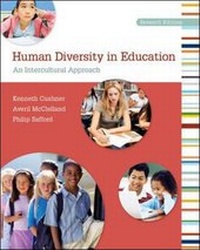
Human Diversity in Education: An Intercultural Approach
7th Edition
Published on 16. March 2011
Book
Paperback/Softback
512 pages
978-0-07-811027-6 (ISBN)
Description
Human Diversity in Education: An Integrative Approach is a research-based, comprehensive text designed to provide an introduction to multicultural education and diversity in society. The text prepares future teachers for the wide diversity of students that they are certain to meet in their classrooms, schools, and communities. It provides an updated and broad treatment of the various forms of human diversity found in today's schools including nationality, ethnicity, race, religion, gender, class, language, sexual orientation, and ability levels. Based on the assumption that it is at the level of the individual teacher where the change that must occur with regard to diversity in schools begins, it assumes that teachers must learn to incorporate issues of diversity in all of their teaching, including, but not limited to their interactions with children, parents, other teachers and the community.
The text contains introductory case studies that are referred back to in a series of chapter-ending critical incidents that prompt students to apply what they learned in the chapter. Important topics covered include: intercultural development of individuals, globalization and international education, religion in society and schools, gender and sexuality, exceptionality, and diversity with respect to early childhood
The text contains introductory case studies that are referred back to in a series of chapter-ending critical incidents that prompt students to apply what they learned in the chapter. Important topics covered include: intercultural development of individuals, globalization and international education, religion in society and schools, gender and sexuality, exceptionality, and diversity with respect to early childhood
More details
Edition
7th edition
Language
English
Place of publication
United States
Publishing group
McGraw-Hill Education - Europe
Dimensions
Height: 262 mm
Width: 196 mm
Thickness: 20 mm
Weight
891 gr
ISBN-13
978-0-07-811027-6 (9780078110276)
Copyright in bibliographic data and cover images is held by Nielsen Book Services Limited or by the publishers or by their respective licensors: all rights reserved.
Schweitzer Classification
Other editions
Previous edition

Kenneth Cushner | Averil McClelland | Philip Safford
Human Diversity in Education: An Integrative Approach
Book
06/2008
6th Edition
McGraw-Hill Humanities/Social Sciences/Languages
€130.93
Article exhausted; check for reprint
Persons
Kenneth Cushner is Professor of Education in the College and Graduate School of Education, Health and Human Services at Kent State University, Kent, Ohio, USA. In addition to this text, Dr. Cushner is author or editor of several books and articles in the field of intercultural education and training, including: Intercultural Student Teaching: A Bridge to Global Competence, (2007, Rowman Littlefield); Human Diversity in Action: Developing Multicultural Competencies in the Classroom, 3rd edition (2006, McGraw-Hill); International Perspectives on Intercultural Education (1998, Lawrence Erlbaum Associates); Improving Intercultural Interactions: Modules for Cross-Cultural Training Programs, volume 2 (with Richard Brislin, Sage Publications, 1997), and Intercultural Interactions: A Practical Guide, 2nd edition (with Richard Brislin, Sage Publications, 1996). A former East-West Center Scholar, he is a frequent contributor to the professional development of educators through writing, workshop presentations, and travel program development. He is a Founding Fellow and Past-President of the International Academy for Intercultural Research, and past Director of COSTthe Consortium for Overseas Student Teaching, which regularly sends students to student teach in 16 countries. In his spare time, Dr. Cushner enjoys music (percussion and guitar), photography, and travel. He has developed and led intercultural programs on all seven continents.
Averil McClelland is currently Associate Professor and Coordinator of the Cultural Foundations of Education program in the College and Graduate School at Kent State University from which she received her Ph.D. Dr. McClelland has had extensive experience in curriculum design and program evaluation, as well as experience with addressing issues of gender and education and cultural diversity in education. In addition to this text, she is the author of The Education of Women in the United States: A Guide to Theory, Teaching, and Research (Garland, 1992), as well as a number of articles in scholarly journals. She received the Distinguished Teaching award from Kent State University in 1996, and has a long-standing relationship with the National First Ladies Library, where she develops web-based curricula based on the lives of the nations 44 First Ladies. Her special interests are the history, sociology, and politics of education, the reconstruction of teacher education, and internationalizing the college curriculum for pre-service and practicing teachers.
Philip Safford, Adjunct Professor of Psychology at Case Western Reserve University, is Emeritus Professor and former chair of Special Education at Kent State University. Prior to earning his Ph.D. through the Combined Program in Education and Psychology at the University of Michigan, with specialization in special education and child development, he had been a teacher and administrator in residential treatment programs for children with emotional disorders. Dr. Safford has authored or edited six books and numerous articles dealing with special education history, early intervention for young children with disabilities, and related topics. He has directed or co-directed a number of training, research, and demonstration projects in special education supported by federal and state grants.
Averil McClelland is currently Associate Professor and Coordinator of the Cultural Foundations of Education program in the College and Graduate School at Kent State University from which she received her Ph.D. Dr. McClelland has had extensive experience in curriculum design and program evaluation, as well as experience with addressing issues of gender and education and cultural diversity in education. In addition to this text, she is the author of The Education of Women in the United States: A Guide to Theory, Teaching, and Research (Garland, 1992), as well as a number of articles in scholarly journals. She received the Distinguished Teaching award from Kent State University in 1996, and has a long-standing relationship with the National First Ladies Library, where she develops web-based curricula based on the lives of the nations 44 First Ladies. Her special interests are the history, sociology, and politics of education, the reconstruction of teacher education, and internationalizing the college curriculum for pre-service and practicing teachers.
Philip Safford, Adjunct Professor of Psychology at Case Western Reserve University, is Emeritus Professor and former chair of Special Education at Kent State University. Prior to earning his Ph.D. through the Combined Program in Education and Psychology at the University of Michigan, with specialization in special education and child development, he had been a teacher and administrator in residential treatment programs for children with emotional disorders. Dr. Safford has authored or edited six books and numerous articles dealing with special education history, early intervention for young children with disabilities, and related topics. He has directed or co-directed a number of training, research, and demonstration projects in special education supported by federal and state grants.
Content
PrefacePART I: FOUNDATIONS FOR MULTICULTURAL TEACHINGChapter 1:Education in a Changing SocietyChapter 2: Multicultural Education: Historical and Theoretical PerspectivesChapter 3:Culture and the Culture-Learning ProcessChapter 4:Classrooms and Schools as Cultural CrossroadsChapter 5:Intercultural Development: Considering the Growth of Self and OthersPART II: MULTICULTURAL TEACHING IN ACTIONChapter 6:Creating Classrooms that Address Race and EthnicityChapter 7:The Classroom as a Global Community: Nationality and RegionChapter 8:Developing Learning Communities: Language and Learning StyleChapter 9:Religious Pluralism in Secular ClassroomsChapter 10:Developing a Collaborative Classroom: Gender and Sexual OrientationChapter 11:Creating Developmentally Appropriate Classrooms: The Importance of Age and Developmental StatusChapter 12:Creating Inclusive Classrooms: The Ability/Disability Continuum and the Health DimensionChapter 13:Improving Schools for All Children: The Role of Social Class and Social Status in Teaching and LearningGlossaryCreditsName IndexSubject Index