

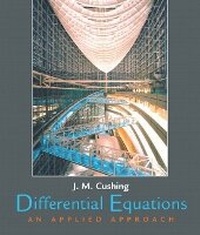
Differential Equations
An Applied Approach
Published on 5. February 2004
Book
Hardback
498 pages
978-0-13-044930-6 (ISBN)
Description
For introductory courses in differential equations.
This modern introduction to differential equations covers traditional subjects, as well as modern topics such as fundamentals of dynamical systems theory and bifurcation theory. The volume emphasizes analyzing solutions rather than finding solution formulas, introduces numerical methods early in the text, and provides case studies for each subject area. Many applications are quite lengthy and detailed, and accompanied with real data and are drawn from many disciplines including many from biological subjects.
This modern introduction to differential equations covers traditional subjects, as well as modern topics such as fundamentals of dynamical systems theory and bifurcation theory. The volume emphasizes analyzing solutions rather than finding solution formulas, introduces numerical methods early in the text, and provides case studies for each subject area. Many applications are quite lengthy and detailed, and accompanied with real data and are drawn from many disciplines including many from biological subjects.
More details
Language
English
Place of publication
United States
Publishing group
Pearson Education (US)
Target group
Professional and scholarly
Dimensions
Height: 241 mm
Width: 208 mm
Thickness: 25 mm
Weight
1068 gr
ISBN-13
978-0-13-044930-6 (9780130449306)
Copyright in bibliographic data and cover images is held by Nielsen Book Services Limited or by the publishers or by their respective licensors: all rights reserved.
Schweitzer Classification
Content
(NOTE: Each chapter concludes with Chapter Summary & Exercises and Applications.)
1. First Order Equations.
The Fundamental Existence Theorem. Approximation of Solutions. Another Numerical Algorithm.
2. Linear First Order Equations.
The Solution of Linear Equations. Properties of Solutions. The Method of Undetermined Coefficients. Autonomous Linear Equations.
3. Nonlinear First Order Equations.
Autonomous Equations. Separable Equations. Change of Variables. Approximation Formulas.
4. Systems and Higher Order Equations.
Systems and Higher Order Equations. Approximating Solutions of Systems. Linear Systems of Equations.
5. Homogeneous Linear Systems and Higher Order Equations.
Introduction. Solving Homogeneous Systems. Homogeneous Second Order Equations. Phase Plane Portraits. Matrices and Eigenvalues. Higher Order Systems.
6. Nonhomogeneous Linear Systems.
Introduction. The Method of Undetermined Coefficients. The Variation of Constants Formula. Matrix Notation.
7. Approximations and Series Solutions.
Taylor Polynomials and Picard Iterates. A Perturbation Method. Power Series Solutions.
8. Nonlinear Systems.
Introduction. Equilibria. The Linearization Principle. Local Phase: Plane Portraits. Global Phase Plane Portraits. Bifurcations. Higher Dimensional Systems.
9. Laplace Transforms.
Introduction. The Laplace Transform. Linearity and the Inverse Laplace Transform. Properties of the Laplace Transform. Solution of Initial Value Problems.
10. Answers to Selected Exercises.
1. First Order Equations.
The Fundamental Existence Theorem. Approximation of Solutions. Another Numerical Algorithm.
2. Linear First Order Equations.
The Solution of Linear Equations. Properties of Solutions. The Method of Undetermined Coefficients. Autonomous Linear Equations.
3. Nonlinear First Order Equations.
Autonomous Equations. Separable Equations. Change of Variables. Approximation Formulas.
4. Systems and Higher Order Equations.
Systems and Higher Order Equations. Approximating Solutions of Systems. Linear Systems of Equations.
5. Homogeneous Linear Systems and Higher Order Equations.
Introduction. Solving Homogeneous Systems. Homogeneous Second Order Equations. Phase Plane Portraits. Matrices and Eigenvalues. Higher Order Systems.
6. Nonhomogeneous Linear Systems.
Introduction. The Method of Undetermined Coefficients. The Variation of Constants Formula. Matrix Notation.
7. Approximations and Series Solutions.
Taylor Polynomials and Picard Iterates. A Perturbation Method. Power Series Solutions.
8. Nonlinear Systems.
Introduction. Equilibria. The Linearization Principle. Local Phase: Plane Portraits. Global Phase Plane Portraits. Bifurcations. Higher Dimensional Systems.
9. Laplace Transforms.
Introduction. The Laplace Transform. Linearity and the Inverse Laplace Transform. Properties of the Laplace Transform. Solution of Initial Value Problems.
10. Answers to Selected Exercises.