

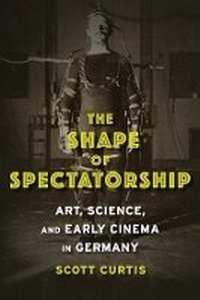
The Shape of Spectatorship
Art, Science, and Early Cinema in Germany
Published on 22. September 2015
Book
Hardback
400 pages
978-0-231-13402-6 (ISBN)
Description
Scott Curtis draws our eye to the role of scientific, medical, educational, and aesthetic observation in shaping modern spectatorship. Focusing on the nontheatrical use of motion picture technology in Germany between the 1890s and World War I, he follows researchers, teachers, and intellectuals as they negotiated the fascinating, at times fraught relationship between technology, discipline, and expert vision. As these specialists struggled to come to terms with motion pictures, they advanced new ideas of mass spectatorship that continue to affect the way we make and experience film. Staging a brilliant collision between the moving image and scientific or medical observation, visual instruction, and aesthetic contemplation, The Shape of Spectatorship showcases early cinema's revolutionary impact on society and culture and the challenges the new medium placed on ways of seeing and learning.
Reviews / Votes
I was invigorated and intrigued by the scholarly rigor, historical acumen, and interdisciplinary incentive of Scott Curtis's book. It brings significant inflections to our understanding of the multiple determinations of early German cinema as well as more generally to the complex relations between film and science. -- Eric Rentschler, Harvard University, author of The Use and Abuse of Cinema This important, historiographically innovative book examines a wide range of materials from the fields of aesthetics, education, medicine, and science-and Curtis knows how to read early film-theoretical texts like poetry. An original contribution to media archaeology, Curtis's research illuminates new sources in the debates about the promise and possible uses of cinema in Germany and beyond. -- Tony Kaes, University of California, Berkeley and author of Shell Shock Cinema: Weimar Culture and the Wounds of War Scott Curtis has produced a fascinating study of the uses of cinema within medicine, science, and education in Germany in the early twentieth century. An exhaustive archival dig into cinema's uses by experts, The Shape of Spectatorship will itself shape conversations about cinema's usefulness as a way of observing and changing the world. -- Alison Griffiths, author of Shivers Down Your Spine: Cinema, Museums, and the Immersive ViewMore details
Series
Language
English
Place of publication
New York
United States
Target group
College/higher education
Product notice
Trade binding
Illustrations
32 b&w illustrations
Dimensions
Height: 229 mm
Width: 152 mm
Weight
638 gr
ISBN-13
978-0-231-13402-6 (9780231134026)
Copyright in bibliographic data and cover images is held by Nielsen Book Services Limited or by the publishers or by their respective licensors: all rights reserved.
Schweitzer Classification
Other editions
Additional editions
E-Book
10/2015
1st Edition
Columbia University Press
from
€32.95
Available for download
Book
09/2015
Columbia University Press
€37.14
Article not available at the moment
Person
Scott Curtis is associate professor in the Department of Radio/Television/Film at Northwestern University, director of the Communication Program at Northwestern University in Qatar, and president of Domitor, the international society for the study of early cinema.
Content
List of Illustrations Acknowledgments Introduction 1. Science's Cinematic Method: Motion Pictures and Scientific Research 2. Between Observation and Spectatorship: Medicine, Movies, and Mass Culture 3. The Taste of a Nation: Educating the Senses and Sensibilities of Film Spectators 4. The Problem with Passivity: Aesthetic Contemplation and Film Spectatorship Conclusion: Toward a Tactile Historiography Notes Bibliography Index