

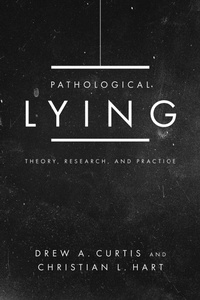
Pathological Lying
Theory, Research, and Practice
Will be published approx. on 22. November 2022
Book
Paperback/Softback
260 pages
978-1-4338-3622-0 (ISBN)
Description
This book analyzes the science behind pathological lying and offers important lessons for research and clinical practice.
Curtis and Hart expertly synthesize and unify historical and contemporary writings and research on pathological lying, into a functional and cohesive resource for researchers and clinicians. By offering a succinct, theory-driven, and empirically corroborated account of this disorder, the authors aim to provide clinicians with the tools they need to more accurately identify and effectively treat patients.
For a hundred years, research on pathological lying has been fragmented and diffuse as a result, the disorder has been called by different names and characterized in innumerable ways, with no formal definition or diagnosis. Recently, there has been a re-emergence of research examining pathological lying, which has helped establish research markers, categorical distinctions, assessment profiles, and clinical parameters.
Curtis and Hart expertly synthesize and unify historical and contemporary writings and research on pathological lying, into a functional and cohesive resource for researchers and clinicians. By offering a succinct, theory-driven, and empirically corroborated account of this disorder, the authors aim to provide clinicians with the tools they need to more accurately identify and effectively treat patients.
For a hundred years, research on pathological lying has been fragmented and diffuse as a result, the disorder has been called by different names and characterized in innumerable ways, with no formal definition or diagnosis. Recently, there has been a re-emergence of research examining pathological lying, which has helped establish research markers, categorical distinctions, assessment profiles, and clinical parameters.
More details
Language
English
Place of publication
Washington DC
United States
Target group
Professional and scholarly
Product notice
Paperback (trade)
Dimensions
Height: 229 mm
Width: 155 mm
Thickness: 14 mm
Weight
381 gr
ISBN-13
978-1-4338-3622-0 (9781433836220)
Copyright in bibliographic data and cover images is held by Nielsen Book Services Limited or by the publishers or by their respective licensors: all rights reserved.
Schweitzer Classification
Persons
Drew A. Curtis, PhD is a Texas licensed psychologist, Rodgers Distinguished Faculty, and the Director of the Psy.D. and M.S. Counseling Psychology programs at Angelo State University (ASU). His research has specifically focused on pathological lying and deception: in the context of therapy, within healthcare professions, intimate relationships, and parental relationships. He has published an abnormal psychology textbook, a book about psychopathology, several papers on deception, and received various research grants and awards for his research. He is also co-author for another book with Dr. Hart, titled Big Liars: What Psychological Science Tells Us About Lying, and How You Can Avoid Being Duped. Follow Dr.Curtis Dr_CurtisPhD.
Christian L. Hart, PhD, is a Professor of Psychology and Director of the Psychological Science graduate program at Texas Woman amp rsquo s University. He holds an MS and PhD in Experimental Psychology and has been a professor for almost 2 years. He teaches courses in deception and forensic psychology and conducts research primarily on lying and deception. He is also the former President and current Executive Director of the Southwestern Psychological Association. Prior to becoming a professor, Dr. Hart held the rank of Lieutenant Commander in the U. S. Navy, where he served as an Aerospace Experimental Psychologist and taught at the Navy Test Pilot School. He is a coauthor of the forthcoming book, Big Liars: What Psychological Science Tells Us About Lying, and How You Can Avoid Being Duped.
Christian L. Hart, PhD, is a Professor of Psychology and Director of the Psychological Science graduate program at Texas Woman amp rsquo s University. He holds an MS and PhD in Experimental Psychology and has been a professor for almost 2 years. He teaches courses in deception and forensic psychology and conducts research primarily on lying and deception. He is also the former President and current Executive Director of the Southwestern Psychological Association. Prior to becoming a professor, Dr. Hart held the rank of Lieutenant Commander in the U. S. Navy, where he served as an Aerospace Experimental Psychologist and taught at the Navy Test Pilot School. He is a coauthor of the forthcoming book, Big Liars: What Psychological Science Tells Us About Lying, and How You Can Avoid Being Duped.
Content
Preface
Acknowledgments
Chapter . Pathological Lying: An Overview
Chapter 2. Normative Aspects of Lying
Chapter 3. Characteristics of People Who Lie a Lot
Chapter 4. Case Studies of Pathological Liars
Chapter 5. Pathological Aspects of Lying
Chapter . Pathological Lying on the Couch
Chapter 7. Assessment
Chapter 8. Diagnosis
Chapter 9. Treatment, Clinical Applications, and the Future
Appendix A: Survey of Pathological Lying (SPL) From Curtis and Hart (2 2 b)
Appendix B: Pathological Lying Inventory From Hart, Curtis, and Randell (2 22)
Appendix C: Therapists' Diagnosis
Appendix D: Therapists' Suggested Treatments
References
Index
About the Authors
Acknowledgments
Chapter . Pathological Lying: An Overview
Chapter 2. Normative Aspects of Lying
Chapter 3. Characteristics of People Who Lie a Lot
Chapter 4. Case Studies of Pathological Liars
Chapter 5. Pathological Aspects of Lying
Chapter . Pathological Lying on the Couch
Chapter 7. Assessment
Chapter 8. Diagnosis
Chapter 9. Treatment, Clinical Applications, and the Future
Appendix A: Survey of Pathological Lying (SPL) From Curtis and Hart (2 2 b)
Appendix B: Pathological Lying Inventory From Hart, Curtis, and Randell (2 22)
Appendix C: Therapists' Diagnosis
Appendix D: Therapists' Suggested Treatments
References
Index
About the Authors