

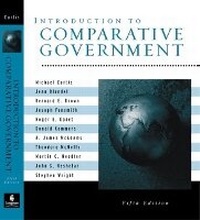
Introduction to Comparative Government
5th Edition
Published on 16. April 2003
Book
Paperback/Softback
640 pages
978-0-321-10478-6 (ISBN)
Description
With an accessible, descriptive approach and an easy-to-use, three-part structure within each chapter-political development, process and institutions, and policy-this is a flexible text that is about 25% less expensive than similar texts.
Instead of focusing on one perspective to the exclusion of others, Introduction to Comparative Government exposes students to multiple approaches. For example, Chapter 1 proposes a number of alternative classifications of political systems and a general context that allows the systems to be compared in different ways. Instructors and students can choose the comparative approach that they think is most helpful for understanding the whole or parts of political systems. In addition to offering a flexible and inclusive theoretical approach, Introduction to Comparative Government offers nine country study chapters and two region study chapters, each written by a specialist in that area. Each country study chapter has been thoroughly updated, and a new chapter on the Middle East (Ch. 9) has been added to help students better understand the tragedy of September 11, 2001 and its aftermath.
Instead of focusing on one perspective to the exclusion of others, Introduction to Comparative Government exposes students to multiple approaches. For example, Chapter 1 proposes a number of alternative classifications of political systems and a general context that allows the systems to be compared in different ways. Instructors and students can choose the comparative approach that they think is most helpful for understanding the whole or parts of political systems. In addition to offering a flexible and inclusive theoretical approach, Introduction to Comparative Government offers nine country study chapters and two region study chapters, each written by a specialist in that area. Each country study chapter has been thoroughly updated, and a new chapter on the Middle East (Ch. 9) has been added to help students better understand the tragedy of September 11, 2001 and its aftermath.
More details
Edition
5th edition
Language
English
Place of publication
United States
Publishing group
Pearson Education (US)
Target group
Professional and scholarly
Dimensions
Height: 235 mm
Width: 189 mm
Thickness: 28 mm
Weight
1153 gr
ISBN-13
978-0-321-10478-6 (9780321104786)
Copyright in bibliographic data and cover images is held by Nielsen Book Services Limited or by the publishers or by their respective licensors: all rights reserved.
Schweitzer Classification
Other editions
New editions
Michael Curtis | Martin C. Needler | Roger E. Kanet
Introduction to Comparative Government, Update Edition
Book
08/2005
5th Edition
Pearson
Unfortunately, price unknown
No shipping information available
Previous edition

Michael Curtis
Introduction to Comparative Government
Book
10/1998
4th Edition
Pearson
€74.27
Article exhausted; check for reprint
Content
1. Introduction: Why Study Comparative Politics and Government?
I. INDUSTRIAL DEMOCRACIES.
2. The Government of Great Britain.
3. The Government of France.
4. The Government of Germany.
5. The Government of Japan.
6. The European Union.
II. COMMUNIST AND POST-COMMUNIST SYSTEMS.
7. The Government of the Russian Federation.
8. The Government of China.
III. THE DEVELOPING AND THIRD WORLD COUNTRIES.
9. The Governments of the Middle East.
10. The Government of India.
11. The Government of Mexico.
12. The Government of Nigeria.
13. Conclusion.
I. INDUSTRIAL DEMOCRACIES.
2. The Government of Great Britain.
3. The Government of France.
4. The Government of Germany.
5. The Government of Japan.
6. The European Union.
II. COMMUNIST AND POST-COMMUNIST SYSTEMS.
7. The Government of the Russian Federation.
8. The Government of China.
III. THE DEVELOPING AND THIRD WORLD COUNTRIES.
9. The Governments of the Middle East.
10. The Government of India.
11. The Government of Mexico.
12. The Government of Nigeria.
13. Conclusion.