

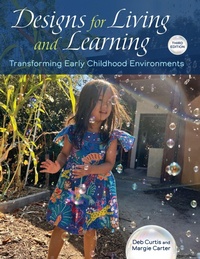
Designs for Living and Learning, Third
Description
For more than two decades Designs for Living and Learning has been a favorite resource among educators, caregivers, consultants, and college instructors, filled with practical ideas to design captivating environments that nurture children, families, and staff while supporting children’s learning. If you wonder how to hold on to your dreams for creating beautiful, engaging early childhood environments even while facing an array of challenges, this book offers a way to think about your choices and a multitude of examples from educators in a variety of settings.
This updated edition adds inspiring new photos and stories from the authors with contributions from a wide range of imaginative, determined educators in programs moving forward with their dreams as they negotiate uncertainty, stress, a regulatory move toward diminishing possibilities.
These pages are filled with stirring words and visual examples of creativity and the wonder of childhood. At the same time the authors take up the hard questions of how to think about our work in the context of climate imperatives, fear, divisiveness, loss and displacement in our communities. As you digest this book, you’ll find yourself nourished and your imagination itching to move into action.
More details
Persons
Deb Curtis has spent many years observing and studying children in early childhood programs throughout North America. Her daily experiences as a child care teacher have led her to a deep respect for children’s competencies and a strong commitment to work on their behalf. Deb is dedicated to learning meaningful anti-bias, anti-racist teaching practices, building on young children’s natural dispositions for empathy, compassion, and fairness to help create a kinder, more equitable world. She holds an MA in human development from Pacific Oaks College and has worked as an infant/toddler caregiver, preschool and school age child care teacher, CDA trainer, Head Start education coordinator, college instructor, and assistant director of a child care program. She is the coauthor of numerous professional learning books with Margie Carter, including The Visionary Director, Training Teachers, The Art of Awareness, Reflecting Children’s Lives, Learning Together with Young Children, and Reflecting in Communities of Practice, and the author of Really Seeing Children.
Margie Carter's decades of work in the early childhood field includes teaching in the primary grades, directing child care centers, serving as adjunct faculty in college settings, speaking and consulting throughout North America, Australia and New Zealand. The pedagogical practices she promotes have deep roots in the study of John Dewey, Paulo Freire, and bell hooks, who promote educational philosophies and practices that serve the goals of a vibrant democracy. With social justice as a lens, Margie speaks to the importance of play as an equity issue, cultural and linguistic democracy, creating environments and organizational cultures that nurture belonging, critical thinking, and active imaginations. She has worked as a preschool, kindergarten and primary school teacher, curriculum developer, High/Scope trainer, child care director, and college instructor. She received her B.S. in Education from Northwestern University and her M.A. in Human Development and Leadership from Pacific Oaks College. Margie is the coauthor of numerous professional learning books with Deb Curtis, including The Visionary Director, Training Teachers, The Art of Awareness, Reflecting Children’s Lives, Learning Together with Young Children, and Reflecting in Communities of Practice.
Content
Introduction
Chapter 1 Lay a Foundation for Living and Learning
Chapter 2 Think Beyond a Traditional Classroom
Chapter 3 Create Connections, a Sense of Place and Belonging
Chapter 4 Keep Space Flexible and Materials Open Ended
Chapter 5 Design Natural Environments That Engage Our Senses
Chapter 6 Provoke Wonder, Curiosity, and Intellectual Challenge
Chapter 7 Engage Children in Symbolic Representations, Literacy, and the Visual Arts
Chapter 8 Enhance Children’s Use of the Environment
Chapter 9 Launch the Process of Transforming an Environment
Chapter 10 Face Barriers and Negotiate Quality Standards
Chapter 11 Seek Children’s Ideas About Environments
Afterword
References
Appendix