

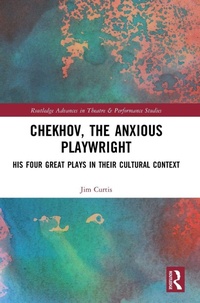
Chekhov, The Anxious Playwright
His Four Great Plays in Their Cultural Context
1st Edition
Published on 29. April 2026
Book
Hardback
162 pages
978-1-032-58110-1 (ISBN)
Description
This book provides an in-depth analysis of Anton Chekhov's four great plays within their cultural context: The Seagull, Uncle Vanya, The Three Sisters, and The Cherry Orchard.
The author explores how Chekhov's historical situation as a non-aristocratic writer gave him an intense awareness of his relationship to the past. Chekhov had a very literary imagination and thus an essential feature of his work is the way he used intertextuality to incorporate and react to the work of his predecessors. Chekhov's plays therefore lend themselves to analysis that uses Harold Bloom's theory of the anxiety of influence. Applying these principles make it possible to give coherence to Chekhov's. The anxiety of influence was a pervasive factor in Chekhov's evolution, and explains why Chekhov used intertextuality more frequently, and to greater effect, than any of his contemporaries. Close study of Chekhov's four great plays shows that they have a hitherto unrecognized stylistic alternation. 'Chekhov the Anxious Playwright' makes extensive use of recent Russian scholarship (including dissertations) on Chekhov and synthesizes it with Western scholarship to produce a general understanding of his plays in their cultural context. It will be the first major book that brings together both a wide range of scholarship and as well as literary theory to analyze Chekhov's plays.
This book will be of great interest to students and scholars in theatre history and Russian literature.
The author explores how Chekhov's historical situation as a non-aristocratic writer gave him an intense awareness of his relationship to the past. Chekhov had a very literary imagination and thus an essential feature of his work is the way he used intertextuality to incorporate and react to the work of his predecessors. Chekhov's plays therefore lend themselves to analysis that uses Harold Bloom's theory of the anxiety of influence. Applying these principles make it possible to give coherence to Chekhov's. The anxiety of influence was a pervasive factor in Chekhov's evolution, and explains why Chekhov used intertextuality more frequently, and to greater effect, than any of his contemporaries. Close study of Chekhov's four great plays shows that they have a hitherto unrecognized stylistic alternation. 'Chekhov the Anxious Playwright' makes extensive use of recent Russian scholarship (including dissertations) on Chekhov and synthesizes it with Western scholarship to produce a general understanding of his plays in their cultural context. It will be the first major book that brings together both a wide range of scholarship and as well as literary theory to analyze Chekhov's plays.
This book will be of great interest to students and scholars in theatre history and Russian literature.
More details
Series
Language
English
Place of publication
London
United Kingdom
Publishing group
Taylor & Francis Ltd
Target group
College/higher education
Academic
Product notice
sewn/stitched
Cloth over boards
Illustrations
11 s/w Abbildungen, 11 s/w Photographien bzw. Rasterbilder, 3 s/w Tabellen
3 Tables, black and white; 11 Halftones, black and white; 11 Illustrations, black and white
Dimensions
Height: 244 mm
Width: 170 mm
Thickness: 11 mm
Weight
481 gr
ISBN-13
978-1-032-58110-1 (9781032581101)
Copyright in bibliographic data and cover images is held by Nielsen Book Services Limited or by the publishers or by their respective licensors: all rights reserved.
Schweitzer Classification
Other editions
Additional editions

E-Book
04/2026
1st Edition
Routledge
€60.49
Available for download

E-Book
04/2026
1st Edition
Routledge
€60.49
Available for download
Person
Jim Curtis is Professor Emeritus of Russian Literature. He received his PhD from Columbia University and was professor of Russian literature at the University of Missouri-Columbia for 31 years.
Content
Preface
Part I. General Considerations
Chapter 1. Individuation and Ideas in Two Jewish Critics: Yury Tynyanov and Harold Bloom
Part II. Chekhov's Evolution
Chapter 2. Chekhov in the 1870s: Initial Encounters with Authority Figures
Chapter 3. Chekhov in the 1880s: The Eventful Decade
Chapter 4. Chekhov's Maturation in the Age of Impressionism
Part III. Chekhov's Plays
Chapter 5. The Unity of Chekhov's four Great Plays
Chapter 6. Ephebes and Precursors in The Seagull
Chapter 7. Uncle Vanya, the Anti-Seagull
Chapter 8. The Three Sisters, a Unique Chekhov Play
Chapter 9. The Cherry Orchard, an Innovative Swan Song
Conclusion
Bibliography
Index
Part I. General Considerations
Chapter 1. Individuation and Ideas in Two Jewish Critics: Yury Tynyanov and Harold Bloom
Part II. Chekhov's Evolution
Chapter 2. Chekhov in the 1870s: Initial Encounters with Authority Figures
Chapter 3. Chekhov in the 1880s: The Eventful Decade
Chapter 4. Chekhov's Maturation in the Age of Impressionism
Part III. Chekhov's Plays
Chapter 5. The Unity of Chekhov's four Great Plays
Chapter 6. Ephebes and Precursors in The Seagull
Chapter 7. Uncle Vanya, the Anti-Seagull
Chapter 8. The Three Sisters, a Unique Chekhov Play
Chapter 9. The Cherry Orchard, an Innovative Swan Song
Conclusion
Bibliography
Index