

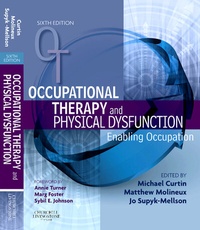
Occupational Therapy and Physical Dysfunction
Enabling Occupation
6th Edition
Published on 19. October 2009
Book
Paperback/Softback
672 pages
978-0-08-045084-1 (ISBN)
Description
The sixth edition of this classic book remains a key text for occupational therapists, supporting their practice in working with people with physical impairments, stimulating reflection on the knowledge, skills and attitudes which inform practice, and encouraging the development of occupation-focused practice. Within this book, the editors have addressed the call by leaders within the profession to ensure that an occupational perspective shapes the skills and strategies used within occupational therapy practice. Rather than focusing on discrete diagnostic categories the book presents a range of strategies that, with the use of professional reasoning, can be transferred across practice settings. This edition heralds a new era in which an international editorial team has coordinated the great work of the retiring founding editors, Annie Turner, Marg Foster and Sybil Johnson. The new editors have radically updated the book, in response to the numerous internal and external influences on the profession, illustrating how an occupational perspective underpins occupational therapy practice.
A global outlook is intrinsic to this edition of the book, as demonstrated by the large number of contributors recruited from across the world.
A global outlook is intrinsic to this edition of the book, as demonstrated by the large number of contributors recruited from across the world.
More details
Series
Edition
6th Revised edition
Language
English
Place of publication
London
United Kingdom
Publishing group
Elsevier Health Sciences
Target group
College/higher education
Professional and scholarly
Occupational therapists
Edition type
Revised edition
Illustrations
illustrations
Dimensions
Height: 189 mm
Width: 246 mm
ISBN-13
978-0-08-045084-1 (9780080450841)
Copyright in bibliographic data and cover images is held by Nielsen Book Services Limited or by the publishers or by their respective licensors: all rights reserved.
Schweitzer Classification
Other editions
New editions
Michael Curtin | Mary Egan | Jo Adams
Occupational Therapy for People Experiencing Illness, Injury or Impairment
Promoting occupation and participation
Book
02/2017
7th Edition
Elsevier
€85.60
Article exhausted; check for reprint
Additional editions
MPhil Curtin EdD | MSc Molineux BOccThy | DipCOT Webb (formerly Supyk/Mellson) MSc
Occupational Therapy and Physical Dysfunction E-Book
Occupational Therapy and Physical Dysfunction E-Book
E-Book
10/2009
6th Edition
Churchill Livingstone
€52.49
Available for download
Previous edition

Annie Turner | Margaret Ann Foster | Sybil E. Johnson
Occupational Therapy and Physical Dysfunction
Principles, Skills and Practice
Book
09/2001
5th Edition
Churchill Livingstone
€64.36
Article exhausted; check for reprint
Persons
Content
List of Contributors Foreword (Annie Turner, Marg Foster, Sybil Johnson) Preface Section 1: Occupation and occupational therapy in context Chapter 1 - Defining occupational therapy (Clare Wilding) Chapter 2 - The nature of occupation (Matthew Molineux) Chapter 3 - Occupational therapy: a disability persepective (John Swain and Sally French) Chapter 4 - Contesting assumptions in occupational therapy practice (Karen Whalley Hammell) Section 2: An overview of occupational therapy practice Chapter 5 - Occupational reasoning (Joan Rogers) Chapter 6 - Understanding models of practice (Jo Supyk and Jacqui McKenna) Chapter 7 - Process of assessment and evaluation (Clare Hocking) Chapter 8 - Writing occupation focussed goals (Julia Bowman and Lise Mogensen) Chapter 9 - Enabling skills and strategies (Michael Curtin) Section 3: Essential foundations for occupational therapy Chapter 10 - Person-centred practice (Thelma Sumsion) Chapter 11 - Occupation in context (Gail Whiteford) Chapter 12 - Enabling communication in a person-centred, occupation-focussed context (Sue Baptiste) Chapter 13 - Analysis of occupations (Gill Chard) Chapter 14 - Psychosocial support (Jacqui McKenna) Chapter 15 - Advocating and lobbying (Valmae Rose, Kevin Cocks and Lesley Chenowich) Chapter 16 - Educational strategies (Tammy Hoffman) Chapter 17 - Health promotion and occupational therapy (Rachael Dixey) Chapter 18 - Working with groups (Claire Craig and Linda Finlay) Section 4: Working with and within communities Chapter 19 - Community development (Nick Pollard, Dikaios Sakellariou and Frank Kronenberg) Chapter 20 - Developing partnerships to privilege participation (Roshan Galvann, Peliwe Mdlokolo and Robin Joubert) Chapter 21 - Working towards inclusive communities (Hanneke van Bruggen) Chapter 22 - Community based rehabilitation: opportunities for occupational therapists in an evolving strategy ((Kirsty Thompson, Christina Parasyn and Beth Fuller) Chapter 23 - Entrepreneurial opportunities in the global community (Marilyn Pattison) Section 5: Working with the individual Chapter 24 - Enabling engagement in self care occupations (Helen van Huet, Tracey Parnell, Virginia Mitsch and Annette McLeod- Boyle) Chapter 25 - Leisure (Ben Sellar and Mandy Stanley) Chapter 26 - Play (Karen Stagnitti) Chapter 27 - Work rehabilitation (Catherine Cook and Sue Lukersmith) Chapter 28 - Home modification: occupation as the basis for an effective practice (Catherine Bridge) Chapter 29 - Towards universal design (Leslie C. Young, Andrew P. Payne and Sharon Joines) Chapter 30 - Assistive devices for enabling occupations (Helen Pain and Sue Pengelly) Chapter 31 - Wheelchairs: posture and mobility (Rachael MacDonald) Chapter 32 - Driver assessment and rehabilitation within the context of community mobility (Marilyn di Stefano and Wendy MacDonald) Chapter 33 - Orthotics for occupational outcomes (Natasha Lannin and Iona Novak) Chapter 34 - Biomechanical strategies (Janet Golledge) Chapter 35 - Skills for addressing sensory impairments (Farieda Adams and Michelle Morcom) Chapter 36 - Moving and handling strategies (April Brooks and Maggie Bracher) Chapter 37 - Optimizing motor performance following brain impairment (Annie McClusky, Natasha Lannin and Karl Schurr) Chapter 38 - Cognitive and perceptual strategies (Carolyn Unsworth) Chapter 39 - Strategies for sensory processing disorders (Deborah Windley) Index