

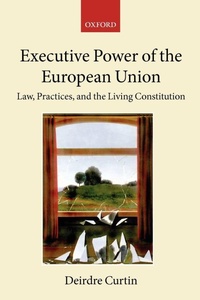
Executive Power of the European Union
Law, Practices, and the Living Constitution
Published on 3. September 2009
Book
Paperback/Softback
376 pages
978-0-19-926409-4 (ISBN)
Description
The picture of Brussels-based bureaucrats exercising wide-ranging, arbitrary executive powers with no accountability is one of the favourite images conjured by Eurosceptics across the political spectrum. What truth is there in the image? This book aims to bring the EU's executive powers out of the shadows by mapping the evolution and current form of the EU's various executive actors, their powers, and the mechanisms for holding them accountable. In doing so it provides a rich understanding of the way in which the EU's institutional and legal framework fits within national constitutional presumptions about how power should be controlled and accountability achieved.
Covering both the political executive and the administrative executive at the EU institutional level, the book analyses their relationship with national executive power, and traces the historical evolution of executive order in Europe from the Peace of Westphalia through classic inter-governmental organizations to the allegedly unique EU framework. The book's analysis covers both the formal legal structure of the Union and the evolution of the EU's living institutions in practice. The picture presented is of a fragmented, cluttered and complex European executive space, resistant to radical constitutional reform and in need of a more nuanced understanding of the different forms of executive power required by different political aims and modes of decision-making.
Covering both the political executive and the administrative executive at the EU institutional level, the book analyses their relationship with national executive power, and traces the historical evolution of executive order in Europe from the Peace of Westphalia through classic inter-governmental organizations to the allegedly unique EU framework. The book's analysis covers both the formal legal structure of the Union and the evolution of the EU's living institutions in practice. The picture presented is of a fragmented, cluttered and complex European executive space, resistant to radical constitutional reform and in need of a more nuanced understanding of the different forms of executive power required by different political aims and modes of decision-making.
Reviews / Votes
This book takes a holistic approach; rather than providing an in-depth analysis of a particlar institution, Curtin analyses the political and administrative branches of the Council and the Commission as well as non-majoritarian agencies. It is the inclusive approach that makes this well written and clearly structured book stand out from other studies in the area. * Helena Ekelund, University of Nottingham, Political Studies Review *More details
Series
Language
English
Place of publication
Oxford
United Kingdom
Target group
Professional and scholarly
Dimensions
Height: 234 mm
Width: 156 mm
Thickness: 20 mm
Weight
567 gr
ISBN-13
978-0-19-926409-4 (9780199264094)
Copyright in bibliographic data and cover images is held by Nielsen Book Services Limited or by the publishers or by their respective licensors: all rights reserved.
Schweitzer Classification
Other editions
Additional editions
Book
09/2009
Oxford University Press
€130.50
Shipment within 15-20 days
Person
Deirdre Curtin is Professor of International and European Governance at the Utrecht School of Governance, University of Utrecht and Professor of European Law at the University of Amsterdam (since 2008). Previously she held the Chair of the Law of International Organisations at the Law Faculty in Utrecht (1992-2002) She is a member of the Royal Dutch Academy for Science (KNAW) and in 2007 was awarded the Spinoza Prize by the Dutch Academy of Science for "outstanding contribution to the development and promotion of international and European law and for her groundbreaking visions concerning the governance of international organisations such as the European Union. " She has written extensively on issues relating to the constitutional and institutional development of the European Union and since 2003 has led a Research Group of political scientists and lawyers on "Enhancing Democracy in the EU " within the EU financed Network of Excellence, CONNEX.
Content
I TOPOGRAPHY AND LAYERED SEDIMENTS; II TIDES OF EU REFORM; III A LIVING EU CONSTITUTION