

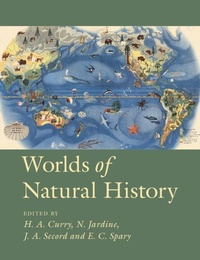
Worlds of Natural History
Published on 22. November 2018
Book
Paperback/Softback
700 pages
978-1-316-64971-8 (ISBN)
Description
From Aztec accounts of hibernating hummingbirds to contemporary television spectaculars, human encounters with nature have long sparked wonder, curiosity and delight. Written by leading scholars, this richly illustrated volume offers a lively introduction to the history of natural history, from the sixteenth century to the present day. Covering an extraordinary range of topics, from curiosity cabinets and travelling menageries to modern seed banks and radio-tracked wildlife, this volume draws together the work of historians of science, of environment and of art, museum curators and literary scholars. The essays are framed by an introduction charting recent trends in the field and an epilogue outlining the prospects for the future. Accessible to newcomers and established specialists alike, Worlds of Natural History provides a much-needed perspective on current discussions of biodiversity and an enticing overview of an increasingly vital aspect of human history.
Reviews / Votes
'This massive, comprehensive, and extremely rich collection of essays features a stellar cast of contributors who have created a worthy sequel to Cultures of Natural History. From its elegant introduction to its colorful chapters and provocative afterword on the continuing vitality of natural history in the twenty-first century, this book fascinates and instructs. Dazzled by its contents, readers will have a difficult time deciding which compartment in this cabinet of curiosities to open first. This is scholarship in the history of science at its finest.' Bernard Lightman, Fellow of the Royal Society of Canada, President of the History of Science Society, and York University 'This volume offers a cornucopia of new approaches to writing the history of natural history from the Renaissance to today. With attention to shifting epistemologies and material cultures, it situates ancient traditions of collecting, classifying, and preserving nature in relation to the modern biological and earth sciences. In our present era of vanishing biological diversity, the authors consider the lessons of the past for the future of both elite and popular scientific institutions, from seed banks to museums and zoos.' Deborah R. Coen, Yale University, Connecticut 'Worlds of Natural History comes as close as is humanly possible to living up to its title. The essays illuminate almost every aspect of the vast enterprise of natural history, from collecting, networking, and voyaging to preserving, image-making, and classifying. Its sites are as various as the Renaissance apothecary's shop and the contemporary genetics lab; its locales criss-cross the globe. This book crystallizes decades of historical scholarship, and is the single best introduction to the topic.' Lorraine Daston, Director, Max Planck Institute for the History of Science, Berlin '... a rich snapshot of the current trends.' Aaron Van Neste, Annals of Science 'The individual scholarly standards are matched by Cambridge University Press's production values and combine to make this volume testimony to the continuing vibrancy of natural history and its historical explication.' W. F. Bynum, Times Literary Supplement '... the essays collected here bring us closer to an understanding of how historians of science gain insights through trying to expand their perspectives, and search for continuities between the past and the present. This volume should become essential reading for both historians of science and all scholars keen to keep abreast of general historical debates about the environment, technology, globalisation, empire and exchange.' Sooyoung An, East Asian Science, Technology, and MedicineMore details
Language
English
Place of publication
Cambridge
United Kingdom
Product notice
Paperback (trade)
Illustrations
Worked examples or Exercises; 1 Tables, black and white; 16 Plates, color; 130 Halftones, black and white
Dimensions
Height: 246 mm
Width: 189 mm
Thickness: 36 mm
Weight
1300 gr
ISBN-13
978-1-316-64971-8 (9781316649718)
Copyright in bibliographic data and cover images is held by Nielsen Book Services Limited or by the publishers or by their respective licensors: all rights reserved.
Schweitzer Classification
Other editions
Additional editions
Helen Anne Curry | Nicholas Jardine | James Andrew Secord
Worlds of Natural History
Book
11/2018
Cambridge University Press
€221.30
Shipment within 15-20 days
Helen Anne Curry | Nicholas Jardine | James Andrew Secord
Worlds of Natural History
E-Book
11/2018
Cambridge University Press
€44.49
Available for download
Persons
Helen Anne Curry is the Peter Lipton Senior Lecturer in History of Modern Science and Technology at the University of Cambridge. Nicholas Jardine is emeritus Professor of History and Philosophy of the Sciences at the University of Cambridge. James A. Secord is Professor of History and Philosophy of Science at the University of Cambridge. E. C. Spary is Reader in the History of Modern European Knowledge at the Faculty of History, University of Cambridge.
Content
Introduction: worlds of history Nicholas Jardine and Emma Spary; Part I. Early Modern Ventures: 1. Visions of ancient natural history Brian W. Ogilvie; 2. Gessner's history of nature Sachiko Kusukawa; 3. Natural history in the apothecary's shop Valentina Pugliano; 4. Horticultural networking and sociable citation Leah Knight; 5. European exchanges and communities Florike Egmond; 6. Making monsters Natalie Lawrence; 7. Indigenous naturalists Iris Montero Sobrevilla; 8. Insects, philosophy and the microscope Eric Jorink; Part II. Enlightened Orders: 9. The materials of natural history Paula Findlen and Anna Toledano; 10. Experimental natural history Mary Terrall; 11. Spatial arrangement and systematic order Robert Felfe; 12. Linnaean paper tools Staffan Mueller-Wille; 13. Image and nature Kaerin Nickelsen; 14. Botanical conquistadors Daniela Bleichmar; 15. Bird sellers and animal merchants Christopher Plumb; 16. Vegetable empire Miles Ogborn; Part III. Publics and Empires: 17. Containers and collections Anne Secord; 18. Natural history and the scientific voyage Katharine Anderson; 19. Humboldt's exploration at a distance Sandra Rebok; 20. Publics and practices Lynn K. Nyhart; 21. Museum nature Samuel J. M. M. Alberti; 22. Peopling natural history Sadiah Qureshi; 23. The oils of empire Sujit Sivasundaram; Part IV. Connecting and Conserving: 24. Global geology and the tectonics of empire James A. Secord; 25. Zoological gardens Mitchell G. Ash; 26. Provincializing global botany Jung Lee; 27. Descriptive and prescriptive taxonomies Jim Endersby; 28. Imperiled crops and endangered flowers Helen Anne Curry; 29. Networks of natural history in Latin America Regina Horta Duarte; 30. The unnatural history of postwar human biology Joanna Radin; 31. Fieldwork out of place Etienne Benson; 32. Wild visions Morgan Richards; Epilogue: natural history and its histories in the twenty-first century Helen Anne Curry and James A. Secord.