

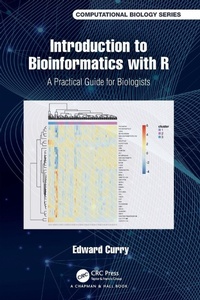
Introduction to Bioinformatics with R
A Practical Guide for Biologists
1st Edition
Published on 3. November 2020
Book
Paperback/Softback
310 pages
978-1-138-49571-5 (ISBN)
Description
In biological research, the amount of data available to researchers has increased so much over recent years, it is becoming increasingly difficult to understand the current state of the art without some experience and understanding of data analytics and bioinformatics. An Introduction to Bioinformatics with R: A Practical Guide for Biologists leads the reader through the basics of computational analysis of data encountered in modern biological research. With no previous experience with statistics or programming required, readers will develop the ability to plan suitable analyses of biological datasets, and to use the R programming environment to perform these analyses. This is achieved through a series of case studies using R to answer research questions using molecular biology datasets. Broadly applicable statistical methods are explained, including linear and rank-based correlation, distance metrics and hierarchical clustering, hypothesis testing using linear regression, proportional hazards regression for survival data, and principal component analysis. These methods are then applied as appropriate throughout the case studies, illustrating how they can be used to answer research questions.
Key Features:
? Provides a practical course in computational data analysis suitable for students or researchers with no previous exposure to computer programming.
? Describes in detail the theoretical basis for statistical analysis techniques used throughout the textbook, from basic principles
? Presents walk-throughs of data analysis tasks using R and example datasets. All R commands are presented and explained in order to enable the reader to carry out these tasks themselves.
? Uses outputs from a large range of molecular biology platforms including DNA methylation and genotyping microarrays; RNA-seq, genome sequencing, ChIP-seq and bisulphite sequencing; and high-throughput phenotypic screens.
? Gives worked-out examples geared towards problems encountered in cancer research, which can also be applied across many areas of molecular biology and medical research.
This book has been developed over years of training biological scientists and clinicians to analyse the large datasets available in their cancer research projects. It is appropriate for use as a textbook or as a practical book for biological scientists looking to gain bioinformatics skills.
Key Features:
? Provides a practical course in computational data analysis suitable for students or researchers with no previous exposure to computer programming.
? Describes in detail the theoretical basis for statistical analysis techniques used throughout the textbook, from basic principles
? Presents walk-throughs of data analysis tasks using R and example datasets. All R commands are presented and explained in order to enable the reader to carry out these tasks themselves.
? Uses outputs from a large range of molecular biology platforms including DNA methylation and genotyping microarrays; RNA-seq, genome sequencing, ChIP-seq and bisulphite sequencing; and high-throughput phenotypic screens.
? Gives worked-out examples geared towards problems encountered in cancer research, which can also be applied across many areas of molecular biology and medical research.
This book has been developed over years of training biological scientists and clinicians to analyse the large datasets available in their cancer research projects. It is appropriate for use as a textbook or as a practical book for biological scientists looking to gain bioinformatics skills.
More details
Series
Language
English
Place of publication
London
United Kingdom
Publishing group
Taylor & Francis Ltd
Target group
College/higher education
Illustrations
75 farbige Abbildungen
75 Illustrations, color
Dimensions
Height: 234 mm
Width: 156 mm
Thickness: 17 mm
Weight
477 gr
ISBN-13
978-1-138-49571-5 (9781138495715)
Copyright in bibliographic data and cover images is held by Nielsen Book Services Limited or by the publishers or by their respective licensors: all rights reserved.
Schweitzer Classification
Other editions
Additional editions
Book
11/2020
1st Edition
CRC Press
€237.70
Shipment within 10-20 days
E-Book
11/2020
1st Edition
Chapman & Hall/CRC
€80.49
Available for download
E-Book
11/2020
1st Edition
Chapman & Hall/CRC
€80.49
Available for download
Person
Ed Curry initially studied computer science (Cambridge) and AI with a systems biology specialism (Edinburgh) before embarking on a PhD in computer-based molecular biology, studying stem cell differentiation at the Centre for Regenerative Medicine in Edinburgh. He spent 10 years in the Faculty of Medicine at Imperial College London, during which time he established a research group focusing on interactions between the genetic, epigenetic and transcriptional state of cancer cells during carcinogenesis and the acquisition of drug resistance. He has extensive teaching experience as a lecturer, examiner and course director, including co-founding Imperial College's Cancer Informatics MRes program and the Genetics & Genomics module for the BSc in Medical Biosciences. He joined GSK R&D in October 2019, remaining an honorary lecturer at Imperial College.
Content
1, Introduction 2. Introduction to R 3. An Introduction to LINUX for Biological Research 4. Statistical Methods for Data Analysis 5. Analyzing Generic Tabular Numeric Datasets in R 6. Functional Enrichment Analysis 7. Integrating Multiple Datasets in R 8. Analyzing Microarray Data in R 9. Analyzing DNA Methylation Microarray Data in R 10. DNA Analysis With Microarrays 11. Working with Sequencing Data 12. Genomic Sequence Profiling 13. ChIP-seq 14. RNA-seq 15. Bisulphite Sequencing 16. Final Notes