

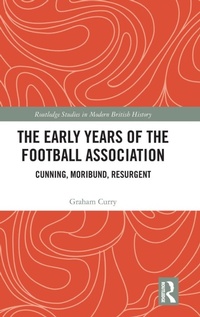
The Early Years of the Football Association
Cunning, Moribund, Resurgent
1st Edition
Published on 4. June 2026
Book
Hardback
186 pages
978-1-041-32073-9 (ISBN)
Description
Over the past two decades, academic, sociological/historical writing on football has flourished, mainly on the back of the debate over the game's early development led by Eric Dunning, Graham Curry, Tony Collins, and Adrian Harvey. This book adds to that debate, providing more information on the early meetings of the Football Association.
The initial two chapters constitute the centrepiece of the work, presenting detailed analysis of the first six meetings of the association when, eventually, arguments raged over the merits and demerits of what, increasingly, had become two very differing forms of football - kicking and dribbling, which was to become soccer, and handling carrying and hacking, which became rugby. The adherents of the former may have conspired to engage additional supporters to the all-important gathering, when significant votes were taken which decided the future of the game.
Despite their triumph in these divisions, the association did not initially thrive. However, mainly due to the growing involvement of Charles Alcock, the body became resurgent in the early 1870s, with the introduction of the FA Cup and international competition. A decade later during the debate over professionalism, the association avoided a split in the sport and, although the game was entering an era of over-seriousness and commercialisation, they maintained their hold over its administration and, precariously, its value system.
Ultimately, the Football Association succeeded in establishing itself as the governing body of the sport in England, thereby cementing its place in the history of the game.
The initial two chapters constitute the centrepiece of the work, presenting detailed analysis of the first six meetings of the association when, eventually, arguments raged over the merits and demerits of what, increasingly, had become two very differing forms of football - kicking and dribbling, which was to become soccer, and handling carrying and hacking, which became rugby. The adherents of the former may have conspired to engage additional supporters to the all-important gathering, when significant votes were taken which decided the future of the game.
Despite their triumph in these divisions, the association did not initially thrive. However, mainly due to the growing involvement of Charles Alcock, the body became resurgent in the early 1870s, with the introduction of the FA Cup and international competition. A decade later during the debate over professionalism, the association avoided a split in the sport and, although the game was entering an era of over-seriousness and commercialisation, they maintained their hold over its administration and, precariously, its value system.
Ultimately, the Football Association succeeded in establishing itself as the governing body of the sport in England, thereby cementing its place in the history of the game.
More details
Series
Language
English
Place of publication
London
United Kingdom
Publishing group
Taylor & Francis Ltd
Target group
College/higher education
Academic
Illustrations
7 s/w Tabellen
7 Tables, black and white
Dimensions
Height: 234 mm
Width: 156 mm
Weight
520 gr
ISBN-13
978-1-041-32073-9 (9781041320739)
Copyright in bibliographic data and cover images is held by Nielsen Book Services Limited or by the publishers or by their respective licensors: all rights reserved.
Schweitzer Classification
Other editions
Additional editions
E-Book
06/2026
Routledge
€60.49
Available for download
E-Book
06/2026
Routledge
€60.49
Available for download
Person
Graham Curry trained at the University of Leicester, gaining his MA and PhD there. He has written extensively on the historical sociology of Association Football, publishing, in 2016 with Eric Dunning, the thought-provoking Association Football: A Study in Figurational Sociology. Still playing, he represents England in the over-65s age group.
Content
Introduction
Chapter 1
Before 1863: the importance of the public schools
Chapter 2
Phoney war: the first three meetings of the Football Association
Chapter 3
Cunning plan: the split between association and rugby
Chapter 4
The Football Association, 1864 to 1870 - success or failure?
Chapter 5
The FA Cup and growing predominance
Chapter 6
Internationalisation and increased momentum
Chapter 7
Grasping the nettle: the coming of professionalism
Conclusion
Appendix 1
Attendees at the first six meetings of the Football Association
Appendix 2
Early homes of the Football Association
Appendix 3
Attendance at founding meetings of the Football Association, 1863
Chapter 1
Before 1863: the importance of the public schools
Chapter 2
Phoney war: the first three meetings of the Football Association
Chapter 3
Cunning plan: the split between association and rugby
Chapter 4
The Football Association, 1864 to 1870 - success or failure?
Chapter 5
The FA Cup and growing predominance
Chapter 6
Internationalisation and increased momentum
Chapter 7
Grasping the nettle: the coming of professionalism
Conclusion
Appendix 1
Attendees at the first six meetings of the Football Association
Appendix 2
Early homes of the Football Association
Appendix 3
Attendance at founding meetings of the Football Association, 1863