

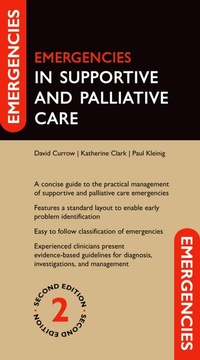
Emergencies in Supportive and Palliative Care
2nd Edition
Published on 9. February 2024
Book
Paperback/Softback
336 pages
978-0-19-289833-3 (ISBN)
Description
Fully revised according to up-to-date clinical guidance, this second edition provides a practical, accessible guide to emergency situations encountered in the practice of supportive and palliative care. Designed for rapid use, it addresses the immediate clinical challenges while more definitive measures are being put in place.
Structured around frequently encountered symptoms, the book is split into two sections. The first section explores how patients with life-limiting illnesses such as cancer, AIDS, and end-stage organ failure normally present, and looks at the reversibility of their condition. The second section provides a detailed approach to specific clinical conditions, and is for use once the clinical diagnosis has been reached on the basis of the presenting symptoms. An improved order to the table of contents for this edition matches clinical practice.
Guiding the decision-making process is an understanding of where the patient is on their disease trajectory. The book uses three categories (terminal, deteriorating, and stable), which consider how the patient's needs are changing as their disease progresses. A brand new chapter 'Care at the end of life' outlines good clinical care for the last hours days of life when the diagnosis of dying has been actively made.
The book provides trainees in palliative medicine, nurses, family doctors, and other allied health professionals with a pocket guide to the emergency care of people requiring supportive and palliative care, and it complements and cross-refers to the Oxford Handbook of Palliative Care.
Structured around frequently encountered symptoms, the book is split into two sections. The first section explores how patients with life-limiting illnesses such as cancer, AIDS, and end-stage organ failure normally present, and looks at the reversibility of their condition. The second section provides a detailed approach to specific clinical conditions, and is for use once the clinical diagnosis has been reached on the basis of the presenting symptoms. An improved order to the table of contents for this edition matches clinical practice.
Guiding the decision-making process is an understanding of where the patient is on their disease trajectory. The book uses three categories (terminal, deteriorating, and stable), which consider how the patient's needs are changing as their disease progresses. A brand new chapter 'Care at the end of life' outlines good clinical care for the last hours days of life when the diagnosis of dying has been actively made.
The book provides trainees in palliative medicine, nurses, family doctors, and other allied health professionals with a pocket guide to the emergency care of people requiring supportive and palliative care, and it complements and cross-refers to the Oxford Handbook of Palliative Care.
Reviews / Votes
Review from previous edition Its small format and resilient soft plastic cover make it easy to carry around and many clinicians will feel empowered to be able to quickly refer to it when face with an emergency which could be life-threatening. ...this book will be invaluable to clinicians. * Oncology News * This little pocket-sized book provides a guide through the maze...[and] will be very useful for nurses and junior medical staff as a quick reference in their day-to-day work in palliative care. * Roger Woodruff, Director of Palliative Care, Austin Health, Melbourne, Australia *More details
Series
Edition
2nd Revised edition
Language
English
Place of publication
Oxford
United Kingdom
Target group
College/higher education
Edition type
Revised edition
Dimensions
Height: 175 mm
Width: 97 mm
Thickness: 13 mm
Weight
170 gr
ISBN-13
978-0-19-289833-3 (9780192898333)
Copyright in bibliographic data and cover images is held by Nielsen Book Services Limited or by the publishers or by their respective licensors: all rights reserved.
Schweitzer Classification
Other editions
Additional editions
David Currow | Katherine Clark | Paul Kleinig
Emergencies in Supportive and Palliative Care
E-Book
01/2024
2nd Edition
OUP eBook
€25.99
Available for download
David Currow | Katherine Clark | Paul Kleinig
Emergencies in Supportive and Palliative Care
E-Book
01/2024
2nd Edition
OUP eBook
€25.99
Available for download
Persons
Professor David Currow is a physician and the Deputy Vice-Chancellor (Research and Sustainable Futures) at the University of Wollongong. He is a widely published researcher focussing on generating a stronger evidence base for symptom control, understanding the population prevalence of key symptoms and their impacts, and health services research.
Katherine Clark (MBBS MMed PhD FRACP FAChPM) is a palliative medicine specialist and the current clinical director of supportive and palliative care in Northern Sydney Local Health District (NSW, Australia). Most recently, she has been appointed as senior clinical advisor in palliative care to the NSW Ministry of Health.
Paul Kleinig is a palliative care physician and general physician in Adelaide, South Australia. His professional passion is the stewardship and mentorship of students and young health professionals towards clinical excellence through role-modelling, teaching, and professional assessment.
Katherine Clark (MBBS MMed PhD FRACP FAChPM) is a palliative medicine specialist and the current clinical director of supportive and palliative care in Northern Sydney Local Health District (NSW, Australia). Most recently, she has been appointed as senior clinical advisor in palliative care to the NSW Ministry of Health.
Paul Kleinig is a palliative care physician and general physician in Adelaide, South Australia. His professional passion is the stewardship and mentorship of students and young health professionals towards clinical excellence through role-modelling, teaching, and professional assessment.
Author
Deputy Vice-Chancellor (Research and Sustainable Futures); Matthew Flinders Distinguished ProfessorDeputy Vice-Chancellor (Research and Sustainable Futures); Matthew Flinders Distinguished Professor, University of Wollongong, Wollongong, Australia; Flinders University, Adelaide, Adelaide
Senior Staff Specialist; Area Director of Palliative Services; Conjoint Professor; Senior Clinical Advisor
Senior Staff Specialist; General Physician; Clinical LecturerSenior Staff Specialist; General Physician; Clinical Lecturer, Southern Adelaide Palliative Services, Adelaide, Australia; Southern Adelaide Local Health Network, Adelaide, Australia; Flinders University, Adelaide, Australia
Content
Section 1 Frequently encountered symptoms
1: Frequently encountered symptoms
Section 2 Specific clinical presentations
2: Clinical pharmacology
3: Dermatological problems
4: Cardiovascular problems
5: Respiratory problems
6: Gastrointestinal disorders
7: Haematological disorders
8: Renal and metabolic disorders
9: Endocrine problems
10: Neurology
11: Mental health
12: Orthopaedic disorders
13: Genito-urological disorders
Appendix 1: Australia-modified Karnofsky Performance Scale (AKPS)
Appendix 2: The LANSS pain scale: Leeds Assessment of Neuropathic Symptoms and Signs
Appendix 3: Glasgow coma score
1: Frequently encountered symptoms
Section 2 Specific clinical presentations
2: Clinical pharmacology
3: Dermatological problems
4: Cardiovascular problems
5: Respiratory problems
6: Gastrointestinal disorders
7: Haematological disorders
8: Renal and metabolic disorders
9: Endocrine problems
10: Neurology
11: Mental health
12: Orthopaedic disorders
13: Genito-urological disorders
Appendix 1: Australia-modified Karnofsky Performance Scale (AKPS)
Appendix 2: The LANSS pain scale: Leeds Assessment of Neuropathic Symptoms and Signs
Appendix 3: Glasgow coma score