

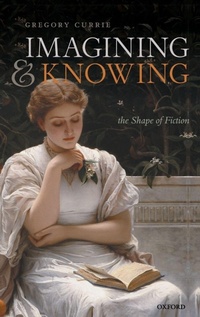
Imagining and Knowing
The Shape of Fiction
Published on 19. February 2020
Book
Hardback
258 pages
978-0-19-965661-5 (ISBN)
Description
Works of fiction are works of the imagination and for the imagination. Gregory Currie energetically defends the familiar idea that fictions are guides to the imagination, a view which has come under attack in recent years. Responding to a number of challenges to this standpoint, he argues that within the domain of the imagination there lies a number of distinct and not well-recognized capacities which make the connection between fiction and imagination work. Currie then considers the question of whether in guiding the imagination fictions may also guide our beliefs, our outlook, and our habits in directions of learning. It is widely held that fictions very often provide opportunities for the acquisition of knowledge and of skills. Without denying that this sometimes happens, this book explores the difficulties and dangers of too optimistic a picture of learning from fiction. It is easy to exaggerate the connection between fiction and learning, to ignore countervailing tendencies in fiction to create error and ignorance, and to suppose that claims about learning from fiction require no serious empirical support. Currie makes a case for modesty about learning from fiction--reasoning that a lot of what we take to be learning in this area is itself a kind of pretence, that we are too optimistic about the psychological and moral insights of authors, that the case for fiction as a Darwinian adaptation is weak, and that empathy is both hard to acquire and not always morally advantageous.
Reviews / Votes
this important and polemical book...shines a penetrating, for some disturbing, light on one of the most prominent lines of defence for a humanistic, literary education, the thought that we can learn from works of fiction in substantial ways: that reading fiction can make us better people, more wise, more morally astute, more empathetic, more knowledgeable about human follies and aspirations.... The book is a major contribution to debates about fiction by one of the pre-eminent philosophers in this area. It contains an immense amount of subtle argument, presented in a pleasing and urbane manner, the author always generous to his adversaries, modest in his own conclusions. But make no mistake, the book completely changes the landscape of "cognitivism" about literature. No one now can go on insisting on the usual beneficial effects of literature without taking serious and systematic account of Currie's arguments. * Peter Lamarque, Notre Dame Philosophical Reviews * While the book focuses on literature and film, it is a worthwhile read for any media scholar with a general interest in its subject. * Jens Kjeldgaard-Christiansen, Department of English, Aarhus University, Journal of Media and Communication Research *More details
Language
English
Place of publication
Oxford
United Kingdom
Target group
Professional and scholarly
Dimensions
Height: 240 mm
Width: 161 mm
Thickness: 19 mm
Weight
555 gr
ISBN-13
978-0-19-965661-5 (9780199656615)
Copyright in bibliographic data and cover images is held by Nielsen Book Services Limited or by the publishers or by their respective licensors: all rights reserved.
Schweitzer Classification
Other editions
Additional editions
Book
02/2022
Oxford University Press
€31.50
Shipment within 15-20 days
E-Book
02/2020
1st Edition
OUP eBook
€16.49
Available for download
E-Book
02/2020
1st Edition
OUP eBook
€16.49
Available for download
Person
Gregory Currie is Professor of Philosophy at the University of York. He was educated at the London School of Economics and at the University of California, Berkeley. He has taught at universities in Australia, New Zealand and the UK, and held visiting positions at the Australian National University, the University of Oxford, and the School for Advanced Studies in the Social Sciences (EHESS), Paris. He is a Fellow of the British Academy and of the Australian Academy of the Humanities.
Content
Introduction
Part I: Imagination's Empire
1: An Essential Connection
2: How Fiction Works
3: Imaginings Like Desires
4: Affective Imagining
Part II: Starting to Think About Fiction and Knowledge
5: The Varieties of Knowing
6: An Empirical Question?
7: Fiction, Mentalizing, and Planning
Part III: Fiction, Knowledge, and Ignorance
8: Knowledge from Imagination
9: Fiction, Truth and the Transmission of Belief
10: Wise Authors?
11: Fiction and Empathy
Where We Are
Part I: Imagination's Empire
1: An Essential Connection
2: How Fiction Works
3: Imaginings Like Desires
4: Affective Imagining
Part II: Starting to Think About Fiction and Knowledge
5: The Varieties of Knowing
6: An Empirical Question?
7: Fiction, Mentalizing, and Planning
Part III: Fiction, Knowledge, and Ignorance
8: Knowledge from Imagination
9: Fiction, Truth and the Transmission of Belief
10: Wise Authors?
11: Fiction and Empathy
Where We Are