

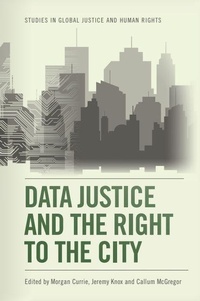
Data Justice and the Right to the City
Published on 13. September 2022
Book
Hardback
304 pages
978-1-4744-9295-9 (ISBN)
Description
Data Justice and the Right to the City engages with theories of social justice and data-driven urbanism. It explores the intersecting concerns of data justice - both the harms and civic possibilities of the datafied society - and the right to the city - a call to redress the uneven distribution of resources and rights in urban contexts. These concerns are addressed through a variety of topics: digital social services, as cities use data and algorithms to administer to citizens; education, as data-driven practices transform learning and higher education; labour, as platforms create new precarities and risks for workers; and activists who seek to make creative and political interventions into these developments. This edited collection proposes frameworks for understanding the effects of data-driven technologies at the municipal scale and offers strategies for intervention by both scholars and citizens.
Reviews / Votes
Global in scope, nimbly written, and drawing together the insights of organizers, NGOs, and scholars, Data Justice and the Right to the City is a must-read for those interested in re-politicizing data and recommitting to equitable and joyous urban life. * Virginia Eubanks, University at Albany, SUNY *More details
Series
Language
English
Place of publication
Edinburgh
United Kingdom
Target group
Professional and scholarly
Illustrations
15 black and white illustrations
Dimensions
Height: 162 mm
Width: 241 mm
Thickness: 27 mm
Weight
716 gr
ISBN-13
978-1-4744-9295-9 (9781474492959)
Copyright in bibliographic data and cover images is held by Nielsen Book Services Limited or by the publishers or by their respective licensors: all rights reserved.
Schweitzer Classification
Other editions
Additional editions
Morgan Currie
Data Justice and the Right to the City
E-Book
11/2022
1st Edition
De Gruyter
€112.99
Available for download
Morgan Currie
Data Justice and the Right to the City
E-Book
09/2022
1st Edition
Edinburgh University Press
€3.49
Available for download
Persons
Morgan Currie is Senior Lecturer in Data and Society at the University of Edinburgh. Her research and teaching interests focus on open and administrative data, algorithms in the welfare state, activists' data practices, cultural mapping and critical GIS. She is principal investigator of The Culture & Communities Mapping Project and co-leads the Digital Social Science Research Cluster at Centre for Data, Culture & Society. Jeremy Knox is co-director of the Centre for Research in Digital Education at the University of Edinburgh, where he leads a research theme on the 'Data Society'. His research interests include the relationships between education, data-driven technologies, and wider society. Jeremy's published work includes critical perspectives on artificial intelligence (AI), learning analytics, data, and algorithms, as well as Open Educational Resources (OER) and Massive Open Online Courses (MOOCs). He is associate editor of Postdigital Science and Education, and co-convenes the Society for Research in Higher Education (SRHE) Digital University network. Callum McGregor is a Lecturer in Education at the Institute for Education, Community and Society, University of Edinburgh. He teaches on the MSc Social Justice and Community Action and the MA Learning in Communities. Callum is also an affiliate of the Edinburgh Futures Institute (EFI). Callum's research interests are inter-disciplinary and address the relationship between democratic citizenship, education and the politics of policy. Within this broad context, he has published recently on topics as broad as education for climate justice, learning for democracy in the context of populism and radical digital citizenship.
Content
Foreword - Lina Dencik
Data Justice and the Right to the City: An Introduction - Morgan Currie, Jeremy Knox and Callum McGregor
Part I Algorithmic Government
1. Predictive policing: transforming the city into a medium for control - Fieke Jansen
2. 'Hostile Data', Migration and the City: Enacting and Resisting Spaces of Hostility in the UK - Philippa Metcalfe
3. Datafied Child Welfare Services as Sites of Struggle - Joanna Redden, Jessica Brand, Ina Sander and Harry Warne
4. Seven Stories from AlgorithmWatch
Part II Education
5. The civic university as key agent in the production of urban space - Nicolas Zehner
6. Rescuing Data Literacy from Dataism - Huw C. Davies
7. Smart Citizen Apprentices: Digital Urbanism and Coding as Techno-Solutions to the City - Ben Williamson
Part III Gig, platform, and crowd labour
8. Cadies, Clocks, and the Data-Driven Capital: Incorporating Gig Workers in Edinburgh - Cailean Gallagher
9. The Students Are Already (Gig) Workers - Karen Gregory
10. Data (in)justice, protest and the (re)making of space among fragmented platform workers - Alex J. Wood and Vili Lehdonvirta
Part IV Art and Activism in the Datafied City
11. The Street, the Square, and the Net: How Urban Activists Make and Use Networked Technologies - Jessica Feldman
12. Facial Recognition and The Right to Appear: Infrastructural Challenges in Anti-Surveillance Resistance - Benedetta Catanzariti
13. Data Burdens: Epistemologies of Evidence in Police Reform and Abolition Movements - Britt Paris, Morgan Currie, Irene Pasquetto and Jennifer Pierre
14. Data Resistance Through Public Art: Reclaiming Narratives In/Of the City - Pip Thornton
Postscript
Doing Data Dialectically: Between Alienation and Democratic Urban Renewal
Data Justice and the Right to the City: An Introduction - Morgan Currie, Jeremy Knox and Callum McGregor
Part I Algorithmic Government
1. Predictive policing: transforming the city into a medium for control - Fieke Jansen
2. 'Hostile Data', Migration and the City: Enacting and Resisting Spaces of Hostility in the UK - Philippa Metcalfe
3. Datafied Child Welfare Services as Sites of Struggle - Joanna Redden, Jessica Brand, Ina Sander and Harry Warne
4. Seven Stories from AlgorithmWatch
Part II Education
5. The civic university as key agent in the production of urban space - Nicolas Zehner
6. Rescuing Data Literacy from Dataism - Huw C. Davies
7. Smart Citizen Apprentices: Digital Urbanism and Coding as Techno-Solutions to the City - Ben Williamson
Part III Gig, platform, and crowd labour
8. Cadies, Clocks, and the Data-Driven Capital: Incorporating Gig Workers in Edinburgh - Cailean Gallagher
9. The Students Are Already (Gig) Workers - Karen Gregory
10. Data (in)justice, protest and the (re)making of space among fragmented platform workers - Alex J. Wood and Vili Lehdonvirta
Part IV Art and Activism in the Datafied City
11. The Street, the Square, and the Net: How Urban Activists Make and Use Networked Technologies - Jessica Feldman
12. Facial Recognition and The Right to Appear: Infrastructural Challenges in Anti-Surveillance Resistance - Benedetta Catanzariti
13. Data Burdens: Epistemologies of Evidence in Police Reform and Abolition Movements - Britt Paris, Morgan Currie, Irene Pasquetto and Jennifer Pierre
14. Data Resistance Through Public Art: Reclaiming Narratives In/Of the City - Pip Thornton
Postscript
Doing Data Dialectically: Between Alienation and Democratic Urban Renewal