

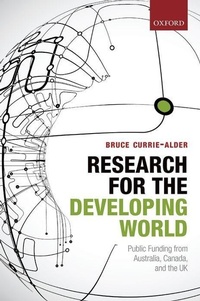
Research for the Developing World
Public Funding from Australia, Canada, and the UK
Published on 8. October 2015
Book
Hardback
206 pages
978-0-19-874293-7 (ISBN)
Description
Research for the developing world can generate evidence on the effectiveness of foreign aid, invent new technologies that serve poor people, and strengthen research capabilities in poor countries. How do countries determine which of these policy goals to pursue? Examining the United Kingdom, Canada, and Australia reveals how each country established a unique approach to research funding. Programs and grantmaking evolved in response to various expectations across government, tempered by the need to remain credible in the scientific community.
This book explores the histories of the UK Department for International Development (DFID), Canada's International Development Research Centre (IDRC), and the Australian Centre for International Agricultural Research (ACIAR). Looking back, changes in research governance encouraged a shift towards whole-of-government priorities, shorter timeframes for realizing results, and performance predicated on academic productivity and research impact. Whereas funders used to encourage 'small is beautiful' with local experiments in development, today the emphasis is on 'getting to scale' delivering innovation through self-financing models.
Looking forward, research for the developing world is fading as part of development assistance, yet rising as collaboration on common global challenges. Funders are adopting new definitions of performance and actively shaping policy to connect science and international development. Leaders are brokering partnerships that connect research governance at home and abroad, bridging the incentives towards academic productivity and research impact. In short, the future of research for the developing world is moving from foreign aid to science diplomacy.
This book explores the histories of the UK Department for International Development (DFID), Canada's International Development Research Centre (IDRC), and the Australian Centre for International Agricultural Research (ACIAR). Looking back, changes in research governance encouraged a shift towards whole-of-government priorities, shorter timeframes for realizing results, and performance predicated on academic productivity and research impact. Whereas funders used to encourage 'small is beautiful' with local experiments in development, today the emphasis is on 'getting to scale' delivering innovation through self-financing models.
Looking forward, research for the developing world is fading as part of development assistance, yet rising as collaboration on common global challenges. Funders are adopting new definitions of performance and actively shaping policy to connect science and international development. Leaders are brokering partnerships that connect research governance at home and abroad, bridging the incentives towards academic productivity and research impact. In short, the future of research for the developing world is moving from foreign aid to science diplomacy.
More details
Product info
Print PDF
Language
English
Place of publication
Oxford
United Kingdom
Target group
College/higher education
Professional and scholarly
Product notice
sewn/stitched
Cloth over boards
Illustrations
10 Figures and 4 Tables
Dimensions
Height: 236 mm
Width: 157 mm
Thickness: 20 mm
Weight
476 gr
ISBN-13
978-0-19-874293-7 (9780198742937)
Schweitzer Classification
Other editions
Additional editions
Bruce Currie-Alder
Research for the Developing World
Public Funding from Australia, Canada, and the UK
E-Book
10/2015
1st Edition
OUP eBook
€63.49
Available for download
Bruce Currie-Alder
Research for the Developing World
Public Funding from Australia, Canada, and the UK
E-Book
10/2015
1st Edition
OUP eBook
€63.49
Available for download
Person
Bruce Currie-Alder is Regional Director, based in Cairo, with Canada's International Development Research Centre (IDRC). His work examines the governance of public research funding and scientific cooperation with developing countries. His previous experience includes facilitating corporate strategy, contributing to Canada's foreign policy, and work in the Mexican oil industry. He recently co-edited International Development: ideas, experience and prospects (Oxford 2014) which traces the evolution of thinking about international development over the past 60 years. Currie-Alder holds a Master's in Natural Resource Management from Simon Fraser University and a PhD in Public Policy from Carleton University.
Content
1. Expecting more: changing governance of public research ; 2. Research funders: adapting to government expectations ; 3. United Kingdom: between Haldane and Rothschild ; 4. Canada: Hopper's vision of empowerment ; 5. Australia: Crawford's legacy of partnership ; 6. Changing context: public management and research governance ; 7. Looking back: program theory and grantmaking practice ; 8. Looking forward: from foreign aid to global challenges ; 9. Conclusion: the quest for research impact