

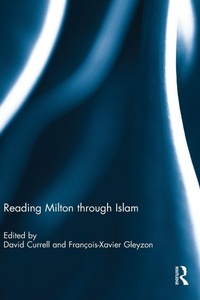
Reading Milton through Islam
1st Edition
Published on 13. September 2017
Book
Hardback
118 pages
978-1-138-72370-2 (ISBN)
Description
John Milton's poetry and prose are central to our understanding of the aesthetic, political and religious upheavals of early modern England. Innovative recent scholarship, however, continues to expand the range of contexts through which we read Milton beyond Christian Europe, unearthing the vitality and resonance of the Miltonic text within religious and political debates across borders, through time and in multiple languages.
The Islamic world has begun to receive deserved recognition as one such global site of this cultural energy. The publication of complete translations of Paradise Lost into Arabic has stimulated fresh critical explorations from a multiplicity of perspectives: historicist, comparative and theological. Attention to spatially and religiously diverse influences and reception contexts offers new avenues of approach into masterpieces including Paradise Lost, Paradise Regained and Areopagitica, as well as into the cultural forces these texts represent, reimagine and contest. By exploring how Milton, Islam and the Middle East address and implicate one another, this collection asks how, why and where Milton matters. This book was originally published as a special issue of English Studies.
The Islamic world has begun to receive deserved recognition as one such global site of this cultural energy. The publication of complete translations of Paradise Lost into Arabic has stimulated fresh critical explorations from a multiplicity of perspectives: historicist, comparative and theological. Attention to spatially and religiously diverse influences and reception contexts offers new avenues of approach into masterpieces including Paradise Lost, Paradise Regained and Areopagitica, as well as into the cultural forces these texts represent, reimagine and contest. By exploring how Milton, Islam and the Middle East address and implicate one another, this collection asks how, why and where Milton matters. This book was originally published as a special issue of English Studies.
More details
Language
English
Place of publication
London
United Kingdom
Publishing group
Taylor & Francis Ltd
Target group
College/higher education
Dimensions
Height: 260 mm
Width: 183 mm
Thickness: 11 mm
Weight
432 gr
ISBN-13
978-1-138-72370-2 (9781138723702)
Copyright in bibliographic data and cover images is held by Nielsen Book Services Limited or by the publishers or by their respective licensors: all rights reserved.
Schweitzer Classification
Other editions
Additional editions
David Currell | Francois-Xavier Gleyzon
Reading Milton through Islam
Book
03/2019
1st Edition
Routledge
€67.50
Shipment within 15-20 days
David Currell | Francois-Xavier Gleyzon
Reading Milton through Islam
E-Book
09/2017
1st Edition
Routledge
€61.99
Available for download
David Currell | Francois-Xavier Gleyzon
Reading Milton through Islam
E-Book
09/2017
1st Edition
Routledge
€61.99
Available for download
Persons
David Currell is Assistant Professor of English at the American University of Beirut, Lebanon. His research addresses issues of reception and early modern literature, with particular attention to classical and contemporary global contexts.
Francois-Xavier Gleyzon is Assistant Professor of English at the University of Central Florida, USA. His research and publication focus on Renaissance Literature, Visual and Cultural Theory.
Francois-Xavier Gleyzon is Assistant Professor of English at the University of Central Florida, USA. His research and publication focus on Renaissance Literature, Visual and Cultural Theory.
Content
1. Milton and Islam: Bridging Cultures 2. Paradise Lost as an Islamic Epic: Muhammad 'Anani's translation (2002/2010) 3. Holistic Typology: "Uniting the Dissevered Pieces": Quranic Retention and Protension in Milton's Areopagitica and Nativity Ode 4. Meditations on Mediation: John Milton and the Muslim Jesus 5. Milton's Enmity towards Islam and the Intellectus Agens 6. Milton's Areopagitica in the Arab World Today