

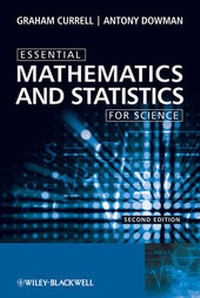
Essential Mathematics and Statistics for Science
2nd Edition
Published on 17. April 2009
Book
Paperback/Softback
404 pages
978-0-470-69448-0 (ISBN)
Description
This book is a completely revised and updated version of this invaluable text which allows science students to extend necessary skills and techniques, with the topics being developed through examples in science which are easily understood by students from a range of disciplines. The introductory approach eases students into the subject, progressing to cover topics relevant to first and second year study and support data analysis for final year projects.
The revision of the material in the book has been matched, on the accompanying website, with the extensive use of video, providing worked answers to over 200 questions in the book plus additional tutorial support. The second edition has also improved the learning approach for key topic areas to make it even more accessible and user-friendly, making it a perfect resource for students of all abilities. The expanding website provides a wide range of support material, providing a study environment within which students can develop their independent learning skills, in addition to providing resources that can be used by tutors for integration into other science-based programmes.
Hallmark Features:
* Applied approach providing mathematics and statistics from the first to final years of undergraduate science courses.
* Second edition substantially revised to improve the learning approach to key topics and the organisation of resources for ease of use in teaching.
* Companion website at www.wiley.com/go/currellmaths2 providing:
* Over 200 videos showing step-by-step workings of problems in the book.
* Additional materials including related topic areas, applications, and tutorials on Excel and Minitab.
* Interactive multiple-choice questions for self-testing, with step-by-step video feedback for any wrong answers.
* A developing resource of study plans for useful topics and applications.
* Figures from the book for downloading.
More details
Other editions
Additional editions
Graham Currell | Antony Dowman
Essential Mathematics and Statistics for Science
Book
04/2009
2nd Edition
Wiley
€129.00
Article not available at the moment
Previous edition
Graham Currell | Antony Dowman
Essential Mathematics and Statistics for Science
Book
04/2005
1st Edition
Wiley
€32.90
Article exhausted; check for reprint
Persons
Graham Currell was a Principal Lecturer in physics at the University of the West of England until his retirement in 2009. During his career, he was involved in the preparation of specialist training programs to support staff in university science laboratories in Asia, the Middle East, Africa and Central America. Since 2000, he has concentrated on the development of data analysis modules and self-study materials for students.
Antony Dowman is the author of Essential Mathematics and Statistics for Science, 2nd Edition, published by Wiley.
Antony Dowman is the author of Essential Mathematics and Statistics for Science, 2nd Edition, published by Wiley.
Content
Preface xi
On-line Learning Support xv
1 Mathematics and Statistics in Science 1
1.1 Data and Information 2
1.2 Experimental Variation and Uncertainty 2
1.3 Mathematical Models in Science 4
2 Scientific Data 7
2.1 Scientific Numbers 8
2.2 Scientific Quantities 15
2.3 Chemical Quantities 20
2.4 Angular Measurements 31
3 Equations in Science 41
3.1 Basic Techniques 41
3.2 Rearranging Simple Equations 53
3.3 Symbols 63
3.4 Further Equations 68
3.5 Quadratic and Simultaneous Equations 78
4 Linear Relationships 87
4.1 Straight Line Graph 89
4.2 Linear Regression 99
4.3 Linearization 107
5 Logarithmic and Exponential Functions 113
5.1 Mathematics of e, ln and log 114
5.2 Exponential Growth and Decay 128
6 Rates of Change 145
6.1 Rate of Change 145
6.2 Differentiation 152
7 Statistics for Science 161
7.1 Analysing Replicate Data 162
7.2 Describing and Estimating 168
7.3 Frequency Statistics 176
7.4 Probability 190
7.5 Factorials, Permutations and Combinations 203
8 Distributions and Uncertainty 211
8.1 Normal Distribution 212
8.2 Uncertainties in Measurement 217
8.3 Presenting Uncertainty 224
8.4 Binomial and Poisson Distributions 230
9 Scientific Investigation 243
9.1 Scientific Systems 243
9.2 The 'Scientific Method' 245
9.3 Decision Making with Statistics 246
9.4 Hypothesis Testing 250
9.5 Selecting Analyses and Tests 256
10 t-tests and F-tests 261
10.1 One-sample t-tests 262
10.2 Two-sample t-tests 267
10.3 Paired t-tests 272
10.4 F-tests 274
11 ANOVA - Analysis of Variance 279
11.1 One-way ANOVA 279
11.2 Two-way ANOVA 286
11.3 Two-way ANOVA with Replication 290
11.4 ANOVA Post Hoc Testing 296
12 Non-parametric Tests for Medians 299
12.1 One-sample Wilcoxon Test 301
12.2 Two-sample Mann-Whitney U-test 305
12.3 Paired Wilcoxon Test 308
12.4 Kruskal-Wallis and Friedman Tests 311
13 Correlation and Regression 315
13.1 Linear Correlation 316
13.2 Statistics of Correlation and Regression 320
13.3 Uncertainty in Linear Calibration 324
14 Frequency and Proportion 331
14.1 Chi-squared Contingency Table 332
14.2 Goodness of Fit 340
14.3 Tests for Proportion 343
15 Experimental Design 349
15.1 Principal Techniques 349
15.2 Planning a Research Project 357
Appendix I: Microsoft Excel 359
Appendix II: Cumulative z-areas for Standard Normal Distribution 363
Appendix III: Critical Values: t-statistic and Chi-squared, ?2 365
Appendix IV: Critical F-values at 0.05 (95 %) Significance 367
Appendix V: Critical Values at 0.05 (95 %) Significance for: Pearson's Correlation Coefficient, r, Spearman's Rank Correlation Coefficient, rS , and Wilcoxon Lower Limit, WL 369
Appendix VI: Mann-Whitney Lower Limit, UL, at 0.05 (95 %) Significance 371
Short Answers to 'Q' Questions 373
Index 379
On-line Learning Support xv
1 Mathematics and Statistics in Science 1
1.1 Data and Information 2
1.2 Experimental Variation and Uncertainty 2
1.3 Mathematical Models in Science 4
2 Scientific Data 7
2.1 Scientific Numbers 8
2.2 Scientific Quantities 15
2.3 Chemical Quantities 20
2.4 Angular Measurements 31
3 Equations in Science 41
3.1 Basic Techniques 41
3.2 Rearranging Simple Equations 53
3.3 Symbols 63
3.4 Further Equations 68
3.5 Quadratic and Simultaneous Equations 78
4 Linear Relationships 87
4.1 Straight Line Graph 89
4.2 Linear Regression 99
4.3 Linearization 107
5 Logarithmic and Exponential Functions 113
5.1 Mathematics of e, ln and log 114
5.2 Exponential Growth and Decay 128
6 Rates of Change 145
6.1 Rate of Change 145
6.2 Differentiation 152
7 Statistics for Science 161
7.1 Analysing Replicate Data 162
7.2 Describing and Estimating 168
7.3 Frequency Statistics 176
7.4 Probability 190
7.5 Factorials, Permutations and Combinations 203
8 Distributions and Uncertainty 211
8.1 Normal Distribution 212
8.2 Uncertainties in Measurement 217
8.3 Presenting Uncertainty 224
8.4 Binomial and Poisson Distributions 230
9 Scientific Investigation 243
9.1 Scientific Systems 243
9.2 The 'Scientific Method' 245
9.3 Decision Making with Statistics 246
9.4 Hypothesis Testing 250
9.5 Selecting Analyses and Tests 256
10 t-tests and F-tests 261
10.1 One-sample t-tests 262
10.2 Two-sample t-tests 267
10.3 Paired t-tests 272
10.4 F-tests 274
11 ANOVA - Analysis of Variance 279
11.1 One-way ANOVA 279
11.2 Two-way ANOVA 286
11.3 Two-way ANOVA with Replication 290
11.4 ANOVA Post Hoc Testing 296
12 Non-parametric Tests for Medians 299
12.1 One-sample Wilcoxon Test 301
12.2 Two-sample Mann-Whitney U-test 305
12.3 Paired Wilcoxon Test 308
12.4 Kruskal-Wallis and Friedman Tests 311
13 Correlation and Regression 315
13.1 Linear Correlation 316
13.2 Statistics of Correlation and Regression 320
13.3 Uncertainty in Linear Calibration 324
14 Frequency and Proportion 331
14.1 Chi-squared Contingency Table 332
14.2 Goodness of Fit 340
14.3 Tests for Proportion 343
15 Experimental Design 349
15.1 Principal Techniques 349
15.2 Planning a Research Project 357
Appendix I: Microsoft Excel 359
Appendix II: Cumulative z-areas for Standard Normal Distribution 363
Appendix III: Critical Values: t-statistic and Chi-squared, ?2 365
Appendix IV: Critical F-values at 0.05 (95 %) Significance 367
Appendix V: Critical Values at 0.05 (95 %) Significance for: Pearson's Correlation Coefficient, r, Spearman's Rank Correlation Coefficient, rS , and Wilcoxon Lower Limit, WL 369
Appendix VI: Mann-Whitney Lower Limit, UL, at 0.05 (95 %) Significance 371
Short Answers to 'Q' Questions 373
Index 379