

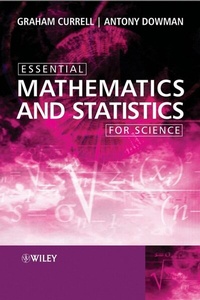
Essential Mathematics and Statistics for Science
1st Edition
Published on 15. April 2005
Book
Paperback/Softback
360 pages
978-0-470-02229-0 (ISBN)
Description
Basic Mathematics and Statistics for Science is a low-level introduction to the essential techniques students need to understand. It assumes little prior knowledge, and adopts a gentle approach that leads through examples in the book and website.
No other text provides this range of educational support for science students. The integration between book and website provides study options that would be impossible through a book alone, and allows students to study in ways that suit their own circumstances and preferences.
The combination of book and website also provides ready-prepared material for lectures, tutorials and computer practicals. Tutors can use the material to develop a variety of coherent programme using different learning styles.
The book develops the mathematics and statistics through examples and questions that reflect the scientific context, and has succeeded in being relevant to a range of undergraduate science programmes.
No other text provides this range of educational support for science students. The integration between book and website provides study options that would be impossible through a book alone, and allows students to study in ways that suit their own circumstances and preferences.
The combination of book and website also provides ready-prepared material for lectures, tutorials and computer practicals. Tutors can use the material to develop a variety of coherent programme using different learning styles.
The book develops the mathematics and statistics through examples and questions that reflect the scientific context, and has succeeded in being relevant to a range of undergraduate science programmes.
Reviews / Votes
"It is concise, complete, and engaging...students, could they be encouraged to hang onto it, would find it an ongoing, useful resource...highly recommended." (CHOICE, July 2006) "The text and web site complement one another and are excellent at giving the reader a workable grasp of the material." (MAA Reviews, July 3, 2006)More details
Edition
1., Auflage
Language
English
Place of publication
Chichester
United Kingdom
Publishing group
John Wiley and Sons Ltd
Target group
Professional and scholarly
Illustrations
Illustrations
Dimensions
Height: 24.6 cm
Width: 17.1 cm
Thickness: 21 mm
Weight
682 gr
ISBN-13
978-0-470-02229-0 (9780470022290)
Schweitzer Classification
Other editions
New editions
Graham Currell | Antony Dowman
Essential Mathematics and Statistics for Science
Book
04/2009
2nd Edition
Wiley
€44.90
Shipment within 10-20 days
Content
Preface.
1 Mathematics and Statistics in Science.
1.1 Data and information.
1.2 Experimental variation and uncertainty.
1.3 Mathematical models in science.
2 Scientific Data.
2.1 Scientific numbers.
2.2 Scientific quantities.
2.3 Angular measurements.
3 Equations in Science.
3.1 Basic equation handling.
3.2 Introduction to rearranging equations.
3.3 Rearranging complicated equations.
3.4 Solving equations.
3.5 Simultaneous equations.
4 Linear Relationships.
4.1 Straight-line graph.
4.2 Linear regression.
4.3 Linearization.
5 Logarithmic and Exponential Functions.
5.1 Mathematics of e, ln and log.
5.2 Exponential growth and decay.
6 Rates of Change.
6.1 Rate of change.
6.2 Differentiation.
7 Statistics and Information.
7.1 Describing and inferring.
7.2 Frequency statistics.
7.3 Probability.
7.4 Bayesian odds.
7.5 Factorials, permutations and combinations.
8 Distributions and Uncertainty.
8.1 Normal distribution.
8.2 Uncertainties in measurement.
8.3 Experimental uncertainty.
8.4 Binomial distribution.
8.5 Poisson distribution.
9 Scientific Investigation.
9.1 Scientific systems.
9.2 The 'scientific method'.
9.3 Hypothesis testing.
10 Parametric Tests.
10.1 Sample variances: F-test.
10.2 Sample means: Student's t-test.
10.3 Linear correlation.
10.4 Test for proportion.
11 Chi-squared Tests.
11.1 Test for frequencies.
11.2 Contingency tests.
11.3 Goodness of fit.
12 Non-parametric Tests.
12.1 Wilcoxon tests.
12.2 Mann-Whitney test.
12.3 Kruskal-Wallis and Friedman tests.
12.4 Sign test.
12.5 Spearman's rank correlation.
13 Experimental Design and Analysis.
13.1 Data variance.
13.2 Analysis of variance (ANOVA).
13.3 Experiment design.
Appendixes.
Review Questions.
Short Answers to In-text Questions.
Index.
1 Mathematics and Statistics in Science.
1.1 Data and information.
1.2 Experimental variation and uncertainty.
1.3 Mathematical models in science.
2 Scientific Data.
2.1 Scientific numbers.
2.2 Scientific quantities.
2.3 Angular measurements.
3 Equations in Science.
3.1 Basic equation handling.
3.2 Introduction to rearranging equations.
3.3 Rearranging complicated equations.
3.4 Solving equations.
3.5 Simultaneous equations.
4 Linear Relationships.
4.1 Straight-line graph.
4.2 Linear regression.
4.3 Linearization.
5 Logarithmic and Exponential Functions.
5.1 Mathematics of e, ln and log.
5.2 Exponential growth and decay.
6 Rates of Change.
6.1 Rate of change.
6.2 Differentiation.
7 Statistics and Information.
7.1 Describing and inferring.
7.2 Frequency statistics.
7.3 Probability.
7.4 Bayesian odds.
7.5 Factorials, permutations and combinations.
8 Distributions and Uncertainty.
8.1 Normal distribution.
8.2 Uncertainties in measurement.
8.3 Experimental uncertainty.
8.4 Binomial distribution.
8.5 Poisson distribution.
9 Scientific Investigation.
9.1 Scientific systems.
9.2 The 'scientific method'.
9.3 Hypothesis testing.
10 Parametric Tests.
10.1 Sample variances: F-test.
10.2 Sample means: Student's t-test.
10.3 Linear correlation.
10.4 Test for proportion.
11 Chi-squared Tests.
11.1 Test for frequencies.
11.2 Contingency tests.
11.3 Goodness of fit.
12 Non-parametric Tests.
12.1 Wilcoxon tests.
12.2 Mann-Whitney test.
12.3 Kruskal-Wallis and Friedman tests.
12.4 Sign test.
12.5 Spearman's rank correlation.
13 Experimental Design and Analysis.
13.1 Data variance.
13.2 Analysis of variance (ANOVA).
13.3 Experiment design.
Appendixes.
Review Questions.
Short Answers to In-text Questions.
Index.