

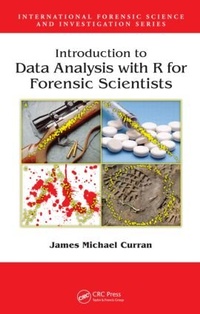
Introduction to Data Analysis with R for Forensic Scientists
1st Edition
Published on 30. July 2010
Book
Hardback
331 pages
978-1-4200-8826-7 (ISBN)
Description
Statistical methods provide a logical, coherent framework in which data from experimental science can be analyzed. However, many researchers lack the statistical skills or resources that would allow them to explore their data to its full potential. Introduction to Data Analysis with R for Forensic Sciences minimizes theory and mathematics and focuses on the application and practice of statistics to provide researchers with the dexterity necessary to systematically analyze data discovered from the fruits of their research.
Using traditional techniques and employing examples and tutorials with real data collected from experiments, this book presents the following critical information necessary for researchers:
A refresher on basic statistics and an introduction to R
Considerations and techniques for the visual display of data through graphics
An overview of statistical hypothesis tests and the reasoning behind them
A comprehensive guide to the use of the linear model, the foundation of most statistics encountered
An introduction to extensions to the linear model for commonly encountered scenarios, including logistic and Poisson regression
Instruction on how to plan and design experiments in a way that minimizes cost and maximizes the chances of finding differences that may exist
Focusing on forensic examples but useful for anyone working in a laboratory, this volume enables researchers to get the most out of their experiments by allowing them to cogently analyze the data they have collected, saving valuable time and effort.
Using traditional techniques and employing examples and tutorials with real data collected from experiments, this book presents the following critical information necessary for researchers:
A refresher on basic statistics and an introduction to R
Considerations and techniques for the visual display of data through graphics
An overview of statistical hypothesis tests and the reasoning behind them
A comprehensive guide to the use of the linear model, the foundation of most statistics encountered
An introduction to extensions to the linear model for commonly encountered scenarios, including logistic and Poisson regression
Instruction on how to plan and design experiments in a way that minimizes cost and maximizes the chances of finding differences that may exist
Focusing on forensic examples but useful for anyone working in a laboratory, this volume enables researchers to get the most out of their experiments by allowing them to cogently analyze the data they have collected, saving valuable time and effort.
More details
Series
Language
English
Place of publication
Bosa Roca
United States
Publishing group
Taylor & Francis Inc
Target group
Professional and scholarly
Academic and Professional Practice & Development
Illustrations
95 s/w Abbildungen, 52 s/w Tabellen
52 Tables, black and white; 95 Illustrations, black and white
Dimensions
Height: 234 mm
Width: 156 mm
Weight
770 gr
ISBN-13
978-1-4200-8826-7 (9781420088267)
Copyright in bibliographic data and cover images is held by Nielsen Book Services Limited or by the publishers or by their respective licensors: all rights reserved.
Schweitzer Classification
Other editions
Additional editions
James Michael Curran
Introduction to Data Analysis with R for Forensic Scientists
Book
06/2019
1st Edition
CRC Press
€94.30
Shipment within 10-20 days
James Michael Curran
Introduction to Data Analysis with R for Forensic Scientists
E-Book
07/2010
1st Edition
CRC Press
€86.99
Available for download
James Michael Curran
Introduction to Data Analysis with R for Forensic Scientists
E-Book
07/2010
1st Edition
CRC Press
€86.99
Available for download
Person
James M. Curran is currently an Associate Professor of Statistics in the Department of Statistics at the University of Auckland (Auckland, New Zealand). Dr. Curran is also the co-director of the New Zealand Bioinformatics Institute at the University of Auckland (www.bioinformatics.org.nz).
Content
Introduction. Basic statistics. Graphics. Hypothesis tests and sampling theory. The linear model. Modeling count and proportion data. The design of experiments.