

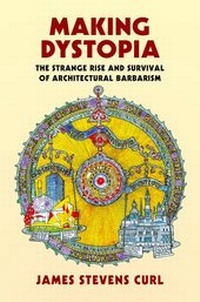
Making Dystopia
The Strange Rise and Survival of Architectural Barbarism
Published on 30. August 2018
Book
Hardback
592 pages
978-0-19-875369-8 (ISBN)
Description
In Making Dystopia, distinguished architectural historian James Stevens Curl tells the story of the advent of architectural Modernism in the aftermath of the First World War, its protagonists, and its astonishing, almost global acceptance after 1945. He argues forcefully that the triumph of architectural Modernism in the second half of the twentieth century led to massive destruction, the creation of alien urban landscapes, and a huge waste of resources.
Moreover, the coming of Modernism was not an inevitable, seamless evolution, as many have insisted, but a massive, unparalled disruption that demanded a clean slate and the elimination of all ornament, decoration, and choice.
Tracing the effects of the Modernist revolution in architecture to the present, Stevens Curl argues that, with each passing year, so-called 'iconic' architecture by supposed 'star' architects has become more and more bizarre, unsettling, and expensive, ignoring established contexts and proving to be stratospherically remote from the aspirations and needs of humanity. In the elite world of contemporary architecture, form increasingly follows finance, and in a society in which the 'haves' have
more and more, and the 'have-nots' are ever more marginalized, he warns that contemporary architecture continues to stack up huge potential problems for the future, as housing costs spiral out of control, resources are squandered on architectural bling, and society fractures.
This courageous, passionate, deeply researched, and profoundly argued book should be read by everyone concerned with what is around us. Its combative critique of the entire Modernist architectural project and its apologists will be highly controversial to many. But it contains salutary warnings that we ignore at our peril. And it asks awkward questions to which answers are long overdue.
Moreover, the coming of Modernism was not an inevitable, seamless evolution, as many have insisted, but a massive, unparalled disruption that demanded a clean slate and the elimination of all ornament, decoration, and choice.
Tracing the effects of the Modernist revolution in architecture to the present, Stevens Curl argues that, with each passing year, so-called 'iconic' architecture by supposed 'star' architects has become more and more bizarre, unsettling, and expensive, ignoring established contexts and proving to be stratospherically remote from the aspirations and needs of humanity. In the elite world of contemporary architecture, form increasingly follows finance, and in a society in which the 'haves' have
more and more, and the 'have-nots' are ever more marginalized, he warns that contemporary architecture continues to stack up huge potential problems for the future, as housing costs spiral out of control, resources are squandered on architectural bling, and society fractures.
This courageous, passionate, deeply researched, and profoundly argued book should be read by everyone concerned with what is around us. Its combative critique of the entire Modernist architectural project and its apologists will be highly controversial to many. But it contains salutary warnings that we ignore at our peril. And it asks awkward questions to which answers are long overdue.
Reviews / Votes
An important and necessary book... Professor Curl has dug behind and chiseled away at the details of a history veneered over by decades of received modernist mythmaking. * Graham Cunningham, The New Criterion * Curl's magnum opus... a polemical, but deeply scholarly, history of architectural modernism, its antecedents and its results. * Anthony Daniels, Quadrant * Excellent book... Prof. Curl traces the history of dystopian modernism from its origins in the early 20th century up to the present day, giving numerous examples of its horrendous consequences. But Curl's book is not merely a lament... he makes some important suggestions for reforming the syllabus in schools of architecture so as to lay the basis for a better built environment in the future. It is to be hoped that his message will be heeded, as much is at stake herefor the future of our civilisation. * Christopher McIntosh, GoodReads * Anyone interested in the ideological foundations, as well as effects, of architectural modernism should read James Stevens Curl's recently published Making Dystopia... a magisterial and to me unanswerable account of one of the greatest aesthetic disasters to have befallen Europe in all its history. * Theodore Dalrymple, takimag.com * Stevens Curl gets his teeth into "the disaster that has been post-1945 British architecture and town planning", tackling the thorny subject with verve, wit and tremendous erudition... This great book, in showing categorically, and cogently, what went wrong, makes an unarguable case for the conservation of the little that remains. * Patricia Craig, The Times Literary Supplement * ... an essential, uncompromising, learned ... critique of one of the worst and most significant legacies of the 20th century. * Anthony Daniels, The Jackdaw * Written with passion and eloquence, Making Dystopia is a work of rare intellectual magnitude, to be recognized as an important ... contribution to the culture of our times. It promises to become essential reading to students of architecture... * Giovanna L Costantini, Leonardo * An impassioned but informed case... meticulously researched and convincingly argued: it is an undoubtedly controversial book that empties out the contents of modernism for all to see and holds them up to the light for judgement... This book is a must-read for students of architecture: a contentious, highly thought-provoking study... * Patrick O'Keeffe, Architecture Today * Curl, a veteran architectural historian with a string of big books to his name, certainly tells us what he thinks... * Richard Morrison, The Times * Whatever you may think of its argument, this book's scholarship is precise. * Clive Aslet, Country Life * A storm is brewing in the world of architecture thanks to James Stevens Curl's lightning bolt of a book ... although Curl's polemic is fierce, and well-written to boot, it is far from a blinkered rant. * Jonathan Glancey, The Daily Telegraph * Polemic, impassioned plea or potent sting of an angry wasp with an interest in architectural history - describe it how you will but this is a book to be read, discussed and debated by anyone with an interest in our built environment... This is a full-blooded, no-holds-barred, scholarly treatise stemming from a lifetime of study and experience... a passionate argument meticulously backed up by detailed notes and a vast range of source material much of which is
new... * Karen Latimer, Perspective * Can a text on architectural history, however thoroughly researched and brilliantly written, trigger an architectural revolution? For a discipline in ferment, this might just provide the jolt to set off an avalanche... This iconoclastic landmark book might change the way we build from now on. Its an outstanding work of scholarship that needs to be read by every architect and architecture student who still possesses a conscience. * Nikos Salingaros, Traditional Building (US) * Professor Curl's magisterial book [...] has now hit the world like a bombshell. In it, Professor Curl documents how a strange type of inhuman and non-adaptive architecture came to take over building activity following World War I, and then to completely dominate the profession after World War II. He has found a use for the cult thesis to explain the remarkable tenacity of this movement, and also how and why it took possession of architecture schools all over the
world. * Nikos Salingaros, New England Review * Deploys passion, erudition, and an enraged sense of social justice to devastating effect... * David Black, Architectural Heritage Society of Scotland Magazine * Making Dystopia, the most gripping and complete account of how architecture and urban planning were corrupted in the 20th and 21st century leading to a catastrophic deterioration of the built environment, is a brilliant, thoroughly researched, and completely novel book... This book, surely the greatest of the many written by Professor Stevens Curl, should be read by staff and students in all schools of architecture who are still pursuing destructive,
irrelevant, outdated paths, as well as by everyone concerned about the erosion of civilisation itself. * The late David Watkin, Emeritus Professor of the History of Architecture, University of Cambridge * This is a book to be read, discussed and debated by anyone with an interest in our built environment... This is a full-blooded, no-holds-barred, scholarly treatise stemming from a lifetime of study and experience and an unwillingness to bow down to popular but often unsubstantiated opinion. [He] ramps up the debate with a passionate argument meticulously backed up by detailed notes and a vast range of source material much of which is new... This scholarly and
challenging book deserves to be widely read. * Karen Latimer, Journal of the Royal Society of Ulster Architects * A milestone in architectural history... this marvellous book suggests that study of the past (denied in Modernist ideology) can liberate the present from what has been a damagingly restrictive straitjacket. * Nikos A. Salingaros, Professor of Mathematics, University of Texas at San Antonio * This brilliant text is a timely marvel... Making Dystopia is unquestionably a major contribution to the history of architecture and quite possibly the most important publication in Stevens Curl's enormously prodigious oeuvre. * Frank Albo, Adjunct Professor of History, University of Winnipeg * An incredibly high level of scholarship distinguishes Making Dystopia, so that its critics will have a hard time shrugging off its message. This makes Professor Stevens Curl's work an invaluable resource for academia, the public, and professional practitioners. * Nikos Salingaros, ARCHNET-IJAR * A coruscating, driven, and passionately committed book which should be read by anyone who believes that a house is more than a machine for living. * Katharine Wilson, author of Fictions of Authorship in Late Elizabethan Narratives: Euphues in Arcadia *
More details
Language
English
Place of publication
Oxford
United Kingdom
Illustrations
72 black & white illustrations and 39 figures
Dimensions
Height: 241 mm
Width: 163 mm
Thickness: 34 mm
Weight
1376 gr
ISBN-13
978-0-19-875369-8 (9780198753698)
Copyright in bibliographic data and cover images is held by Nielsen Book Services Limited or by the publishers or by their respective licensors: all rights reserved.
Schweitzer Classification
Other editions
Additional editions
Book
08/2019
Oxford University Press
€37.00
Shipment within 15-20 days
E-Book
08/2018
1st Edition
OUP eBook
€45.99
Available for download
Person
Professor James Stevens Curl has been Visiting Fellow at Peterhouse, Cambridge, and is a Member of the Royal Irish Academy, a Fellow of the Society of Antiquaries of London, and a Fellow of the Royal Incorporation of Architects in Scotland. In 2014, De Montfort University awarded him an Honorary Doctorate of Arts in recognition of his 'distinctive contribution... to the intellectual and cultural life of the nation and region'. His many publications include studies of
Classical, Georgian, and Victorian architecture, and the most recent edition of his Oxford Dictionary of Architecture (with contributions on landscape from Susan Wilson) was published by Oxford University Press in 2015. In 2017 he was awarded the British Academy President's Medal for 'outstanding
service to the cause of the humanities and social sciences' in his wider study of the History of Architecture in Britain and Ireland.
Classical, Georgian, and Victorian architecture, and the most recent edition of his Oxford Dictionary of Architecture (with contributions on landscape from Susan Wilson) was published by Oxford University Press in 2015. In 2017 he was awarded the British Academy President's Medal for 'outstanding
service to the cause of the humanities and social sciences' in his wider study of the History of Architecture in Britain and Ireland.
Content
Timothy Brittain-Catlin: Prolegomenon
Preface & Acknowledgements
1: Origins of a Catastrophe
2: Makers of Mythologies & False Analogies
3: Modernism in Germany in the Aftermath of the 1914-18 War
4: The International Style 1920s & 1930s
5: The International Style Truly International
6: Universal Acceptance of the International Style: A Surprising Aftermath of 1945
7: Descent to Deformity
8: Dangerous Signals
9: Some Further Reflections
10: Epilogue
Select Glossary
Bibliography
Index
Preface & Acknowledgements
1: Origins of a Catastrophe
2: Makers of Mythologies & False Analogies
3: Modernism in Germany in the Aftermath of the 1914-18 War
4: The International Style 1920s & 1930s
5: The International Style Truly International
6: Universal Acceptance of the International Style: A Surprising Aftermath of 1945
7: Descent to Deformity
8: Dangerous Signals
9: Some Further Reflections
10: Epilogue
Select Glossary
Bibliography
Index