

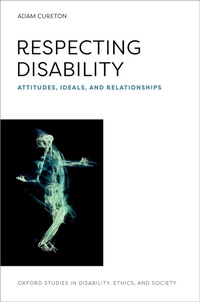
Respecting Disability
Attitudes, Ideals, and Relationships
Will be published approx. on 21. January 2026
Book
Paperback/Softback
312 pages
978-0-19-777501-1 (ISBN)
Description
Proper treatment of people with disabilities should not incur any head scratching. Yet for many, it requires a multifaceted and thoroughly considered approach. Respecting people with disabilities can involve a plethora of considerations and approaches to social relations and care: how we interact with them in interpersonal contexts, what kinds of attitudes we have toward them, how we relate with them, and how people with disabilities regard and treat ourselves.
Drawing on the author's own perspective and experiences as a disabled person, Adam Cureton emphasizes the importance of relationships, ideals, virtues, and attitudes in how we approach ethical issues that concern disability, and explores the nature and moral importance of respect for people with disabilities and of respect for ourselves. The book explores ways to understand and evaluate one's own disability and how to maintain one's self-respect in the face of disparaging social pressures. It also addresses unique moral challenges that disabled people face and characterizes some guiding moral ideals of self-respect for navigating these complex situations.
Cureton emphasizes the importance of expressing respect for disabled people. By distinguishing several different kinds of respect for people with disabilities, he shows how many of the common attitudes that even well-meaning people have towards those with disabilities are complicated and morally problematic. Through these intricacies, he charts a nuanced path forward. This book speaks to disabled people and others with experience of disability to help people understand and evaluate the many ways we can properly respect disability.
Drawing on the author's own perspective and experiences as a disabled person, Adam Cureton emphasizes the importance of relationships, ideals, virtues, and attitudes in how we approach ethical issues that concern disability, and explores the nature and moral importance of respect for people with disabilities and of respect for ourselves. The book explores ways to understand and evaluate one's own disability and how to maintain one's self-respect in the face of disparaging social pressures. It also addresses unique moral challenges that disabled people face and characterizes some guiding moral ideals of self-respect for navigating these complex situations.
Cureton emphasizes the importance of expressing respect for disabled people. By distinguishing several different kinds of respect for people with disabilities, he shows how many of the common attitudes that even well-meaning people have towards those with disabilities are complicated and morally problematic. Through these intricacies, he charts a nuanced path forward. This book speaks to disabled people and others with experience of disability to help people understand and evaluate the many ways we can properly respect disability.
More details
Series
Language
English
Place of publication
New York
United States
Product notice
Paperback (trade)
Unsewn / adhesive bound
Dimensions
Height: 226 mm
Width: 152 mm
Thickness: 20 mm
Weight
431 gr
ISBN-13
978-0-19-777501-1 (9780197775011)
Copyright in bibliographic data and cover images is held by Nielsen Book Services Limited or by the publishers or by their respective licensors: all rights reserved.
Schweitzer Classification
Other editions
Additional editions
Book
11/2025
Oxford University Press Inc
€141.50
Shipment within 15-20 days
Person
Adam Cureton is Lindsay Young Professor of Philosophy at the University of Tennessee. He is an internationally recognized disability scholar and advocate who draws on his own experiences as a legally blind person. He is the author of Sovereign Reason (2025), and the co-editor of The Oxford Handbook of Philosophy and Disability (2020), Disability in Practice (2018), and Disability and Disadvantage (2009). He founded and served as President of the Society for Philosophy and Disability and currently serves on the Editorial Board of the Journal of Philosophy of Disability.
Content
- Introduction
- PART I: SELF-RESPECT OF PEOPLE WITH DISABILITIES
- 1. Hiding a Disability and Passing as Non-Disabled
- 2. Gaming the System?: Justice, Fairness, and Disability Accommodations
- 3. Depending on the Undependable: Disability, Fragility, and Instability
- 4. Prudence and Responsibility to Self in an Identity Crisis
- PART II: RESPECT FOR PEOPLE WITH DISABILITIES
- 5. Ideals of Respect: Identity, Dignity, and Disability
- 6. Some Virtues of Disability
- 7. The Limiting Role of Respect
- 8. Offensive Beneficence
- PART III: RESPECTING DISABILITY IN PRACTICE
- 9. Expressing Respect for People with Disabilities in Medical Practice
- 10. Parents with Disabilities
- 11. Character Education for Students with Disabilities
- 12. Treating Disabled Adults as Children
- References
- Index