

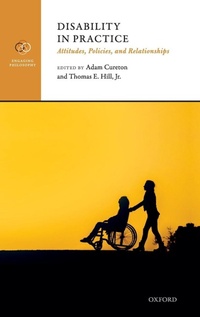
Disability in Practice
Attitudes, Policies, and Relationships
Published on 7. August 2018
Book
Hardback
262 pages
978-0-19-881287-6 (ISBN)
Description
Everyone is disabled in some respect, at least in the sense that others can do things that we cannot. But significant limitations on pursuing major life activities due to severely limited eyesight, hearing, mobility, cognitive functioning and so on pose special problems that fortunately have been recognized (to some extent) in our public policies. Public policy is important, as are the deliberative frameworks that we use to justify them, and the essays in the second and third sections of this volume have significant implications for public policy and offer new proposals for justifying frameworks. Underlying public policies and their assessment, however, are the attitudes, good and bad, that we bring to them, and our attitudes as well deeply affect our interpersonal relationships. The essays here, especially in the first section, reveal how complex and problematic our attitudes towards persons with disabilities are when we are in relationships with them as care-givers, friends, family members, or briefly encountered strangers. Our attitudes towards ourselves as persons with (or without) disabilities are implicated in these discussions as well. Among the special highlights of this volume are its focus on moral attitudes and relationships involving disabilities and its contributors' recognition of the multi-faceted nature of disability problems. The importance of respect for persons as a necessary complement to beneficence is an underlying theme, and a deeper understanding of respect is made possible by considering closely its implications for relationships with persons with disabilities. Awareness of the common and uncommon human vulnerabilities also makes clear the need for modifying traditional deliberative frameworks for assessing policies, and several essays make constructive proposals for the changes that are needed.
More details
Series
Language
English
Place of publication
Oxford
United Kingdom
Target group
Professional and scholarly
Dimensions
Height: 240 mm
Width: 161 mm
Thickness: 19 mm
Weight
561 gr
ISBN-13
978-0-19-881287-6 (9780198812876)
Copyright in bibliographic data and cover images is held by Nielsen Book Services Limited or by the publishers or by their respective licensors: all rights reserved.
Schweitzer Classification
Other editions
Additional editions
E-Book
07/2018
1st Edition
OUP eBook
€42.49
Available for download
E-Book
07/2018
1st Edition
OUP eBook
€53.49
Available for download
Persons
Adam Cureton, Associate Professor of Philosophy at the University of Tennessee, works primarily on ethics, Kant, and disability. He co-edited (with Kimberley Brownlee) Disability and Disadvantage (2009) and he is currently co-editing (with David Wasserman) the Oxford Handbook of Philosophy and Disability. He is the President of the Society for Philosophy and Disability.
Thomas E. Hill, Jr., Professor Emeritus at the University of North Carolina at Chapel Hill, is author of essays in moral and political philosophy collected in Autonomy and Self-Respect (1991), Dignity and Practical Reason in Kant's Moral Theory (1992), Respect, Pluralism, and Justice (2000), Human Welfare and Moral Worth (2002), and Virtue, Rules, and Justice (2012).
Thomas E. Hill, Jr., Professor Emeritus at the University of North Carolina at Chapel Hill, is author of essays in moral and political philosophy collected in Autonomy and Self-Respect (1991), Dignity and Practical Reason in Kant's Moral Theory (1992), Respect, Pluralism, and Justice (2000), Human Welfare and Moral Worth (2002), and Virtue, Rules, and Justice (2012).
Content
Adam Cureton and Thomas E. Hill, Jr.: Introduction
Part I. Attitudes and Relationships
1: Adam Cureton: Hiding a Disability and Passing as Non-Disabled
2: Sarah Holtman: Beneficence and Disability
3: Karen Stohr: Pretending Not to Notice: Respect, Attention, and Disability
4: Oliver Sensen: Respect for Human Beings with Intellectual Disabilities
Part II. Attitudes and Policies
5: J. David Velleman: Not Alive Yet
6: David Sussman: Respect, Regret, and Reproductive Choice
7: Richard Dean: Neurodiversity and the Rejection of Cures
8: Andrew M. Courtwright: "I Would Rather Die Than Live Like This": When the Newly Disabled Refuse Life Sustaining Treatment
Part III. Justifying Frameworks
9: Lawrence C. Becker: Disability, Basic Justice, and Habilitation into Basic Good Health
10: Samuel Freeman: Contractarian Justice and Severe Cognitive Disabilities
11: Richard Galvin: Obligations to the Cognitively Impaired in Nonstructured Contexts
12: Virginia L. Warren: Moral Disability, Moral Injury and the Flight from Vulnerability
Part I. Attitudes and Relationships
1: Adam Cureton: Hiding a Disability and Passing as Non-Disabled
2: Sarah Holtman: Beneficence and Disability
3: Karen Stohr: Pretending Not to Notice: Respect, Attention, and Disability
4: Oliver Sensen: Respect for Human Beings with Intellectual Disabilities
Part II. Attitudes and Policies
5: J. David Velleman: Not Alive Yet
6: David Sussman: Respect, Regret, and Reproductive Choice
7: Richard Dean: Neurodiversity and the Rejection of Cures
8: Andrew M. Courtwright: "I Would Rather Die Than Live Like This": When the Newly Disabled Refuse Life Sustaining Treatment
Part III. Justifying Frameworks
9: Lawrence C. Becker: Disability, Basic Justice, and Habilitation into Basic Good Health
10: Samuel Freeman: Contractarian Justice and Severe Cognitive Disabilities
11: Richard Galvin: Obligations to the Cognitively Impaired in Nonstructured Contexts
12: Virginia L. Warren: Moral Disability, Moral Injury and the Flight from Vulnerability