

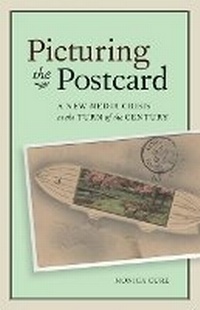
Picturing the Postcard
A New Media Crisis at the Turn of the Century
Published on 18. December 2018
Book
Paperback/Softback
264 pages
978-1-5179-0279-7 (ISBN)
Description
The first full-length study of a once revolutionary visual and linguistic medium
Literature has "died" many times-this book tells the story of its death by postcard. Picturing the Postcard looks to this unlikely source to shed light on our collective, modern-day obsession with new media. The postcard, almost unimaginably now, produced at the end of the nineteenth century the same anxieties and hopes that many people think are unique to twenty-first-century social media such as Facebook or Twitter. It promised a newly connected social world accessible to all and threatened the breakdown of authentic social relations and even of language.
Arguing that "new media" is as much a discursive object as a material one, and that it is always in dialogue with the media that came before it, Monica Cure reconstructs the postcard's history through journals, legal documents, and sources from popular culture, analyzing the postcard's representation in fiction by well-known writers such as E. M. Forster and Edith Wharton and by more obscure writers like Anne Sedgwick and Herbert Flowerdew. Writers deployed uproar over the new medium of the postcard by Anglo-American cultural critics to mirror anxieties about the changing nature of the literary marketplace, which included the new role of women in public life, the appeal of celebrity and the loss of privacy, an increasing dependence on new technologies, and the rise of mass media. Literature kept open the postcard's possibilities and in the process reimagined what literature could be.
Literature has "died" many times-this book tells the story of its death by postcard. Picturing the Postcard looks to this unlikely source to shed light on our collective, modern-day obsession with new media. The postcard, almost unimaginably now, produced at the end of the nineteenth century the same anxieties and hopes that many people think are unique to twenty-first-century social media such as Facebook or Twitter. It promised a newly connected social world accessible to all and threatened the breakdown of authentic social relations and even of language.
Arguing that "new media" is as much a discursive object as a material one, and that it is always in dialogue with the media that came before it, Monica Cure reconstructs the postcard's history through journals, legal documents, and sources from popular culture, analyzing the postcard's representation in fiction by well-known writers such as E. M. Forster and Edith Wharton and by more obscure writers like Anne Sedgwick and Herbert Flowerdew. Writers deployed uproar over the new medium of the postcard by Anglo-American cultural critics to mirror anxieties about the changing nature of the literary marketplace, which included the new role of women in public life, the appeal of celebrity and the loss of privacy, an increasing dependence on new technologies, and the rise of mass media. Literature kept open the postcard's possibilities and in the process reimagined what literature could be.
Reviews / Votes
"Picturing the Postcard recovers just how fraught and powerful a communications technology postcards were at the turn of the twentieth century. With a dazzling range of reference, Monica Cure demonstrates the remarkable cultural and literary power of the postcard and rewrites our contemporary narratives of new media."-Kate Marshall, author of Corridor: Media Architectures in American Fiction"Picturing the Postcard turns our attention to a small yet vital piece of nineteenth-century new media. Tracking the postcard's outsized effects, in everything from touristic travel to the rise of feminism, Monica Cure illuminates an often-overlooked item whose cult popularity reveals much about modern life and culture in turn-of-the-century America and Britain."-Rachel Teukolsky, Venderbilt University
More details
Language
English
Place of publication
Minnesota
United States
Target group
Professional and scholarly
Illustrations
33
Dimensions
Height: 216 mm
Width: 140 mm
Thickness: 38 mm
ISBN-13
978-1-5179-0279-7 (9781517902797)
Copyright in bibliographic data and cover images is held by Nielsen Book Services Limited or by the publishers or by their respective licensors: all rights reserved.
Schweitzer Classification
Person
Monica Cure is assistant professor of comparative literature at the Torrey Honors Institute at Biola University in Los Angeles, California.
Content
Introduction: The Frankenstein Postcard
1. The Economic Postcard
2. Insincerely Yours: The New Postcard and the New Woman
3. Return to Sender: The Postcard Terror
4. The Voracious Postcard: The Craze of Collecting
Postscript: The Rewriting of the Postcard
Acknowledgments
Notes
Index
1. The Economic Postcard
2. Insincerely Yours: The New Postcard and the New Woman
3. Return to Sender: The Postcard Terror
4. The Voracious Postcard: The Craze of Collecting
Postscript: The Rewriting of the Postcard
Acknowledgments
Notes
Index